Artificial Intelligence is not just a far-off thing anymore it is actually changing how businesses function. AI agents are becoming so important for the transformation of enterprises that they can do everything from automating monotonous tasks to giving highly customized customer experiences. Agentforce is a major step within the Salesforce environment towards creating smart and independent agents that surpass the level of traditional automation.
The emergence of AI agents is not just a theory. In fact, the adoption of AI agents went up by 119% in enterprises during the first half of 2025, which shows that the uptake is very quick, according to Salesforce data. Plus, a little over half of the salespeople are using AI agents, almost 90% of them want to start using these tools by 2027. So, together all this will really change the way we do work. This blog is a step-by-step guide to build AI agent with Agentforce covering implementation, optimization, and long term capabilities of Salesforce Agentforce AI agents.
Here is a guide that will demonstrate using Agentforce how you can build AI agent with Agentforce. The manual introduces first the basic ideas, the actual Agentforce AI agent development, fine tuning and long-term expansion.
Overview
In the Salesforce ecosystem, AI agents refer to sophisticated computer systems which not only analyze data but also interact with users and perform certain operations with different levels of independence.
In contrast with the conventional automation based on predefined rules, these agents are always aware of their context and capable of learning continuously.
They are capable of: handling massive datasets, recognizing trends, as well as deciding instantaneously. This feature empowers enterprises to transition from merely responding workflows to initiating ones. For example, a Salesforce Agentforce AI agents can locate a problem before a customer lodges a complaint and start an action towards solving it.
This change is giving rise to tangible benefits. Companies implementing AI-powered solutions experience – faster turnaround times, higher customer satisfaction, and increased productivity.
What is Agentforce and Why It Matters?
Agentforce is a platform developed by Salesforce that is used to build AI agent with Agentforce that are capable of reasoning, acting, and collaborating. It is a platform that is used for integrating data, automation, and AI.
What gives Agentforce an edge is that it has the capability of being integrated with existing Salesforce technologies such as CRM, Data Cloud, and automation platforms. This gives businesses the opportunity to develop agents that are not only intelligent but also highly contextual.
Another advantage that Agentforce has is that it is scalable. A business may need an assistive agent or a number of autonomous agents; and this platform gives a business the flexibility that is needed for scalability.
Key Benefits of Building AI Agents for Business Automation
AI agents deliver real business values in several ways. They cut down the manual work, enhance accuracy, and support quick decision-making.
Consistency is among the greatest advantages. While human processes tend to fluctuate, AI agents, being machines, can work non-stop without getting tired and so deliver a consistent level of performance. AI agents in small businesses are particularly handy in customer support roles where the quality of the response is a key factor in shaping the perception of the brand.
Besides that, AI agents are also quite energy-effective. By automating monotonous tasks, Agentforce AI agent development allows companies to focus human resources on more-value-added activities like designing and innovating.
Understanding Different Levels of AI Agent Autonomy
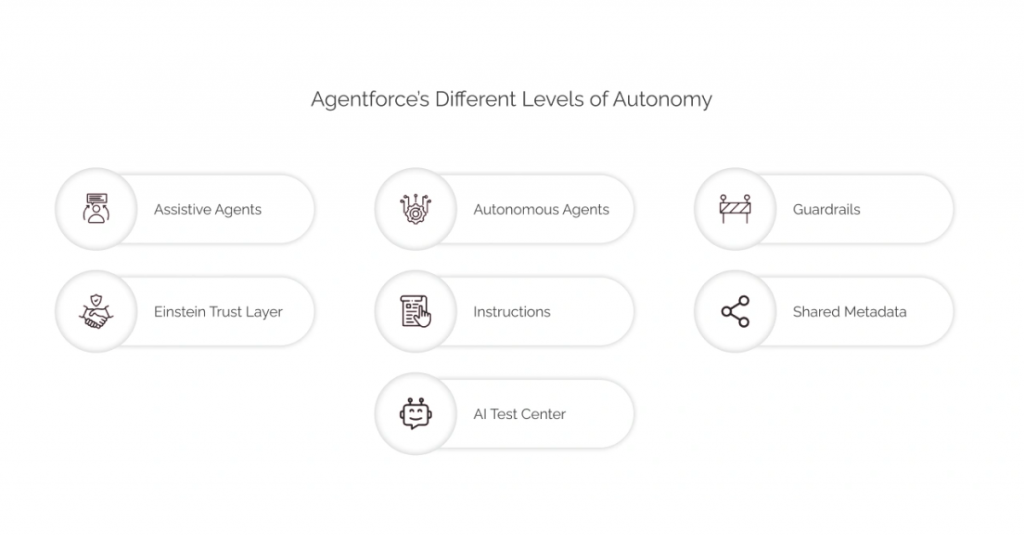
AI agents operate at different levels of autonomy, depending on their design and intended use.
Assistive Agents
Assistive agents are designed to assist human users instead of replacing them. They offer the user suggestions, insights, and information that can improve their decision-making capabilities.
Assistive agents can be applied in the following scenarios:
- Sales Support
- Customer Service Assistance
- Marketing Analytics
Assistive agents can offer the user suggestions on the best time to contact a customer or even offer them products based on their previous interactions.
This kind of autonomy is best for an organization that needs to improve human capabilities without automating them.
Autonomous Agents
Autonomous agents are a step further in the development of AI. Capable of doing all the work, deciding, and implementing processes on their own, they don’t need any human assistance.
Usually, systems that are set up to do a lot of work in the shortest amount of time benefit the most from this feature. That’s why, an autonomous agent, for instance, is able to attend to a customer, carry out a transaction and solve a problem, all without human interference.
With the increasing trend of businesses incorporating automation into their daily operations, it is anticipated that the function of autonomous agents will undergo major growth.
Guardrails
As autonomy increases, so does responsibility. This is where guardrails come in, which is critical for an AI agent. Guardrails are used to ensure that an AI agent is used within a certain boundary.
Einstein Trust Layer
When looking to build AI agent with Agentforce the Einstein Trust Layer plays a crucial role in ensuring secure and compliant AI operations. It lays out the main principles of data protection, governance, and openness.
Handling sensitive data makes these aspects even more crucial. The implementation of a trust layer means that enterprises are able to go ahead with AI agents without any compromising of their security.
Shared Metadata and Instructions
Instructions specify an agent’s behavior – the tone, the logic of decisions, and the manner of responses. On the other hand, shared metadata guarantees system-wide consistency, which is key to smooth integration and interoperability.
Evidently, these factors jointly form a well-organized setting where AI agents are expected to perform reliably.
AI Test Center
The AI Test Center is a platform for checking and improving the efficiency of agents. It provides the ability to developers to recreate scenarios of the real-world, discover faults, and enhance the agents before their release.
This sort of testing becomes all the more important as AI systems without proper configuration may exhibit unpredictable behaviors.
Key Components to Build & Customize AI Agents in Agentforce
To build AI agent with Agentforce, different components must be integrated within a single architectural framework.
Metadata
The metadata describes how the agent is organized and set up. It is the very base on which all other elements rest.
The agent can function effectively and be easily extended or updated if the metadata is properly structured.
Data Cloud
Data Cloud offers a consolidated and up-to-date perspective of a customer’s data. It compiles data from different origins; thus helping AI agents reach well-informed conclusions.
This consolidated layer of data is really the core for providing personalized experiences and exact insights.
Models
AI models are at the heart of the agent’s intelligence. Programming the models to: handle the data, make forecasts, and provide resolutions is what gives the agent a mind of its own.
Choosing the appropriate models, and always improving them is very important for keeping them performing at a high level.
Einstein Trust Layer
Security and compliance should be a part of all AI endeavors, especially the Salesforce Einstein AI. The Einstein Trust Layer makes sure that every operation is in line with very stringent governance standards.
Actions and Topics
Actions are what the agent is capable of doing, while topics are the areas the agent comprehends. In a way, actions and topics are two sides of the same coin as together they define the behavior of the agent towards users and systems.
Say, for instance, you make an agent for customer support. Such an agent, as far as actions are concerned, can be resolving support requests or making changes to customer’s files. On the other hand, the topics can be features pricing account troubles, etc.
Tooling
Agentforce’s software development kits give businesses the ability to customize and integrate their AI agents. Using these tools, companies building AI agents can adapt AI agents to their business processes and requirements.
Step-by-Step Guide to Build and Implement an AI Agent with Agentforce
1. Prerequisites
It is really important to set up a solid foundation when you build AI agent with Agentforce. This includes having an access to Salesforce, nicely organized data, and use cases well thought out and documented. Having a strong base in place is what makes sure the agent is in line with the goals of the business.
2. Enable Required Features
Enabling features like Data Cloud, AI models, and automation tools will be the next step. These major parts will help with Agentforce AI agent development.
3. Agent Creation Process
To build AI agent with Agentforce process is a series of steps: one is to specify the aim of the agent, next comes setting the agent configurations (metadata), lastly you have to make sure that the data sources are properly connected.
Additionally, this phase is when you give the limits so that the agent focuses on certain tasks.
4. Define Agent Capabilities
When you define capabilities, you are outlining the actions the agent is able to carry out and the mode of communication it will use. This comes down to the agents actions, topics, and its internal decision-making.
5. Testing & Deployment
The last stage to build AI agent with Agentforce is Testing. Testing ensures that the agent performs as expected. It involves simulating different scenarios and validating outcomes.
Once testing is complete; the agent can be deployed into production, where it begins interacting with real users.

Best Practices for Building AI Agents with Agentforce
Agentforce AI agent development requires a strategic approach.
Using flows instead of Apex wherever possible improves scalability and flexibility. Flows simplify management and make it easier to respond to changes in requirements.
Reusability constitutes leveraging one of the most important approaches in component development. Reducing production time by using pre-existing components and achieving a uniform look and feel are two things that go hand in hand.
It is a good idea to keep the number of features of an agent to a minimum. Agents with capability sets that are too large may hinder the management of the system and, in turn, generate unexpected outputs.
Compliance is definitely a must-have when deploying any AI systems. The organizations have to periodically ensure that their AI tools conform to legal and ethical standards.
Certainly, keeping up performance should not be considered as a separate thing in the continuous monitoring and optimization cycle. The new data and the evolution of business needs must lead to the performance measurement and the refreshing of the AI agents on a regular basis.
How Can A3Logics Help?
A3Logics as a leading AI agent development company has deep knowledge in Salesforce and AI development and can help businesses create smart and scalable AI agents using Agentforce. Besides just building the AI solution, we focus on making the solution align with business needs and expected results.
A3Logics knows how to build AI agents with Agentforce that work seamlessly with Salesforce solutions like – CRM, Data Cloud, and automation tools. Therefore, businesses can quickly get data, perform operations efficiently, and make decisions effectively. Additionally, A3Logics has expertise in AI development, which enables AI agents to learn and improve over a period of time.
A3Logics has a wide range of skills in custom Agentforce AI agent development that meet very specific needs of the business.
It is not only about creating generic AI agents, but A3Logics also build AI agent with Agentforce from very specific business needs, like making an AI agent for customer support, sales, and process automation.
A3Logics builds integration with Salesforce Data Cloud and other enterprise systems, which helps to create an environment in which AI agents can have access to the most up-to-date information for a more personalized way of communicating.
Continuous support, optimization, and scaling help solutions for your AI agents are things that you as a business need but these are the things that A3Logics is doing for you along with making sure that high performance and reliability have been maintained.
Final Thoughts
AI agents are quickly becoming a fundamental component of modern enterprises. Platforms such as Agentforce allow companies to create smart systems that not only automate but also bring about significant changes.
More and more, companies adopting AI, will find that the skills to plan, launch, and operate AI agents will be a key factor in outdoing competitors.
With a well-organized method and the proper tools; companies will be able to harness the power of AI agents fully and build systems that are more efficient, scalable, and intelligent.