When it comes to automating simple, repetitive tasks, traditional chatbots may be sufficient. But what about scenarios that involve complex and more nuanced interactions? Let’s consider a more relevant goal – In organizations where teams today wish to work faster with fewer handoffs, and customers expect more personalized answers and services, are traditional chatbots sufficient?
Probably not! And that’s where we need advanced tools like Salesforce Agentforce. Before we delve further into the blog, let’s understand what Agentforce is, it is an AI-powered solution that enables autonomous actions, making the system more efficient and enhancing customer experience.
The question is – how is Agentforce different from traditional chatbots? Through this post, we’ll discuss the differences between the two, when you should choose one option over another, and how to determine the right fit for your business needs.
Important Stats Demonstrating the Importance of Agentforce Over Traditional Bots
- Agentforce resolves 85% of Salesforce’s customer service requests.
- Salesforce Agentforce autonomously resolved 70 % of 1‑800Accountant’s -a leading virtual accounting service provider’s administrative chat engagements during peak periods, outperforming traditional bots.
- A Salesforce survey found 67 % of consumers get frustrated when service isn’t resolved instantly — highlighting traditional bots’ limits.
- By 2029, agentic AI will autonomously resolve 80% of common customer service issues without human intervention, leading to a 30% reduction in operational costs, according to Gartner, Inc.
What is a Traditional Chatbot?
1. Definition and Working Mechanism
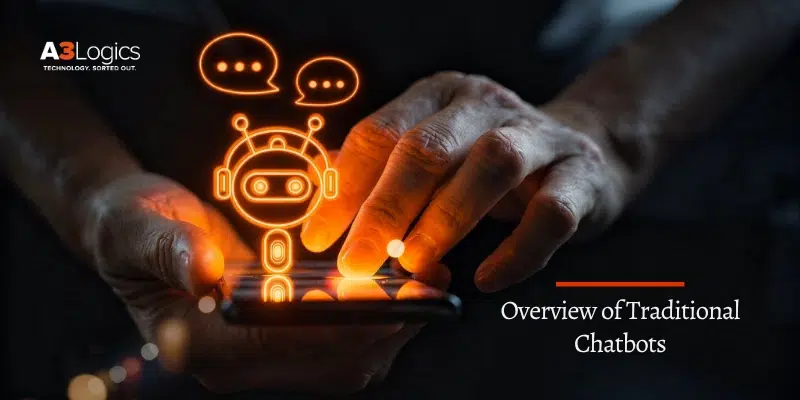
Traditional chatbots are rule-based programs that are designed to automate repetitive conversations. They follow pre-defined scripts to guide users through structured paths and provide fixed responses instead of understanding intent or context.
They operate using if-then logic to scan user input. Once they have the input they look for pre-programmed keywords and match them against a static database; to give predetermined answers.
2. Rule-based vs AI-powered Chatbots
Rule-based chatbots answer simple, structured questions by following strict, pre-written scripts and keywords. They work like automated FAQ trees. AI-powered chatbots, on the other hand, use Machine Learning and Natural Language Processing (NLP) to understand context, intent, and subtleties. They learn from conversations and can handle complicated, human-like conversations in real time.
3. Common Use Cases in Customer Support
Let’s have a look at some of the common use cases of traditional chatbots in customer support –
- In retail; chatbots assist with product discovery, personalized recommendations, and purchase support.
- Healthcare chatbots help schedule appointments; send medical reminders, offer basic medical guidance, and conduct symptom checks.
- In banking, bots offer help with transactions in real-time.
- Chatbots support students with course registration; campus queries, and library access.
4. Limitations of Traditional Chatbots
Since traditional chatbots depend on pre-programmed scripts instead of natural language; they are rigid in nature. They often get stuck in conversational loops. Unlike Agentforce; traditional chatbots can’t retain information across sessions. Furthermore, traditional bots lack emotional intelligence and require constant and costly manual updates.
What is Agentforce?

1. Introduction to Salesforce Agentforce
Salesforce Agentforce uses Salesforce Agentic AI to deploy agents across sales, customer service, marketing, and operations. As a result, it is able to handle high-volume, routine work so that employees can focus more on strategic work.
2. How does Agentforce leverage AI and Automation?
Agentforce leverages AI and automation by deploying autonomous, intelligent agents that use the Atlas Reasoning Engine to analyze data, make decisions, and execute tasks across sales, service and marketing. The difference between Salesforce Agentforce and traditional agents is that Salesforce Agents can independently handle complex, multi-step workflows
3. Key Features and Capabilities
Let’s have a look at some of the key features and capabilities of Agentforce –
- Executes multi-step tasks across systems without human intervention.
- Agents operate using real-time, trusted data from Salesforce Data Cloud and CRM.
- Low-code conversational workspace.
- Agents interact with customers across multiple channels such as email, chat, phone, social media, etc.
- AI-powered voice capabilities for natural, high-speed conversation and assistance across multiple channels.
- Includes tools to qualify leads and book meetings (Sales) and autonomously resolve customer cases; provide summaries, and offer step-by-step guidance (Service).
Evolution of AI in Customer Support
AI in customer support has evolved from the 1960s, starting with ELIZA and early IVRs, to scripted chatbots in the 1990s–2000s. NLP and basic machine learning slowly made these systems smarter; and automating routine tasks.
By the 2010s, cloud-based AI leveraged historical data and predictive models, while in the 2020s, large language models enabled advanced AI agents to handle complex queries; summarize conversations, and provide personalized guidance.
Agentforce vs Chatbot: Key Differences Explained
1. Intelligence and Decision-Making Capabilities
When considering Salesforce Agentforce vs Chatbot; one of the major differences is that Salesforce Agentforce uses Large Language Models and the Atlas Reasoning Engine to analyze complex data. It also helps make independent data-driven decisions and reason through scenarios. Chatbots; on the other hand, rely on pre-defined scripts and simple logic. They are best suitable for basic FAQ-style interactions and not complex judgment.
2. Automation vs Autonomy
Another important difference between Chatbot vs Agentforce is the fact that Chatbots provide automated, rule-based responses. This implies that they wait for specific user inputs in order to trigger a scripted action. Conversely, Agentforce is autonomous, i.e. it initiates multi-step workflows on its own. It hardly requires human intervention, and it can work round the clock to achieve goals.
3. Learning and Adaptability
In Salesforce Agentforce vs Chatbot; Agentforce has the upper hand because it learns from past interactions and user feedback. It takes into account these data changes to enhance future accuracy. As opposed to that, Chatbots are static in nature. They require rule changes, manual updates, and technical maintenance to adapt to new scenarios or improve performance.
4. Context Awareness and Personalization
Here’s another differentiating factor when considering Salesforce Agentforce vs Chatbots; Agentforce integrates with CRM data and understands the context deeply. It provides personalized; relevant responses based on customer history. Chatbots often fail to maintain context across complex conversations and offer generic answers.
5. Integration Capabilities
If we take a deep dive into Chatbot vs Agentforce; one difference is that Chatbots are chat-centric. Which means, they are confined to providing information within a messaging channel. They don’t execute deep, cross-system business actions. Agentforce, on the other hand, is built natively into Salesforce Customer 360. It can connect with external systems via APIs.
6. Scalability and Performance
As the business scales, Agentforce can easily handle high-complexity and high-volume requests at the same time. In contrast, Chatbots lack this capability since they are scripted and often require costly, manual maintenance to maintain performance standards and prevent failures.
Salesforce Agentforce vs Chatbots: Feature Comparison Table
| Category | Salesforce Agentforce | Traditional Chatbots |
| Features | Handles customer questions, updates orders, resets passwords, processes refunds, schedules appointments, works across systems | Limited to scripted responses and FAQs, cannot perform actions across systems |
| Performance | High resolution rate, fast responses, handles complex tasks, reduces need for human agents | Basic responses, often fails with unexpected queries, low task resolution for complex issues |
| Flexibility | Adaptable to different workflows, integrates with multiple platforms, scalable across business needs | Rigid flow, difficult to scale, limited integration capabilities |
| Cost | Reduces operational costs, allows scaling without adding support staff, over 50% savings compared to traditional models | Higher operational costs, relies heavily on human support for complex tasks, savings limited |
When to Choose Each Solution
Every company has different customer demands; so Salesforce Agentforce vs Chatbots must be chosen based on complexity and automation needs. To begin with, it is important to distinguish between Salesforce Agentforce and traditional chatbots such as Salesforce Einstein AI bots, since each addresses different business needs.
Choose Agentforce when you want AI-driven agents that can handle complex tasks involving multiple steps without human intervention. It is best for scenarios requiring deep Salesforce CRM integration; real-time data analysis; and proactive decision-making, such as personalized service; predictive sales, or autonomous case resolution.
Now that we have discussed Salesforce Agentforce we can’t rule out the importance of traditional chatbots. If your business needs to automate simple, repetitive, and rule-based FAQs and basic tasks, you can choose traditional chatbots.

Benefits of Using Agentforce Over Traditional Chatbots
i. Enhanced Customer Experience
Unlike chatbots; Salesforce Agentforce offers personalized, natural language conversations that don’t depend on rigid scripts. It leverages Data Cloud and understands context and sentiments. Using this capability, it provides tailored solutions to users. And, this is not just a one-time occurrence, Agentforce answers nuanced queries 24/7 resulting in higher customer satisfaction.
ii. Faster Issue Resolution
Choosing Salesforce Agentforce over traditional chatbots can be a wise decision since traditional chatbots might be conversational, but Agentforce agents are autonomous. They can resolve complex queries in an end-to-end manner. For instance; they can process refunds, or even update records.
iii. Reduced Operational Costs
Agentforce automates routine support tasks and reduces dependency on large support teams. It handles basic customer issues with high resolution rates, allowing service scaling without hiring more staff. This implies no more extra hiring costs.
iv. Data-driven Insights
The difference in AI Agents vs. AI Chatbots can be seen when tasks require reasoning, not just responses.Agentforce uses advanced analytics and AI-powered insights to analyze customer behavior and sentiment in real-time. It doesn’t just manage data; it identifies trends, gaps in knowledge bases, and opportunities for improvement.
v. Seamless CRM Integration
Built on the Salesforce platform; Agentforce has immediate access to Customer 360 data, knowledge articles, and Salesforce flows. It seamlessly integrates with Service and Sales Clouds; letting autonomous agents to update customer records in real-time.
Use Cases of Agentforce in Different Industries
i. E-commerce and Retail
Agentforce enhances shopping by providing 24/7; AI-driven customer support, automating returns/ exchanges. It recommends products based on behavior and boosts merchandising.
ii. Banking and Financial Services
An Agentforce Consulting Company can build systems that automate customer interactions. These systems can handle inquiries, verify account details, and process transactions.
iii. Healthcare
Healthcare organizations worldwide are choosing Agentforce when considering Salesforce Agentforce vs Traditional Chatbots. It delivers AI-driven automation on a unified platform; connecting care teams; clinicians, and service representatives. It handles tasks such as answering inquiries.
iv. Travel and Hospitality
Agentforce elevates guest experiences with AI-powered bots providing personalized travel recommendations; booking modifications, and 24/7 service inquiries. It handles complex logistics like rebooking during disruptions.
v. SaaS and IT Services
Salesforce Agentforce is used in SaaS and IT services to provide a modern IT service desk that automates incidents. It uses agentic AI to deliver instant conversational resolutions for employees; directly within platforms like Slack and Microsoft Teams.
Challenges with Traditional Chatbots
1. Limited Understanding of Complex Queries
Between Chatbot vs Agentforce; Agentforce gets the upper hand because understanding intent is a challenge for traditional bots. They rely on rigid keyword matching and, hence, provide irrelevant responses when a query contains a complex sentence structure or falls out of its pre-programmed scope.
2. Poor User Experience in Dynamic Scenarios
When compared with Agentforce agents, traditional chat lacks context retention and emotional intelligence. They often fail at handling unexpected user input; such as frustration and as such deliver abrupt.
3. High Dependency on Predefined Scripts
Functioning on rigid rules; these bots cannot learn from new interactions. If a scenario isn’t explicitly coded in the script; the bot doesn’t understand it and fails. Maintaining these systems requires constant; manual updates for any changes in logic or information, making them inflexible
How Agentforce Overcomes Chatbot Limitations?
1. Autonomous Decision-making
Agentforce uses the Atlas reasoning engine. This allows it to comprehend objectives and autonomously make multi-step action plans.
2. Real-time Data Processing
Agentforce connects directly to CRM; Data Cloud to access live, accurate data rather than relying on static knowledge bases.
3. Continuous Learning Capabilities
Agentforce improves through structured feedback loops by analyzing interaction data to refine its own prompts, knowledge base, and responses over time.

Why Partner with Experts like A3Logics for Implementation?
We help companies execute Agentforce so it integrates with existing systems and delivers measurable results. Our team focuses on optimizing workflows while at the same time, making AI-driven support reliable.
Through our Salesforce Development Services; we maintain intelligent agents that help companies across various departments such as sales and customer service. As a leading AI Agent Development Company, we also guide businesses to enhance customer experiences, and support teams to work smarter.
Final Thought
Considering the needs of modern businesses; while traditional chatbots can handle simple queries, Salesforce Agentforce is a powerful AI-driven platform that businesses must have if they want to deliver personalized, efficient support. As opposed to chatbots that rely heavily on scripts, Agentforce uses technologies like NLP and LLM to understand context and intent. It helps provide tailored responses to customers, not only improving satisfaction but also increasing operational efficiency.