In 2026, low-code platform development has already become a significant cornerstone in the field of digital transformation. As per the 2025 Gartner reports, over 70% of new enterprise applications now built using low-code or no-code platforms. As organisations race to deliver faster, smarter, and AI-driven solutions, Salesforce’s low-code ecosystem is also strongly growing.
With different latest features such as user-friendly interfaces, ready-made templates, and reusable components, these platforms allow users to focus on addressing different business needs rather than navigating certain complex programming or coding challenges.
Salesforce, as a leading platform, successfully stands out as the world’s #1 CRM platform. It has also become a leading low-code development platform, making it an ideal choice for businesses looking to innovate quickly and effectively.
In this article, we will guide you on everything you need to know about Salesforce low-code platform, where this shift is not just about empowering teams but about reducing costs and scaling intelligent automation across different industries.
What Do We Mean by a Salesforce Low-Code Platform?
Salesforce low-code platform allows users to create different modern applications with minimal manual coding. Utilizing the latest visual interfaces, drag-and-drop tools, and some pre-built components, the platform allows for making the development process easier.
Hence, this approach is very useful for both developers and non-developers, enabling them to successfully build, modify, and deploy the latest applications quickly and efficiently.
Organisations these days are also increasingly adopting Salesforce’s latest low-code platform because it strongly accelerates:
- Digital transformation
- Reduces the overall development costs
- Enhances seamless collaboration across different departments
Salesforce platform’s scalability also ensures that different businesses can successfully adapt it to meet the changing market demands while maintaining a proper and competitive edge. Below is a table that guides you on different aspects, showing how the leading platform Salesforce is different from traditional development approaches.
| Aspect | Salesforce Low-code Approach | Traditional Development Approach |
| Development Style | Visual, drag-and-drop tools | Manual coding from scratch |
| Speed | Rapid development (days/weeks) | Slower development (months) |
| Skill Requirement | Usable by non-developers & developers | Requires skilled programmers |
| Cost | Lower development and maintenance cost | Higher cost due to resources |
| Flexibility | Hybrid (low-code + custom code if needed) | Fully customizable but complex |
| Collaboration | Strong business & IT collaboration | Mostly developer-centric |
| Maintenance | Easier updates and changes | Complex and much time-consuming |
| Scalability | Built-in cloud scalability | Requires manual scaling setup |
Role of Salesforce Einstein 1 Platform (Low-Code + AI)
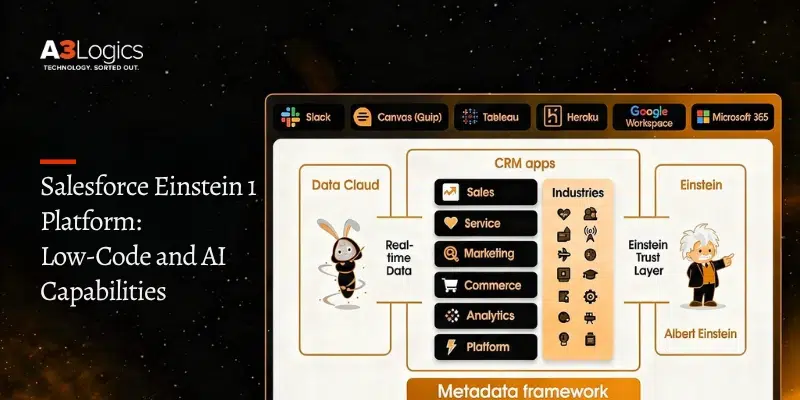
- When it comes to Salesforce low-code development, it successfully enables the rapid creation of different AI-powered apps using low-code tools. This also combines Data Cloud, automation, and generative AI in one platform.
- It successfully integrates different platforms such as Copilot, Prompt Builder, and Salesforce Flow. These help automate different workflows and embed smart AI-driven decisions without the need for heavy coding.
- The Salesforce platform also unifies data, AI, and CRM. These deliver real-time insights and intelligent automation across different business processes.
- The platform also supports custom AI model deployment for app development. However, the best part is it is possible with minimal technical effort.
Key Industries and Different Use Cases Benefiting from Salesforce Low-code Development
- Healthcare – It helps with AI-driven patient management, automated workflows, and predictive care systems
- Financial Services – In case of financial services, the platform assists with risk analysis, fraud detection, and also greater compliance automation.
- Retail & eCommerce – Salesforce assist with easy customer journeys and excellent AI-powered recommendations.
- Manufacturing – For supply chain automation and predictive maintenance, Salesforce plays a vital role
- Telecom – AI-based customer support and service automation
- Public Sector – Salesforce platform helps with digital citizen services and process automation
Key Features of Low-Code Platforms
Salesforce low-code development is transforming how different businesses build the latest applications, with visual tools and seamless automation, while accelerating innovation. In fact, there are almost 50% new low-code buyers preferring to use this platform, which highlights the overall growing demand for faster, scalable, and latest AI-driven development solutions.
1. Visual Development Environment
When it comes to focusing on a visual development environment, the platform allows users to easily design different applications using the latest drag-and-drop builders. This also reduces overall coding complexity while speeding up the latest development cycles. It also enables non-technical users to actively participate in building and customising smart business applications.
2. Reusable Components
Pre-built templates and modular components also streamline proper development by allowing different teams to reuse existing elements. This also reduces the chances of redundancy while ensuring greater consistency. It also significantly accelerates proper deployment across multiple projects and the latest use cases.
3. Integration Capabilities
Low-code platforms also provide seamless integration with different third-party systems. This not only ensures smooth data flow across innovative and modern business applications but also enables businesses to unify smart business operations.
4. Workflow Automation
Salesforce automation tools help businesses to streamline different repetitive tasks. These not only help businesses to reduce the issues of manual intervention, but also help organisations to improve efficiency while minimising the chances of errors and enhancing productivity across different departments.
5. Collaboration and Governance
Low-code platforms encourage businesses to opt for seamless collaboration between IT and business teams while maintaining proper governance. Furthermore, some built-in controls ensure greater compliance, better security, and also certain standardised development practices across different organisations.
6. Advanced Analytics and Reporting
Salesforce platforms also offer innovative and real-time dashboards with the latest Salesforce automation tools for reporting, which provide strong actionable insights. Businesses can also successfully monitor overall performance, track the latest KPIs, and make data-driven decisions with greater accuracy.
7. Mobile App Development
Salesforce low-code platform supports rapid mobile app creation with smart and responsive design capabilities. This also successfully enables organisations to deliver seamless and the best user experiences across different devices. These not only improve accessibility but also genuine engagement for modern and mobile-first users.
Salesforce’s Low-Code Tools and Capabilities
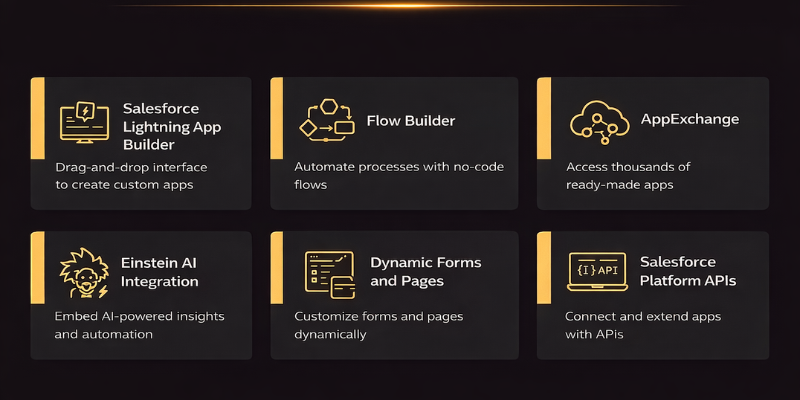
Salesforce automation tools are redefining the concept of enterprise app development with scalable and modern AI-driven capabilities. In 2025, more than 75% of enterprise applications will have already used the latest low-code platforms, which strongly highlights the overall growing reliance on Salesforce’s ecosystem for ensuring faster innovation and seamless digital transformation.
1. Salesforce Lightning App Builder
Lightning App Builder enables users to design different custom pages and latest applications using the latest drag-and-drop components. This visual tool also simplifies the latest UI creation while enhancing productivity and supporting rapid customisation without extensive coding expertise.
2. Flow Builder
Salesforce Flow Builder, on the other hand, allows businesses to successfully automate different complex processes using the latest visual workflows. It also successfully streamlines business approvals with proper task routing and data updates. This also strongly improves operational efficiency while reducing the chances of manual effort across departments.
3. AppExchange
AppExchange, an advanced tool, provides greater access to thousands of pre-built applications and seamless integrations. Organisations can also quickly extend the best Salesforce functionalities while reducing the overall development time and adopting certain proven solutions. These are particularly tailored to meet specific business needs.
4. Einstein AI Integration
Einstein AI Platform integration allows artificial intelligence to be directly integrated into the latest business applications. This also enables predictive insights and the latest automation. Users can also apply some exclusive and intelligent features, such as recommendations and chatbots, without requiring advanced programming skills.
5. Dynamic Forms and Pages
Dynamic Forms and Pages also allow real-time customisation of different user interfaces based on the best data and different user roles. This also enhances the best user experience by delivering personalised and relevant information dynamically across different modern applications.
6. Salesforce Platform APIs
Salesforce automation tools also enable the platform APIs for seamless integration with different external systems and services. Those also strongly support proper data exchange, greater connectivity, and advanced scalability. The platform also helps businesses to develop modern and connected ecosystems while meeting extended application capabilities efficiently.
Best Implementation Practices for Salesforce Low-Code Platforms
One of the most powerful demonstrations of Salesforce’s low-code approach is the Agentforce AI Agent Builder. This low-code AI agent builder can successfully customise an existing agent for any industry or use case. However, to have the best outcome, it is necessary to apply the best implementation practices for Salesforce low-code platform.
1. Define Clear Objectives and Align with Business Goals
Start by identifying different measurable business outcomes. These include faster deployment, improved customer experience, and cost reduction. In 2026, successful organisations will also perfectly align different low-code initiatives with digital transformation and AI strategies. These ensure every modern application strongly delivers a genuine value while supporting long-term growth.
2. Invest in Training and Enablement Programs
Upskilling different teams is also essential to maximise the overall low-code potential. Providing hands-on training on Salesforce Flow and the latest Salesforce automation tools is also important. In 2026, companies will also strongly focus on continuous learning while ensuring higher adoption rates and better utilisation across different departments.
3. Establish Governance Frameworks and Processes
Salesforce low-code development focuses on different government standards, better security, and greater compliance. In 2026, with the increased citizen development, organisations will also need to enforce proper role-based access, approval of different workflows, and monitoring of the latest systems to maintain consistency.
4. Encourage Collaboration and Knowledge Sharing
Focus on cross-functional collaboration between IT and business teams using shared platforms and documentation. In 2026, organisations leveraging such innovative and collaborative low-code environments can ensure faster innovation, improved solution quality, and better alignment between the latest technical capabilities, besides meeting business needs.
5. Leverage the Salesforce Ecosystem
Utilise Salesforce’s ecosystem, including APIs, AppExchange, and AI tools like the Einstein 1 platform. In 2026, businesses will also gain a certain competitive advantage by integrating advanced and pre-built solutions, accelerating overall development, and enhancing the latest applications with different AI-driven features and also real-time data capabilities.
6. Regularly Review and Refine Practices
Continuously evaluate different business applications, performance metrics, and proper user feedback to improve overall business efficiency. In 2026, agile refinement and business updates will also ensure that low-code solutions remain highly scalable, secure, and perfectly aligned with evolving business requirements and certain emerging technologies like generative AI.
Build Faster With Salesforce Low-Code Platforms
A3Logics develops custom solutions to accelerate app development
Benefits of Using Salesforce Low-Code Platform in 2026
Salesforce low-code development is accelerating the concept of digital transformation by enabling faster and AI-driven application delivery. As per Gartner, the low-code development market is expected to reach $44.5 billion, which helps businesses to successfully reduce costs while improving agility and scaling the latest innovation across rapidly evolving competitive markets.
1. Accelerated Development and Deployment
Rapid application development allows organisations to build and deploy solutions in days instead of months. With visual tools and pre-built components, businesses can quickly respond to market changes and deliver updates efficiently without lengthy development cycles.
2. Cost Efficiency
Reduced development costs are another prime benefit of low-code platforms. These minimise the overall need for hiring large engineering teams. Organisations can also get the chance to save on modern infrastructure, overall maintenance, and latest resources while achieving faster returns on investment.
3. Enhanced Flexibility and Agility
Business agility also improves as companies can quickly modify different exclusive applications based on the overall changing requirements. Low-code platforms can also support proper iterative development, besides enabling continuous improvements and faster adaptation to meet certain evolving customer needs and market demands.
4. Empowerment of Non-Technical Users
Salesforce development successfully empowers businesses to create smart and modern applications without any deep technical expertise. This reduces the chances of dependency on the IT team. Furthermore, this also strongly accelerates innovation while allowing different departments to independently solve different problems using intuitive and low-code Salesforce automation tools.
5. Improved Collaboration and Innovation
Cross-functional collaboration also strongly enhances greater innovation by bringing IT teams and businesses together on a single and unified platform. Shared tools and workflows also encourage idea exchange, faster problem-solving, and also the development of some effective and user-centric solutions.
6. Scalability and Integration
Enterprise scalability also ensures that modern applications can grow to meet business needs. The Salesforce low-code platform offers seamless integration with multiple systems. This enable organisations to expand capabilities while maintaining consistent performance and better connectivity.
7. Enhanced User Experience
User-centric design improves engagement by delivering intuitive and personalised interfaces. Low-code Salesforce automation tools enable rapid UI customisation. This also ensures that different business applications to meet overall user expectations and provide seamless experiences across devices and touchpoints.
8. Automation and Efficiency
Salesforce low-code development also assists with different application process automation. This reduces the chances of different repetitive tasks while reducing the need for manual efforts. Businesses can also successfully benefit from improved productivity, faster workflows, and optimised resource utilisation. Therefore, teams can focus on certain strategic activities.
9. Security and Compliance
There are some built-in security features that ensure complete data protection and greater regulatory compliance. Salesforce also provides excellent access controls and strong governance that help organisations maintain trust. The platform also help meeting the latest industry standards while protecting sensitive information.
10. Future-Proofing the Business
With digital resilience, low-code platforms can strongly support continuous innovation and emerging technologies like AI and Blockchain. Businesses can also remain competitive by quickly adopting different new capabilities, scaling different operations while adapting to the best future technological advancements with minimal disruption.
Challenges in Adopting Salesforce Low-Code Platform
Salesforce automation tools simplify the proper development, but seamless adoption comes with certain significant challenges. However, organisations still face some issues like governance, integration, and also skill gaps that make strategic planning much essential for successful implementation and long-term scalability.
1. Change Management and Resistance
Organisational change management and resistance slows seamless adoption as many employees often hesitate to shift from different traditional systems. Successful implementation requires clear communication, proper leadership support, and different structured transition strategies to encourage overall acceptance and ensure smooth adoption across different teams and departments.
2. Skill Gaps and Training Needs
Workforce upskilling is also considered essential as employees need to understand the correct usage of new tools and latest platforms. Without proper training programs, businesses may also struggle to leverage the best low-code capabilities. This also limits business productivity while slowing down digital transformation initiatives.
3. Integration Complexity
System integration challenges often arise when connecting Salesforce platform with modern legacy systems or latest third-party applications. Here Salesforce automation tools ensure seamless data flow and also the latest compatibility also requires careful planning, proper integration of APIs, and technical expertise to avoid the chances of disruptions and inefficiencies.
4. Customisation Limits
Platform limitations also restrict some highly complex customisations. While low-code tools offer greater flexibility, those need traditional coding while facing certain challenges for organisations with specific business processes.
5. Scalability Concerns
Application scalability may emerge as business demand grow with time. With some poorly designed low-code Salesforce development applications businesses may also face performance bottlenecks, making it very important to follow best practices while ensuring different systems are built to handle increasing workloads.
6. Data Security and Compliance
Regulatory compliance challenges require modern businesses to ensure proper data protection and meeting different industry standards. Misconfigured access controls and improper data handling may also lead to certain security risks, making the case of governance and monitoring much vital.
7. Governance and Control
IT governance becomes crucial as multiple users develop applications. Without proper oversight, organisations may face inconsistencies, duplication, and compliance issues, highlighting the need for standardised processes and centralised control mechanisms. Salesforce automation tools help businesses to deal with these.
8. Technical Debt
Long-term technical debt can also successfully accumulate if business applications are built without proper planning. Quick development may also lead to inefficient designs. This makes future updates, proper maintenance, and the option for scalability more complex and costly.
9. Cost Management
Hidden costs can arise from licensing, integrations, and scaling requirements. While initial development may be cost-effective, organisations must carefully manage expenses to avoid budget overruns and ensure sustainable long-term value.
10. Vendor Lock-In
In case of Salesforce low code development, Platform dependency risks also occur when businesses rely heavily on the modern Salesforce ecosystems. Migrating to other platforms can also become much complex and costly, which is why it is necessary to evaluate long-term flexibility and avoiding over-dependence.
Build Scalable Apps Using Salesforce Low-Code
A3Logics creates efficient platforms tailored to your needs
How A3Logics Can Help?
If you want to opt for Salesforce Development Services, you can rely on the best agency, A3Logics, and you will have the best assistance.
a. Salesforce Development Services
A3Logics successfully delivers the best end-to-end Salesforce low-code development. This enables businesses to build much stronger, scalable, and modern AI-powered applications, which are particularly tailored to meet unique operational needs.
b. Expert Consulting
Having deep expertise in Salesforce consulting services, A3Logics can successfully helps businesses to define different strategies, select the right tools. Those align perfectly with the best low-code solutions while meeting overall business goals.
c. Custom Integrations
The team ensures seamless integration with different third-party systems, APIs, and modern legacy platforms. Hence, they can develop an innovative and unified digital ecosystem.
d. AI & Automation Enablement
Leveraging the innovation of the Einstein AI platform and the latest automation tools, A3Logics help businesses to enhance seamless workflows, better decision-making, and excellent productivity.
e. Ongoing Support & Optimisation
The platform also provides continuous monitoring, latest upgrades while ensuring smooth business performance optimisation. This also ensures long-term success and greater business scalability.
Conclusion
Salesforce low-code platform strongly empowers businesses to build efficient, modern, and scalable solutions with minimal coding expertise. Furthermore, by leveraging the latest tools offered by the leading Salesforce platform, businesses can successfully streamline different processes while boosting productivity.
Partnering with a renowned company allows you to bridge the perfect gap with its hands-on Salesforce low code development services. Their expertise also provides excellent support at every step, from the initial ideation to the execution, hence the experts ensure that everything is taken care of.
So, are you ready to transform your business with tailored Salesforce solutions? Connect to the professionals and unlock the full potential of low-code development to drive success.