
Artificial intelligence is already working at the forefront of different business operations, and the legal sector is no exception. While many law firms and corporate legal departments are increasingly using the latest AI technologies, they can efficiently improve better decision-making while reducing the expense.
Though far from replacing human expertise, these automated models serve as a valuable assistant that assists legal professionals to focus on complex and strategic tasks. One industry survey found that AI adoption among skilled legal professionals jumped from 22% in 2024 to 80% in 2025, demonstrating the demand and rapid integration of modern AI tools into legal workflows.
However, let’s dive in and explore how the large language models for law firms can benefit lawyers and leading law firms, allowing you to perform multiple business operations successfully.
What Are Large Language Models for Law Firms?
Large language models are advanced artificial intelligence systems trained on massive datasets. Such LLM models contain multiple legal texts, judicial opinions, statutes, contracts, all the up-to-date regulations, and professional commentary. These models also help analyse and understand legal language, context, and structure, allowing them to generate, analyse, and summarise legal content with greater sophistication.
Unlike traditional legal software based on proper rule-based logic, large language models in Law use deep learning and natural language processing. Both of these interpret some nuanced legal queries. This also enables law firms to deploy proper AI-driven solutions for complete legal research, document review, drafting, and internal knowledge management.
Why Are Law Firms Rapidly Adopting Large Language Models

A 2025 report showed that almost 74% of legal professionals are expected to use some latest AI-driven tools within the next 12 months. This signals a strong future adoption momentum. Law firms are also focusing on integrating large language models into everyday practice because this tool allows them to address growing competition while achieving the best outcomes for businesses.
1. Accelerating Legal Workloads and Efficiency Gains
Modern legal work usually involves massive volume of data and proper research. By using different latest LLMs, legal firms can successfully automate certain routine tasks such as proper document review and legal research. This reduces the hours spent on these functions. Hence, it is expected that adoption will increase rapidly and smooth firm workflows.
2. Productivity and Time Savings
The legal AI market was valued at roughly $764.9 million in 2024 and is expected to grow by almost 16.6% by 2030, signaling the growing demand. A legal LLM model helps lawyers easily complete repetitive or time-intensive tasks far more quickly than manual methods. These include proper document review, legal research, and contract analysis, which translates, which translate into significant productivity boosts.
3. Competitive Differentiation and Client Value
Firms adopting different large language models are also better positioned to offer faster turnarounds and multiple cost-effective services with proper and deeper insights. As clients demand faster responses along with greater pricing predictability, LLMs also provide a competitive edge.
4. Addressing Talent and Workforce Challenges
Research also indicates AI can help attorneys save nearly 240 hours per year by automating routine tasks. This also includes a part to address serious talent shortages; LLM adoption has successfully helped relieve pressure on lawyers by handling various lower-value tasks. This enables firms to allocate genuine human expertise where it matters most.
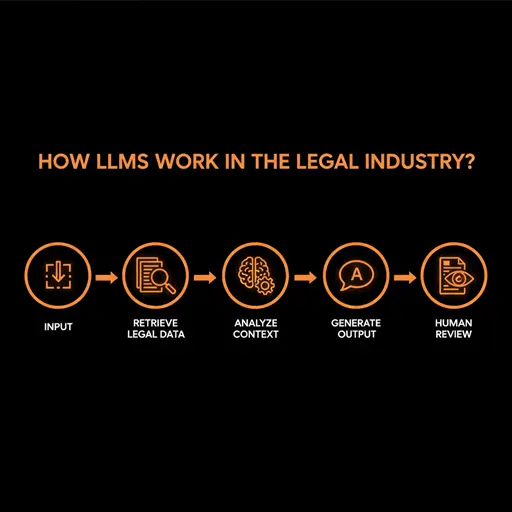
Core Use Cases of Large Language Models for Law Firms
Large language models for law firms are transforming how different legal work is executed by automating research, proper analysis, and some documentation-intensive tasks. These use cases also demonstrate how LLMs enhance speed, accuracy, and scalability across different legal operations. These models also support lawyers in delivering higher-quality and insight-driven legal services.
1. Legal Research and Case Law Analysis
LLMs rapidly analyze statutes, judgments, and relevant precedents to surface relevant case law, summarize legal reasoning, and identify the latest trends across jurisdictions. This reduces the need for lawyers to spend time on manual research.
2. Contract Review & Risk Identification
Large language models for legal documents also enable the leading law firms to properly review different contracts to detect risky clauses, deviations, and overall compliance gaps. This also enables lawyers to focus on high-impact risks rather than routine reviews.
3. Contract Drafting & Clause Generation
LLMs also assist in drafting different contracts while generating clauses aligned with legal standards. This also accelerates proper drafting while maintaining greater consistency and accuracy.
4. eDiscovery & Document Review
AI Case law analysis also helps classify, prioritize, and analyze large document sets during eDiscovery. These also help legal teams identify relevant evidence more quickly while reducing the costs of manual document review.
5. Litigation Strategy & Case Preparation
An innovative LLM for legal research also assists in analyzing evidence and prior rulings. Furthermore, LLMs support in developing sound arguments, identifying certain weaknesses, and structuring multiple litigation strategies.
6. Legal Document Summarization
LLMs also successfully generate concise summaries of judgments, contracts, and regulatory texts. Thus, it allows both the lawyers and clients to quickly grasp key points without having to review lengthy documents.
7. Knowledge Management and Internal Search
An LLM in law also helps enhance internal knowledge systems by enabling natural-language searches across prior cases, memos, and precedents. This, in turn, allows law firms to preserve proper institutional knowledge.
8. Compliance and Regulatory Monitoring
LLMs continuously track regulatory updates and assess their overall impact across multiple existing legal frameworks. This also helps different firms and clients remain much more compliant in rapidly changing, modern regulatory environments.
9. Intake, Matter Triage & Case Classification
Large language models for legal documents can automate proper client intake by analyzing specific case details. It also helps categorize matters by practice, proper area, and urgency, while improving internal routing and resource allocation.
10. Internal Legal Assistants & Copilots
LLM-powered legal copilots also assist lawyers with accurate, genuine, real-time research, drafting, and other administrative tasks. This, in turn, improves productivity while allowing professionals to focus on ideal and strategic legal work.

Benefits of Large Language Models for Law Firms
Large language models for law firms deliver some measurable value by improving efficiency, accuracy, and scalability across different legal operations. Let’s have a look at the advantages in detail.
1. Significant Reduction in Research Time
LLMs quickly analyze vast amounts of legal databases and genuine case law, allowing skilled lawyers to retrieve accurate, and relevant information in minutes rather than spending hours. This, in turn, accelerates proper legal research workflows.
2. Faster Contract Review & Drafting
By automating clause analysis and document generation, LLM in law speeds up proper contract review while drafting different processes and ensuring the right alignment with legal standards and firm-approved language.
3. Lower Operational Costs
Large language models also reduce proper reliance on manual labor for different routine tasks. This lowers billable-hour inefficiencies while enabling different firms to deliver high-quality legal services at reduced operational costs.
4. Improved Consistency & Standardization
Large language models in Law also ensure the uniform application of legal language, templates, and risk standards across multiple documents. This minimizes the overall chances of inconsistencies while reducing significant errors.
5. Enhanced Legal Knowledge Management
LLM for legal research also helps centralize and organize proper institutional knowledge. This allows the lawyers to easily assess different past cases, legal opinions, and internal documents. Such documents can also be easily shared across different teams and practice areas.
6. Better Client Experience
LLMs also ensure faster turnaround times, clearer legal insights, and more transparent communication, which are also enabled by leading LLMs. These significantly improve overall client satisfaction while creating trust.
7. Scalable eDiscovery & Litigation Support
Large language models for law firms help to efficiently process large document volumes during the chances of litigation. This also allows skilled law firms to scale certain eDiscovery operations without proportionally increasing time or costs.
8. Increased Accuracy in High-Volume Work
By minimizing the issues of human fatigue and proper chances of oversight, LLMs also improve better accuracy when handling certain repetitive and high-volume legal tasks.
9. Improved Compliance & Risk Management
LLM in law also proactively identifies different regulatory changes and multiple contractual risks. This also helps law firms to properly manage compliance obligations while reducing some potential legal exposure.
10. Data-Driven Legal Decision Making
By analyzing different historical case data and specific outcomes, LLMs also provide actionable insights. These successfully support more informed and evidence-based legal strategies along with better decisions.
Step-by-Step Implementation Strategy for Large Language Models
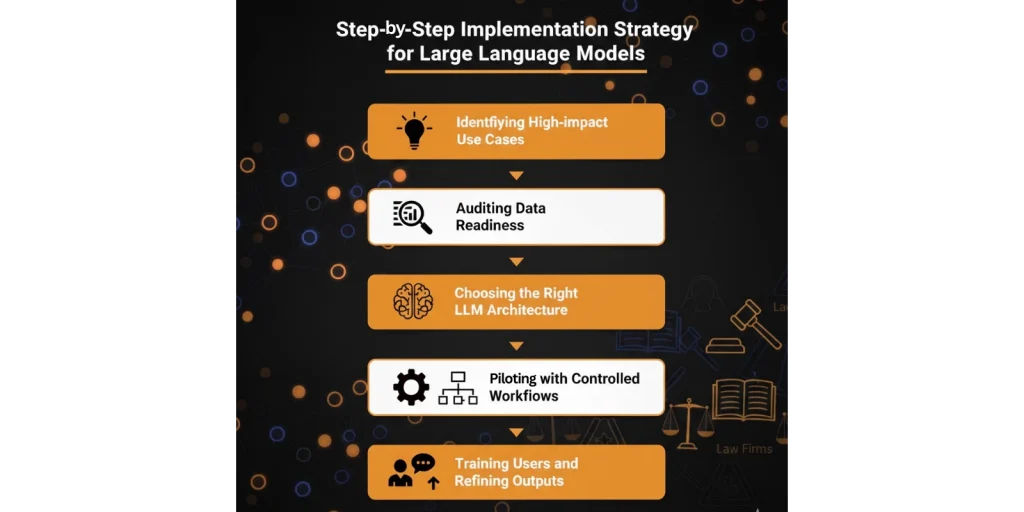
When you opt for developing large language models for law firms, you will need to learn that any development team follows a proper method and structured approach that perfectly balances the latest innovation with genuine responsibility.
Step 1: Identifying High-impact Use Cases
The first step is to define certain clear use cases and a scope. Legal teams should properly identify different workflows where LLM assistance offers clear benefits with some manageable risk. Internal research, genuine document summarization, and drafting standard forms are common starting points.
Step 2: Auditing Data Readiness
Data security is also necessary because it can store client information under encryption, access controls, and clear vendor obligations. Public or unmanaged tools often lack these safeguards, and they align perfectly with different professional duties.
Step 3: Choosing the Right LLM Architecture
Selecting the appropriate LLM architecture is also critical for legal accuracy and security. Law firms also need to evaluate whether to use different general-purpose models, fine-tuned legal models, or custom legal AI Models, based on proper data sensitivity and overall scalability needs.
Step 4: Piloting with Controlled Workflows
Piloting LLMs within certain controlled workflows enables law firms to test overall performance, accuracy, and reliability before proper full-scale deployment. This also helps identify certain risks, refine multiple prompts, and validate genuine outputs through genuine human review.
Step 5: Training Users and Refining Outputs
Training is also equally important when developing large language models in law, because lawyers and staff need realistic expectations about what LLMs can and cannot do. Understanding certain risks and even flaws also helps users to focus on automated output.
Custom Legal LLMs vs General-Purpose Language Models
Law firms need to choose between legal AI chatbot development that is customized and some general-purpose language models. While both of these models offer certain automation benefits, their suitability differs in different aspects and sometimes those differ in case of sensitive and compliance-driven legal environments.
| Criteria | Custom Legal LLMs | General Purpose Models |
| Domain Expertise | These are particularly trained or fine-tuned based on legal data, statutes, case law, and contracts. These ensure higher accuracy | These are trained based on general datasets. |
| Accuracy in different legal tasks | This helps with legal research, draft, and compliance-related tasks | This type helps with generic legal cases |
| Data Security & Privacy | Designed for secure and private deployments that are aligned with some legal requirements, particularly for confidential cases | As these are open source and cloud based, often raise concern regarding data security and privacy |
| Customization | Highly advanced and customizable based on a firm’s workflow | Limited customization available |
| Regulatory compliance | Easier alignment with legal, data protection while meeting industry-specific compliance | Compliance depends on specific control |
| Cost structure | Higher initial investment but delivers long-term value | Lower upfront costs but may increase need to add more features for better security |
| Best use case | Ideal for enterprise law firms that need to handle sensitive, high-risk legal matters | Suitable for general, non-critical cases. |
Common Challenges When Implementing LLMs in Law Firms
The adoption of large language models in Law brings certain significant efficiency but also introduces different challenges that must be managed responsibly.
1. Intellectual Property (IP) Issues
LLMs also successfully generate great content that resembles different copyrighted works, raising concerns about ownership and infringement. Hence, clear legal frameworks and genuine oversight are also essential to ensure better compliance.
2. Data Privacy Risks
Large language models for legal documents rely on some robust and extensive datasets that are potentially exposing sensitive or confidential information. Furthermore, meeting certain regulations such as GDPR and CCPA, and implementing proper data are also considered critical to protect overall client privacy.
3. Bias and Discrimination
LLMs can also reflect different biases in their training data, leading to certain unfair or discriminatory outcomes in proper legal analysis. Furthermore, regular audits, bias-detection tools, and some validation layers are also crucial to ensure fairness.
4. Accuracy and Over-Reliance
LLM for legal research also plays an essential role, but in certain cases it produces certain errors showing the need for human oversight. In this way, certain flawed legal documents can be avoided.
While LLMs offer some transformative potential for different legal operations, managing certain risks such as IP issues, data privacy, and security is also vital. These ensure proper ethical and effective implementation.
Future Trends: Where Large Language Models in Law Are Headed
The use of large language models for legal purposes is also rapidly evolving, and there are several exciting trends that are expected to shape the greater future. Here are some of the key areas where the modern LLMs will continue to revolutionize the best legal practice:
1. Legal Software Integration
LLMs are also increasingly being integrated into certain comprehensive legal software platforms. This integration also enables seamless workflows across various legal tasks, from proper document review to seamless client communications.
2. Litigation Prediction and Different Client-Centric Solutions
Large language models for legal will play a pivotal role in predicting certain litigation outcomes by analyzing vast amounts of case data, judicial rulings, as well as legal precedents. This will also help law firms and clients make more informed decisions while managing risks.
3. AI Legal Document Analysis and Automation
The future of law firm software development services and legal document management is heavily reliant on AI. LLMs will be used to analyze, review, and automate legal documents with greater accuracy and speed. This will significantly reduce the time spent on mundane tasks.
4. Data Security and Remote Work
As remote work continues to grow, data security will become a vital concern for different law firms adopting LLMs. Future LLM systems will also be designed with far stronger security protocols that ensure client data is protected, particularly when assessed remotely.
Moreover, the future of LLM in law also promises multiple advancements and as these latest trends continue to evolve, LLMs are expected to play a crucial role in shaping the next generation of legal technology.

Why Choose A3Logics for Building Large Language Models for Law Firms?
A3Logics, being a genuine AI development company, combines deep AI expertise with some tailored legal technology solutions. This also ensures scalable, secure, and large-scale language model development. Their team also focuses on certain custom integrations and domain-specific workflows that enhance operational efficiency and compliance for law firms.
A3Logics specializes in proper designing, fine-tuning, and testing certain prompts deliver high-accuracy and context-specific results that are tailored to meet specific legal industry requirements. Their team also provides some strategic guidance on AI adoption, helping law firms identify priority use cases with defined roadmaps, and meeting ultimate business objectives.
Conclusion
Large language models in law are transforming the whole concept of legal industry by enhancing efficiency, improving accuracy, and enabling different legal services. From streamlining document review to contract analysis as well as providing advanced legal research and compliance support, LLMs are also reshaping the whole concept of traditional workflows. It also empowers legal professionals to focus on certain higher-value tasks.
As AI continues to evolve with time, LLMs is also likely to play a more prominent role in the legal sector, driving greater innovation and expanding access to justice. All you need to understand the full potential of LLMs and use them responsibly.