Using advanced technology has become the need of the hour in the legal sector, especially when firms have to deal with large volumes of case files, contracts, and deadlines. With the advent of AI, automation, and intelligent assistance seem to have reshaped how legal work gets done. That said, law firms face a critical choice when it comes to choosing AI – whether to go for a custom legal AI model or choose an off-the-shelf AI model for legal workflow optimization. Both options have their share of advantages and challenges.
As a legal firm, if you are planning to manage large volumes of cases, contracts, and legal documents efficiently, you have come to the right place. In this post, we’ll measure the various aspects of deploying custom legal AI models or off-the-shelf legal AI tools. You’ll possibly be able to pick the one that best suits your firm’s workflow, data sensitivity, and operational requirements.
Important Statistics
- The AI software market in the legal industry market size in 2026 is estimated at USD 2.67 billion.
- 61% of lawyers are now using AI, up from 46% in January 2025
- Only 17% report that AI is embedded in their firm’s strategy and operations
- A remarkable 79% of law firm respondents anticipate that AI will have a high or transformational impact on their work within the next five years
Understanding Legal AI: What Powers Modern Legal Technology?

AI models for legal workflow optimization apply advanced AI algorithms to carry out legal tasks. These models support everything from legal research and document review to litigation strategy and regulatory analysis, often by generating time-intensive outputs or by surfacing patterns. Tools in this category extend legal decision-making through predictive analytics, machine learning, and natural language processing.
What Are Off-the-Shelf Legal AI Tools?
Off-the-shelf legal AI tools are pre-built; ready-to-deploy applications that help legal professionals with tasks such as contract analysis, document review, litigation, and legal research. They use natural language processing (NLP); and machine learning to improve efficiency, allowing lawyers to analyze documents, identify risks, and accelerate workflows.
What Does It Mean to Build Custom Legal AI Models?
In simple terms; building custom legal AI models means developing artificial intelligence (AI) specifically trained on a legal department’s or law firm’s proprietary data. As opposed to general-purpose AI; the AI model for legal workflow optimization is fine-tuned to understand jurisdictional nuances; legal terminology, and unique internal workflow. .
Legal AI models are optimized to make law-related repetitive tasks easy. These include compliance checks, contract review; and legal research. The models learn from internal data to understand the law and increase accuracy.
Custom Legal AI Models vs Off-the-Shelf Tools: Core Differences
| Aspect | Custom Legal AI Models | Off-the-Shelf Legal AI Models |
| Training Data | Trained on a law firm’s own legal data (cases, contracts, judgments) | Trained on generic and public legal data |
| Legal Understanding | Deep understanding of specific laws, jurisdictions, and practice areas | Broad understanding, not jurisdiction-specific |
| Workflow Fit | Built around the firm’s exact legal workflows | Fixed workflows that can’t be fully customized |
| Accuracy & Relevance | High accuracy for daily legal work | Acceptable, but often misses context |
| Setup & Effort | Takes time and effort to build and optimize | Ready to use, minimal setup |
Cost Comparison: Upfront Investment vs Long-Term ROI
When considering legal AI chatbot development; it is important to find out which option requires greater investment; and which delivers stronger returns by evaluating both cost and ROI.
First, let’s discuss the ROI. Custom legal AI models offer better long-term ROI; ownership of data and systems, and scalability. However; they have a higher upfront cost since they are trained on a firm’s unique processes or proprietary data. Off-the-shelf AI legal models; on the other hand, offer limited scalability and customization; however, they offer a lower initial setup cost.
Now, let’s compare the cost –
| Aspect | Custom Legal AI Models | Off-the-Shelf Legal AI Models |
| Initial Investment | $10,000 to $500,000 | $1,000 to $100,000+ |
| Customization | Fully customizable | Limited customization |
| Time to ROI | 1-3 years | Immediate, but there are ongoing costs |
| Data Ownership | Full ownership of data | Limited data ownership; most ownership of data rests with the vendor |
| Scalability | Highly scalable. They are built to scale with growing data; evolving workflows, and users | Limited scalability because of rigid workflows, fixed features, and usage caps |
Accuracy and Performance: One-Size-Fits-All vs Tailored Intelligence
Custom Legal AI models provide intelligence that is tailored to a specific firm because they are trained; on a specific law firm’s data, past cases, documents, and working style. This helps them understand legal context; jurisdictional differences, and complex issues in a better manner.
In contrast; off-the-shelf legal AI tools follow a one-size-fits-all approach. They are designed for general legal tasks and standard use cases, so while they are fast and easy to use, they often miss deeper legal nuances and firm-specific requirements.

Data Control, Privacy, and Compliance Considerations
When implementing a custom AI model for legal workflow optimization; there has to be very tight control over data to keep client information protected by the attorney-client privilege. It is crucial to store data on-premises; or in private cloud environments. To follow laws such as CCPA and GDPR, companies must have strict rules for removing personal details and keeping records of data use for audit trails.
A reliable AI model for Legal Workflow Optimization must include a “human-in-the-loop” feature. This means lawyers must review and approve AI-generated work; ensuring the technology supports, rather than replaces, professional judgment while following ethical standards.
Scalability and Flexibility in Legal AI Systems
Scalability and flexibility are very important for AI models for legal document analysis since they can handle increasing data volumes and evolving workflows without hampering performance.
AI for Legal Research allows law firms to manage high-volume tasks such as contract review or e-discovery without any proportional increase in cost. The flexibility aspect ensures that legal AI systems adapt to changing regulatory demands.
Time-to-Value: Speed of Deployment vs Strategic Depth
Off-the-shelf legal AI can be used almost immediately within a matter of days or weeks. It gives quick, low-cost benefits for routine tasks such as legal research, contract review, or document drafting. However, it cannot adapt to a firm’s specific needs or handle complex strategic tasks.
Custom legal AI models, on the other hand, take months to build. The reason being that they are trained on the firm’s own data; workflows and legal nuances. They offer stronger data privacy, and higher accuracy, making them the right choice for cases that require strategic depth.
Use Cases Best Suited for Off-the-Shelf Legal AI Tools
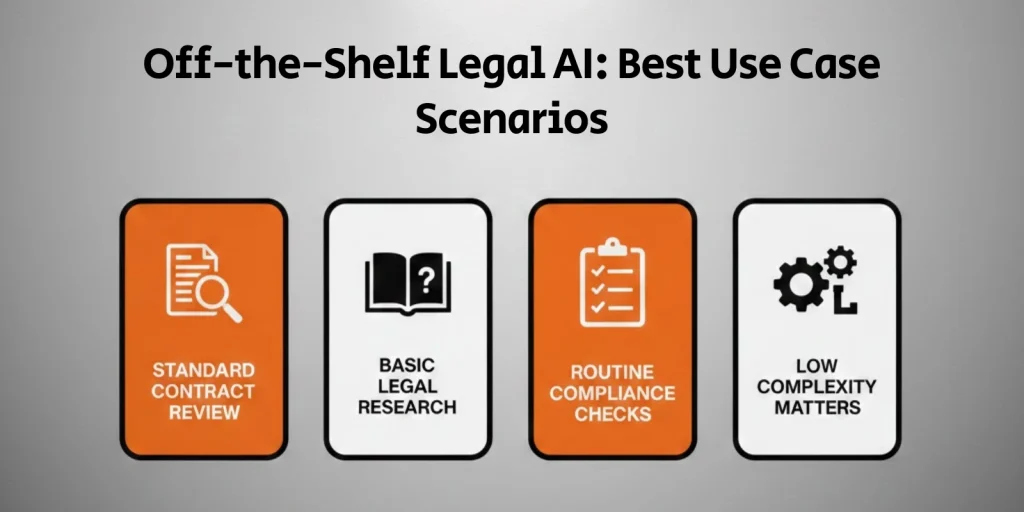
1. Standard Contract Review
As opposed to custom AI models for legal document analysis that handle deep legal context, standard contract review AI tools focus on speed. They quickly spot common clauses, flag missing protections, and identify risky language in NDAs or MSAs, reducing manual effort and improving accuracy in routine reviews.
2. Basic Legal Research
Natural Language Processing (NLP); allows these tools to scan vast databases of case law and statutes in seconds. They summarize essential information and provide contextual answers to initial legal inquiries, significantly accelerating the early discovery phase.
3. Routine Compliance Checks
Off-the-Shelf Legal AI tools are best for routine compliance checks because they follow standard templates. They are capable of quickly verifying whether disclosures; clauses or formats are present making them efficient for low-risk tasks.
4. High-volume, Low-complexity Matters
These tools are best for large amounts of simple work. They quickly read many documents, pick out key information, and handle repetitive tasks. This saves time and lets lawyers focus on more important work.
Use Cases Where Custom Legal AI Models Win
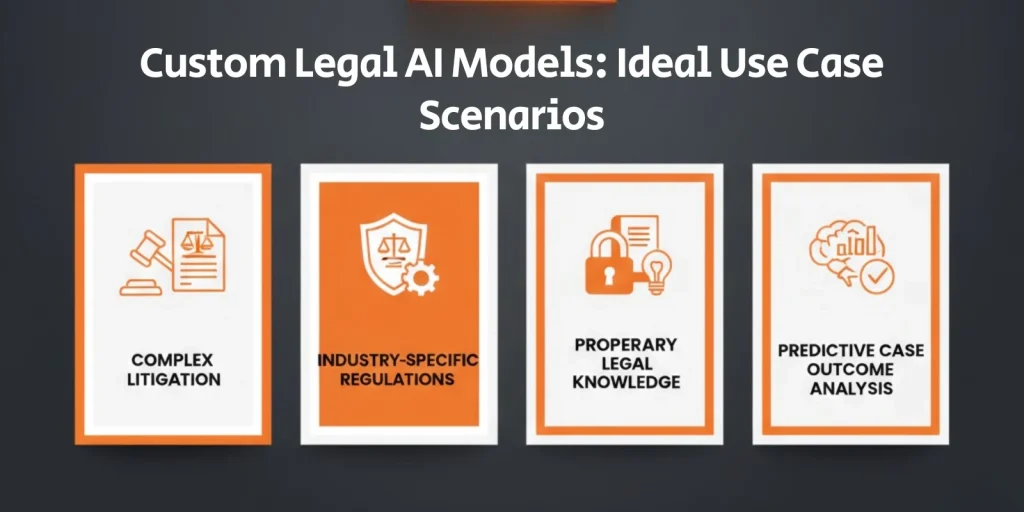
1. Complex Litigation
Custom legal AI models can be trained to analyze case-specific documents. They can manage complex litigation; which involves vast, unstructured data that’s difficult to manage. These models can predict outcomes using historical data; and automate reviews, letting lawyers focus on strategy and identify critical evidence faster.
2. Industry-specific Regulations
Custom AI models for legal document analysis can be trained on industry-specific regulations such as FDA requirements (pharma); or HIPAA (healthcare). The models can be programmed to monitor new regulatory changes and find out how they impact internal policies. The models also allow firms to keep client information confidential within their own secure environment.
3. Proprietary Legal Knowledge
Through legal AI chatbot development, you can have custom AI models that utilize a firm’s private data such as past briefs, client-specific playbooks, etc. Through retrieval augmented generation (RAG) systems; the model provides answers rooted in the firm’s own unique expertise.
4. Predictive Case Outcome Analysis
AI case law analysis helps analyze historical data, including past trial outcomes; specific judge behavior, etc., to provide accurate predictions. Custom AI models for legal document analysis can simulate court decision trends.
Vendor Dependency vs Ownership of Legal AI Models
When a legal firm relies on a third-party AI provider’s proprietary software; the vendor controls updates, data handling, and the model’s functionality. This limits customization and creates operational risks if the vendor changes pricing; or discontinues services.
Ownership of a legal AI model gives you the intellectual property rights; to the AI model itself. You own the training data; and underlying algorithms. This allows for full customization; data privacy control, and freedom from third-party roadmap restrictions. Even though it is costly, owning a model eliminates dependence on a single vendor for critical legal tools.
Hybrid Approach: Combining Custom Models with Prebuilt Tools
Here is a step-by-step breakdown of a likely hybrid approach; of combining custom AI legal models with prebuilt off-the-shelf AI legal models –
1. Define Goals
Identify tasks requiring high accuracy vs general tasks.
2. Select Pre-built Tools
Integrate fast, off-the-shelf APIs for general tasks.
3. Develop Custom Models
Train bespoke models on proprietary data for niche, high-security, or domain-specific needs.
4. Implement Orchestration
Create a layer to direct traffic between custom and pre-built models.
5. Monitor and Optimize
Continuously evaluate, validate and retrain models to improve performance.

Why Choose A3Logics for Building Custom Legal AI Models?
Law firms often struggle with a lot of paperwork; slow case handling, and inefficient processes. A3Logics solves these challenges with smart; tailored solutions. As a reliable AI development company, we design AI models for legal workflow optimization and provide effective law firm software development services to help legal teams save time and work smarter.
Conclusion
The AI model for legal workflow optimization offers a lot of potential; from smart document review to predictive insights—but not all solutions fit every firm. Evaluating whether a custom legal AI model or an off-the-shelf tool best suits your operations is essential. Aligning the choice with your workflow data security; and team needs makes sure that AI becomes a true asset rather than a costly experiment.