Life insurance is transforming rapidly as advanced technologies replace slow paperwork. Generative AI in life insurance, for instance, enables insurers to underwrite faster, process claims more accurately, and deliver more personalized customer experiences.
That said, the implementation may come with challenges. In a landscape where customers expect instant services, generative AI for life insurance operations may cause delays in underwriting, claims may take too long, or there might be fraud risks.

However, generative AI–driven intelligence has come a long way. Unlike traditional automation it can predict risks; make complex decisions, and streamline life insurance operations efficiently. In this post we’ll discuss how generative AI is reshaping life insurance operations and how insurers can adopt it strategically.
Important Stats
- The Global Generative AI in Life Insurance Market size is expected to be worth around USD 1,739.9 Million
- 65% of Gen Z consumers prefer using an AI-guided interface to purchase life insurance.
- 90% of surveyed insurance organizations now utilize these tools, with 44% advancing to full-scale cloud production environments
- In 2026, around 80% of insurers are actively deploying AI across at least one core function, marking a shift from pilots to scaled production use.
What Is Generative AI in Life Insurance?
1. Understanding Generative AI
a. Definition and core capabilities of Generative AI
Generative AI refers to the branch of artificial intelligence; that generates new content; in the form of text, images, code, audio, etc. It leverages neural networks to produce content. It learns from massive; existing datasets using deep learning models. Its core capabilities lie in generating original, human-like outputs instead of merely classifying data. Using this, it generates and summarizes content and performs data synthesis.
b. Difference between traditional AI, ML, and Generative AI
AI, Machine Learning, and Generative AI are often used interchangeably; but they serve different roles in life insurance. Traditional AI; follows fixed rules to automate structured tasks like basic risk checks. Machine Learning studies policy and claims data to detect patterns and improve underwriting or fraud detection over time. Generative AI goes further by creating personalized policy recommendations; summarizing documents, and enabling intelligent customer interactions.
c. Role of GenAI in handling structured and unstructured insurance data
To deal with structured data such as policy numbers; premium amounts, claim values, customer age, etc., GenAI uses deep learning models to turn organized insurance data into risk scores, alerts, forecasts, and business insights that support faster and more accurate decisions.
On the other hand; GenAI uses techniques like Natural Language Processing (NLP) to break text into smaller parts (tokens) when dealing with unstructured data. It analyzes sentence structure and understands intent. It can extract key information from claim descriptions; summarize long documents; and convert free text into structured fields that systems can process.
2. Why Life Insurers Are Adopting Generative AI
a. Managing growing data volumes and complexity
Life insurers use Generative AI to efficiently process large volumes of unstructured data; including medical records and legal documents. It automatically identifies and extracts relevant information, converting scattered data into structured, meaningful insights.
b. Need for faster decision-making and personalization
GenAI supports quick underwriting and claims processing by analyzing risks in real time. It also creates personalized policy suggestions and customer messages; helping insurers improve customer satisfaction.
c. Competitive pressure to modernize legacy insurance operations
To remain competitive with technology-driven companies; traditional companies are adopting GenAI to modernize legacy systems. It streamlines routine administrative processes and let’s employees concentrate on strategic tasks.
Key Operational Challenges in Life Insurance
1. Manual and time-consuming underwriting processes
As opposed to AI-powered life insurance underwriting, traditional life insurance relies on human review and physical documentation, which indeed slows policy issuance. What further hampers customer experience is long wait times for risk assessment.
2. High claims processing costs and settlement delays
Another issue that generative AI in life insurance can tackle is that; it removes manual verification and complex approval layers. In the absence of automated systems; these cause inefficiencies that lead to transparency issues and slow payouts in critical times.
3. Limited personalization of policies
With legacy systems in place; traditional life insurance is unable to deliver personalized coverage based on a customer’s usage. What adds to this is the fact that legacy systems cannot process customer data quickly or at scale.
4. Increasing fraud and compliance risks
Through generative AI development services; insurers can identify and counter sophisticated fraudulent claims; such as impersonation or fake documents. Such claims drain profitability and raise premiums.
5. Fragmented data across legacy systems
When important customer data and policy information are stored in separate systems, it is difficult for insurers to carry out processes. They are unable to get a real-time, complete view of policyholders, make slow decisions, and instances of errors also increase.
Core Use Cases of Generative AI in Life Insurance Operations
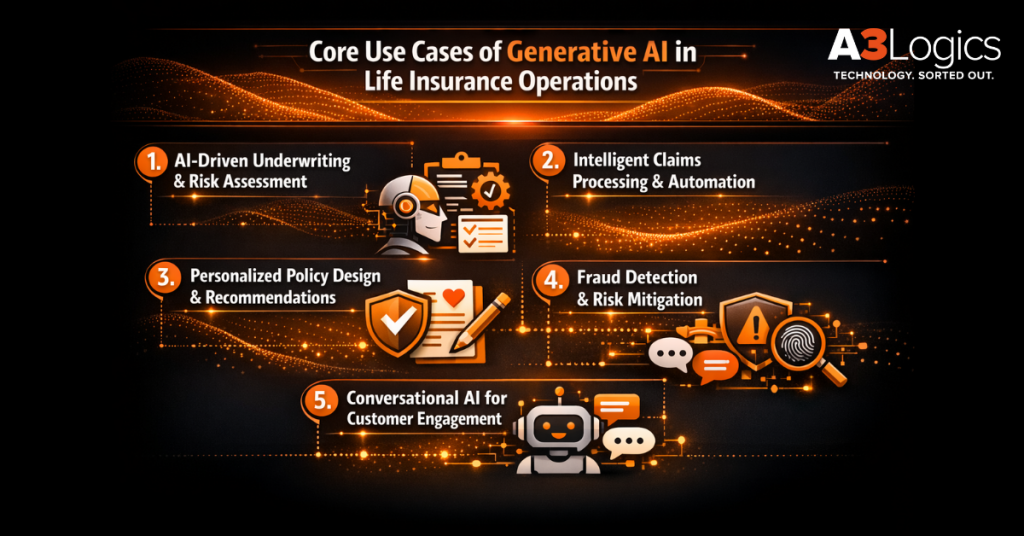
1. AI-Driven Underwriting & Risk Assessment
Instead of manual checks, AI-driven insurance underwriting automatically reviews medical and lifestyle details. Based on this data, predictive analytics in life insurance compares thousands of similar profiles to predict risks and make informed decisions. Since generative AI for life insurance operations is automated; the time taken to approve a policy drops sharply.
2. Intelligent Claims Processing & Automation
In life insurance claims automation; AI systems quickly read, extract, and verify information from various sources automatically. The automation speeds up approval and settlements, and reduces errors. Simultaneously; generative AI in life insurance provides clear status updates to customers, improving transparency and customer trust.
3. Personalized Policy Design & Recommendations
AI in life insurance takes into account an individual’s age; lifestyle, financial goals, and risk profile. Based on this; it provides hyper-personalized insurance products. It uses advanced models; to optimize policy pricing that balances customer risk with affordability. This enhances customer engagement; since policies meet customer expectations.
4. Fraud Detection & Risk Mitigation
AI in insurance; uses AI-powered pattern recognition to identify suspicious behaviors and repeated fraud trends. It continuously analyzes large volumes of claim; and policy data to detect unusual claim amounts, timings, or inconsistencies. This approach reduces false claims, minimizes manual investigations, and lowers investigation and financial costs.
5. Conversational AI for Customer Engagement
Generative AI in life insurance uses intelligent chatbots and virtual assistants to interact with customers naturally. The AI systems guide customers with policy onboarding, renewals, reminding customers about due dates, etc., providing constant support. Conversational AI in Intelligent insurance claims processing works across channels such as websites; mobile apps, call centers, etc., and enhances customer experience.

Business Benefits of Generative AI for Life Insurers
1. Reduced operational and administrative costs
Generative AI in life insurance; automates document-heavy tasks like data entry and policy drafting. This minimizes manual labor; cuts overhead, and allows staff to focus on high-value strategic initiatives rather than repetitive paperwork.
2. Faster processing across underwriting and claims
AI-driven underwriting instantly extracts data from unstructured medical reports and claim forms. This accelerates decision-making and reduces turnaround times; ensuring that policyholders receive payouts quick.
3. Improved risk accuracy and compliance
By analyzing vast datasets; generative AI in life insurance identifies subtle risk patterns and anomalies. It also automates regulatory reporting, ensuring policies stay updated with evolving legal standards and reducing penalties.
4. Enhanced customer satisfaction and loyalty
Personalized AI assistants in AI-powered life insurance underwriting; provide 24/7 support and tailored policy recommendations. This empathetic interaction fosters trust, and increases long-term policyholder retention.
5. Scalable and future-ready insurance operations
GenAI lets insurers handle growing data volumes and complex market demands without increasing staff. Its adaptive learning ensures operations remain competitive, agile, and ready for emerging industry shifts.
Implementation Strategy for Generative AI in Life Insurance
1. Data Readiness & Governance
To implement generative AI in life insurance; it is essential to have clean, secure, and well-organized data that can help make correct decisions. It is equally important to manage both structured as well as unstructured datasets so that AI can learn accurate patterns and on the basis of that make reliable predictions.
2. Integration with Legacy Insurance Systems
API-led and modular approaches in life insurance claims automation connect GenAI with existing policy administration systems. This strategy ensures that data flows smoothly; and correctly while AI tools are being adopted.
3. Regulatory Compliance & Ethical AI
It is important for Generative AI in life insurance to prioritize transparency; and data privacy to meet strict regulations guidelines such as; HIPAA, and GDPR. This involves implementing explainable AI models to remove bias in claims and underwriting.
4. Change Management & Workforce Enablement
When implementing AI-based intelligent insurance claims processing, human-in-the-loop models improve AI accuracy since humans guide complex decisions. In this regard, it is important to upskill teams on prompt engineering and AI-assisted decision making to accelerate adoption, and maximize AI productivity.
Challenges & Risks of Generative AI Adoption
i. Data privacy and security concerns
Using generative AI in life insurance risks data leakage since models might ingest, retain, or leak Personally Identifiable Information (PII) during training or public API interactions. This may further lead to breaches.
ii. Bias and explainability challenges in AI models
Historical biases in generative AI in life insurance can lead to unfair coverage or pricing. Its “black box” nature makes decisions hard to explain; creating regulatory challenges, and lowering customer trust.
iii. High initial investment and infrastructure complexity
The initial cost of integration can be a barrier since, first, insurers must buy advanced technology, integrate it with existing systems, and finally, train staff on its usage. All these aspects can be expensive, especially for companies with limited infrastructure.
iv. Organizational resistance to AI-driven change
Employees may resist adopting AI tools out of fear that technology will make their roles redundant. Moreover; there might be a shortage of skilled professionals required to deploy generative AI-based life insurance systems.
Best Practices for Successful GenAI Adoption
1. Responsible AI governance frameworks
Establishing ethical guidelines ensures that systems using generative AI for life insurance operations are unbiased and transparent. The frameworks include human-in-the-loop oversight, social responsibility, and legal compliance.
2. Continuous monitoring and model optimization
Generative AI in insurance; requires ongoing performance to detect accuracy downfall over time. Regular updates and fairness audits; ensure models remain relevant; effective, and aligned with changing business goals.
3. Strong cybersecurity and data protection measures
When integrating generative AI for life insurance operations, it is essential to deploy robust cybersecurity and data protection measures. These protect against external breaches and data leakage while also meeting global compliance and privacy standards.
4. Partnering with experienced AI and insurance technology providers
Working with experienced AI and insurance technology partners; makes it easier and faster to adopt generative AI in the insurance workflow. They provide ready-to-use tools and proven frameworks. They also help in the integration of AI; with existing systems.
How A3Logics Can Help Transform Life Insurance with Generative AI?
If you are looking for an experienced; AI development company that can help you adopt generative AI in your life insurance operations, you can partner with A3Logics. As a trusted leader in generative AI, A3Logics exhibits the following strengths –
Custom Generative AI solution development for life insurers
A3Logics is an insurance software development company that creates tailored Generative AI for life insurance operations, designed to meet unique business needs
AI-powered underwriting, claims automation, and fraud detection
It designs systems that automate underwriting, claims fraud detection processes accurately.
Conversational AI and customer engagement platforms
It enables chatbots and virtual assistants; that give proactive solutions to customers, enhancing customer engagement and support.
Seamless integration with legacy insurance systems
A3Logics helps life insurers; add generative AI to legacy systems smoothly, making operations faster and easier.
Compliance-ready, secure, and scalable AI architectures
A3Logics builds AI systems that are safe, meet regulations, and can grow easily as business needs increase.
End-to-end AI consulting, implementation, and support
A3Logics provides end-to-end support; guiding strategy, implementing AI solutions, and offering ongoing maintenance and assistance.
Real-World Applications & Industry Adoption Trends
1. AI-enabled underwriting automation
Insurers use AI-driven insurance underwriting to analyze vast datasets, including IoT and telematics, for real-time risk assessment. This reduces turnaround times from weeks to minutes. This improves accuracy; and lowers loss ratios.
2. Intelligent claims management platforms
Intelligent insurance claims processing; automates the entire claims lifecycle using computer vision for damage assessment and NLP for document parsing. Some leaders in the insurance domain, now settle simple claims in seconds.
3. GenAI-driven customer service in insurance
Generative AI for life insurance operations powers context-aware virtual assistants; that handle complex queries 24/7 with empathy. These tools can improve customer satisfaction; and reduce average call times.
4. Early adopters gaining operational and competitive advantages
Intelligent insurance claims processing accelerates; the underwriting process by instantly analyzing vast amounts of unstructured data. It can reduce manual intervention and provide tailor-made policies to customers.
Conclusion
Generative AI for life insurance is becoming essential for daily operations. It will automate underwriting; claims, and customer service, making it necessary for insurers to adopt this technology to stay competitive. Furthermore, predictive analytics in life insurance goes beyond just a tool; it transforms risk management into instant, personalized pricing that makes traditional manual underwriting obsolete.