Most CRMs are mere data repositories, whereas Agentforce acts upon the data.
The Agentforce Architecture has transformed CRM into an AI-driven execution system from rule-based systems, where agents manage multi-step workflows. This shift is critical, especially as nearly 90% of enterprise data is unstructured, yet only a small portion is actively used in decision-making. Agentforce addresses this gap by allowing agents to understand intent, utilize real-time customer data, and perform tasks within defined guardrails.
Being a product of the Salesforce core platform, it includes Data Cloud, generative AI, and real-time integrations that make it possible to achieve complete automation.
In the Salesforce Agentforce Architecture, agents are digital workers that do tasks through several systems. This is turning CRM from a record-keeping system into an execution system.
In this blog post, we will analyze the fundamental components, workflow, and architecture that make up Agentforce.
What is Agentforce Architecture and How Does It Work in CRM?
To understand What is Agentforce, it is a layered AI framework that automates the execution of tasks through intelligent, autonomous agents. It applies reasoning dynamically based on the context. Agentforce is powered by a system architecture that combines the reasoning capabilities enabled by the Atlas Reasoning Engine, the Data Cloud, and the API and workflow integrations that provide autonomous task execution.
This enables an end-to-end processing of requested tasks covering data retrieval, applying logical reasoning to the data, and initiating a task or update.

Agentforce Architecture: Multi-Agent AI Workflow Across Salesforce Ecosystem
The picture above shows how the Salesforce Agentforce Architecture coordinates multi-agent workflows throughout the enterprise systems. For instance, user conversations on platforms, e.g. Slack get directed to agents within the Selling Org, and there are different agents like Scoping Agent and Project Manager Agent, that understand the needs and prepare the execution.
The agents can work with unified enterprise data through Data Cloud One, and they can also integrate with external systems like MuleSoft and Google Drive to get or update the information simultaneously. When it comes to sophisticated AI processing, the request is done through the Einstein Trust Layer, which is a security and governance layer. It ensures that the interaction is safe before the LLMs or custom models, which run on BYOM platforms such as AWS SageMaker are used.
After that, the Delivery Org makes use of domain-specific agents and Experience Cloud interfaces to carry out activities, and as a result, the entire secure, scalable, and autonomous workflow execution is done within the Salesforce ecosystem.
Key Components of Agentforce Architecture Explained in Detail
1. Data Layer
Agentforce Architecture‘s Data Layer is built on top of Salesforce Data Cloud, and it is the contact point for users in a uniform way with different types of data, structured or unstructured. The single point of contact to multiple systems is achieved by a federated query approach, and it happens instantly without copying data.
The Data Layer is not limited to helping agents pinpoint the necessary information through the use of vector search and RAG, but also facilitates decision-making processes in agents through providing accurate context.
2. AI Engine
At the heart of the Agentforce Architecture‘s decision-making process lies the AI Engine based on the Atlas Reasoning Engine. Among its capabilities is understanding intent, dividing tasks into manageable units, and carrying them out independently. This engine makes multi-step reasoning possible, and it is a synthesis of the functionalities of the large language model, business logic, and the presence of guardrails.
3. Agent Layer
The Agent Layer represents a group of AI agents that were created with the intention of performing single tasks within the Architecture. The agents have a work environment characterized by the presence of roles, the possibility to take actions, and restrictions.
The modularity of the Salesforce Agentforce Architecture is achieved by having agents not only work side by side but also cooperate with each other. This way, it is the agent’s unit that is responsible for the improvement of their task performance and scalability.
4. Orchestration Layer
The Orchestration Layer in the Agentforce Architecture takes care of the interactions between agents. It decomposes complicated requests and dispatches tasks to the relevant agents. It ensures the proper execution by aggregating outputs and maintaining the workflow.
5. Integration Layer
The integration layer is like a bridge that links the Architecture with the outside world through APIs, MuleSoft, and custom actions. It gives agents the ability to work even when not dealing with Salesforce. The Salesforce Agentforce Architecture via this layer carries out inter-system workflows so that the entire automation process is covered across corporate environments.
Understanding Agentforce AI Agents and Their Core Functions
AI agents in the Agentforce Architecture are responsible for performing all business logic and system operations. They follow numerous design principles that are based on specific functional patterns. In general, any AI Agent in the system is responsible for the following operations:
Intent Recognition: These NLP-based components are responsible for understanding the user intent and classifying it in a specific domain (e.g. billing, product queries). A front-end agent will interpret the request first and then forward it to another agent.
Context Retrieval: Agents retrieve the relevant data with the Data Cloud and RAG, such as CRM records, knowledge articles, and past interactions. So, the decisions are based on real-time and accurate context.
Task Execution: Through APIs, Flows, or even other agents, agents can perform various tasks such as record updating, scheduling actions, or starting a workflow within the system.
Content Generation: Agents generate structured responses like emails, summaries, or replies based on prompts and retrieved data using language models.
Decision Support: Evaluate data through an LLM to get scores, summaries, or other insights.
Monitoring and Feedback: Everything an LLM does is logged and can be used to update prompts, guardrails, and workflows.
Turn Complex Workflows into Smart Automation with A3Logics’ Agentforce Expertise
Workflow Automation in Agentforce: Step-by-Step Process
1. Data Collection and Processing
Agentforce Architecture starts with real-time data ingestion using Salesforce Data Cloud. It merges structured CRM data and unstructured sources such as emails and documents. Data is indexed and vectorized for making semantic retrieval feasible through RAG. This way, agents can always work with a single, updated context.
2. AI Model Training and Analysis
AI Model behaviors are primarily defined based on prompt templates, instructions, and business rules rather than frequent retraining. Agents are configured and tested using simulation tools to approve the workflows. This helps in producing controlled, predictable AI outputs that adhere to enterprise logic.
3. Decision-Making by AI Agents
Atlas Reasoning Engine is used for intent interpretation, task decomposition, and determination of execution. Agents evaluate available data, the choice of action, and the application of constraints are dynamic. This allows multi-step reasoning rather than static rule execution.
4. Task Execution and Automation
After decisions are reached by the system, the Agentforce Architecture interacts with the Salesforce data and functions through APIs, Flows, and Apex actions. Agents can update records based on decisions, trigger any processes as Workflow, Approvals, or Flows in Salesforce, or they may notify customers through chat or other supported channels.
If an appropriate resolution is not possible, Agentforce hands over the interaction to human support agents, providing the full context of the interaction.
5. Continuous Learning and Optimization
Every interaction with any user or an agent is logged by the Agentforce Architecture. It captures the user input, prompts, system decisions, the action taken by the system or agent, and the eventual outcome with any feedback from the user or agent.
These logs are utilized to improve processes and to optimize the agent’s performance on various tasks. This feedback loop provides important usage data to ensure the system grows optimally based on real usage.
Role of APIs and Integrations in Agentforce Architecture
APIs enable the Agentforce Architecture to extend beyond Salesforce and interact with enterprise systems. Agents use Salesforce APIs, Apex, and Flows to access and update CRM data in real time.
Through Salesforce Integration Services, the architecture integrates with external systems via MuleSoft, enabling connections to ERP, HR, and legacy platforms. Besides these standard capabilities, agent workflows can be augmented by custom actions that involve third-party services or databases.
Agent-to-Agent (A2A) and Model Context Protocol (MCP) are examples of such protocols that allow the agents to safely interact with external systems. This way, the architecture can be implemented in various locations without the formation of data silos.
Agentforce Architecture vs Traditional CRM Systems

One distinction usually discussed is Agentforce vs Einstein Copilot, where Copilot helps provide users with suggestions, and Agentforce makes it possible for tasks to self-execute without any manual involvement.
| Aspect | Traditional CRM System | Agentforce Architecture |
| Automation Model | Rule-based workflows and manual processes | AI-driven agents with multi-step reasoning |
| Intelligence | Limited analytics and basic automation | Advanced NLP and generative AI for decision-making |
| Data Access | Batch processing and siloed systems | Unified Data Cloud with real-time access |
| Response Time | Dependent on human intervention | Instant, 24/7 automated responses |
| Flexibility | Rigid and difficult to modify | Modular agents with dynamic execution |
| Scalability | Limited by workforce and infrastructure | Scales through autonomous agents |
| Channels Supported | Primarily email or web | Omni-channel including chat, voice, and APIs |
| Governance | Manual enforcement of policies | Real-time guardrails and compliance checks |
Benefits of Implementing Agentforce Architecture in Enterprises
1. Enhanced Automation and Efficiency
Agentforce Architecture allows companies to automate operations with a high volume, for instance, customer support, lead qualifying process, and data processing. Agents keep working nonstop, following workflows without human interaction, thereby lowering the need for manual work significantly. As a result, the task can be done more quickly, and workers are less burdened.
2. Improved Customer Experience
With access to data in real time and generating a consistent response, agents can provide support that is both immediate and accurate through the different channels. They provide faster turnaround times, which leads to the rise in customer happiness.
3. Real-Time Decision-Making
Agentforce Architecture makes it possible for agents to work on data streaming, and make their decision on the spot. This feature is a lifeline for scenarios like personalized suggestions, counter-offering a price on the spot, or real-time assistance.
4. Scalability and Flexibility
The architecture’s component-based layout gives the team the freedom to bring in more agents whenever they see fit. As a result, the system is able to support rising requests without having to go for extensive infrastructure overhauls.
5. Cost Optimization and ROI
By reducing reliance on manual processes, Agentforce lowers operational costs. Its usage-based model allows organizations to align costs with actual system utilization, improving overall return on investment.
Key Technologies Behind Agentforce Architecture
1. Machine Learning and NLP Capabilities
The Agentforce Architecture uses advanced NLP models to analyze user input and produce responses. The models enable users to identify intents from their input and extract entities while understanding the context.
2. Generative AI in Salesforce
Generative AI powers response creation, content generation, and workflow execution. The platform uses prompt templates combined with real-time data to ensure accurate and context-aware outputs.
3. Predictive Analytics and Insights
The agents use predictive models to assist decision-making processes. The models help organizations to assess their work activities through scoring systems, which also include forecasting methods and prioritization techniques.
4. Role of Cloud Computing and Microservices
The Salesforce Agentforce Architecture operates on cloud-native infrastructure, which uses microservices to achieve both scalability and system resilience. The system delivers optimal performance through its ability to maintain high availability across worldwide implementations.
Best Practices for Designing Salesforce Agentforce Architecture
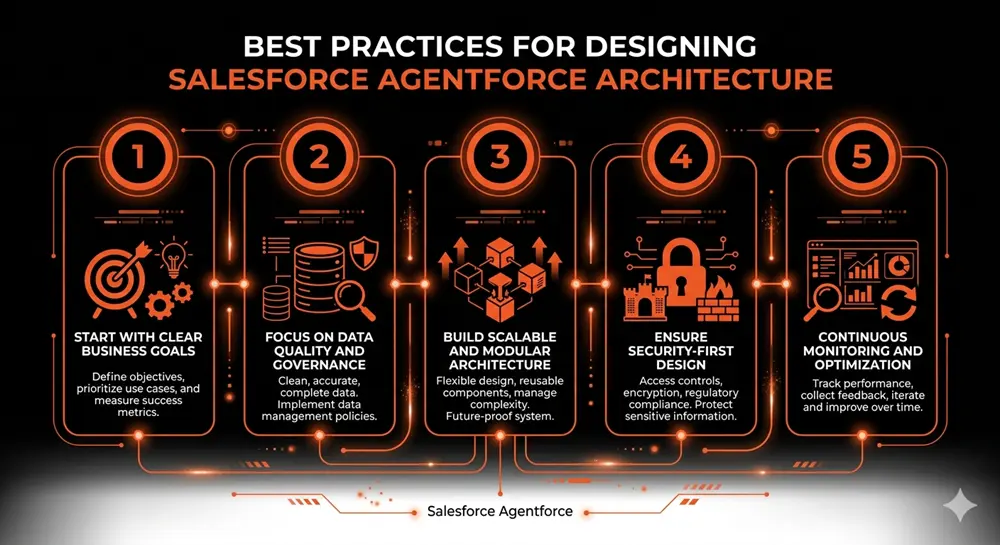
1. Start with Clear Business Goals
The Agentforce Architecture needs to be implemented after defining specific use cases, which include support automation and lead qualification. Each agent should be aligned with measurable outcomes like resolution time or conversion rate. The system requires construction for actual results instead of testing various designs.
2. Focus on Data Quality and Governance
The Salesforce Agentforce Architecture functions effectively when it receives correct unified data from the Data Cloud. Agent reasoning becomes restricted through poor data quality, which results in incorrect system outcomes. The organization needs to implement all governance policies together with masking procedures and access controls throughout every operational phase.
3. Build Scalable and Modular Architecture
The design process for Agentforce Architecture requires multiple specialized agents instead of using a single monolithic system. The modular agent system enables organizations to achieve better operational flexibility while achieving better system security and operational capacity. The method used here follows Salesforce’s operation system, which controls multiple agents through its orchestration framework.
4. Ensure Security-First Design
The architecture implements real-time guardrails through its security system, known as Einstein Trust Layer. The system requires three security measures, which include data masking and permission checks, together with execution compliance validation.
5. Continuous Monitoring and Optimization
The system records all prompt details together with their complete set of actions and their resulting effects. The data should be analyzed to develop better prompts that will enhance workflow processes while fixing existing problems. The process of continuous testing, together with monitoring activities, ensures long-term performance and reliability.
Challenges and Considerations in Agentforce Deployment
1. Integration Complexity
The Agentforce Architecture entails a great deal of integration work between the CRM, external systems, and APIs. Connecting legacy systems and making sure that the data flows smoothly make it pretty complicated. MuleSoft and API strategies are valuable tools for handling this matter efficiently.
2. Data Quality Issues
Any defect in data indirectly makes the Salesforce Agentforce Architecture less effective. Because agents depend on the updated context, bad data will inevitably result in wrong decisions. There should always be data check-ups and data additions.
3. Initial Setup Costs
Rolling out the architecture requires additional AI credit purchases, Data Cloud setup, and ongoing development resources. Prices change depending on how much the system is used and the level of complication. Companies should only proceed with their deployment plans when they have clear ROI-driven use cases.
4. Skill Requirements
Agentforce deployment skills are a big challenge scenario as one needs to be fluent in AI, prompt engineering, and Salesforce integration. The team should know the agent behavior, data pipes, and workflow orchestration. Not having the right skills may hinder the implementation and optimization.
Transform your Business Workflows with Next-gen Agentforce Solutions
Why Choose A3Logics for Agentforce Architecture Implementation?
A3Logics brings 20+ years of experience in delivering enterprise-grade technology solutions, including advanced Salesforce and AI-driven systems. As an experienced AI Development Company, we design and implement Agentforce Architecture aligned with complex business workflows, ensuring scalability and operational reliability from the outset.
With deep expertise in the Salesforce Agentforce Architecture, A3Logics integrates Data Cloud, APIs, and multi-agent systems into a unified framework. Our Agentforce Consulting Services focus on building modular, secure, and well-orchestrated agent ecosystems that support real-time data access, automated decision-making, and seamless cross-system execution.
Beyond implementation, A3Logics emphasizes outcome-driven delivery by aligning solutions with measurable business goals. Our structured approach ensures improved operational efficiency and long-term ROI through intelligent automation.
Final Thoughts
The Salesforce Agentforce Architecture provides a flexible and scalable framework that enables enterprises to automate their business operations. The solution enables companies to boost their operational efficiency while delivering better customer service and making instant decisions.
Organizations that adopt this model will achieve success through their ability to maintain strong data foundations, effective integration strategies, and continuous improvement of AI agents.
If you’re exploring how to implement this within your organization, the right approach and the right partner can make all the difference. At A3Logics, we work closely with teams to turn these architectures into practical, scalable systems that deliver real business value.