Traditional claims adjusting used to be a tedious process. It was filled with endless paperwork, back-and-forth phone calls, and manual reviews. What further made the process tedious was that insurers also struggled with rising fraud risks and heavy operational pressures. Clients were left waiting for long periods for claim approvals, despite expecting faster and more transparent service.
With AI-based insurance claims adjusting automation, insurers no longer have to chase documents or rely on error-prone processes. They can validate claim details, settle genuine claims faster, reduce fraud exposure, and deliver a smoother, more reliable customer experience.
AI in insurance claims processing is becoming a game-changer in modern claims management. Insurance claims adjusting automation reduces operational workload by improving assessments; minimizing errors; and improving efficiency. In this blog; we will discuss the key aspects of AI in insurance claims adjusting and its growing impact.
Understanding Traditional Claims Adjusting
Traditional claims adjusting is the process of investigating losses; assessing damage, and negotiating fair settlements. Human adjusters play an important role; inspecting sites, interviewing parties, and reviewing policies. That said; heavy reliance on manual, rule-based workflows makes the process, costly, and error-prone; often leading to delayed settlements.
Important Stats
- The AI in insurance market has exploded, it reached $10.24 billion in 2025.
- Insurers using advanced AI systems report up to 75% faster processing speeds and 99% accuracy in risk assessments
- The adoption of AI is expected to create 2 million new specialized jobs in the insurance sector by 2030
- Fraud detection accuracy improved 20–40% for soft fraud and 40–80% for hard fraud.
Challenges with Traditional Claims Adjusting
1. Long claim settlement cycles
Traditional claims adjusting often takes weeks or months to resolve claims; since it is dependent on manual reviews, physical documents, and back-and-forth communication between all parties, such as adjusters, claimants, and third-party vendors.
2. High dependency on manual inspections and paperwork
Instead of reliance on automated data entry and digital and remote assessments; traditional claims adjusting is dependent on paper-based workflows. It involves claim forms, invoices, and physical and manual property inspections.
3. Inconsistent claim assessments and human bias
Different adjusters may interpret the same policy or damage differently based on training, personal experience, or mood, leading to a lack of standardization in payouts. Hence, the decisions may be subjective.
4. Difficulty in managing high claim volumes (catastrophes, disasters)
When there are natural disasters or catastrophes, traditional claims adjusters may struggle to scale. Severe backlogs are accumulated, especially in a scenario when policyholders need immediate attention.
5. Increased exposure to fraud and leakage
Traditional methods are “reactionary,” meaning audits often happen after a claim has been settled. Also, due to high caseloads, claims may not receive in-depth investigations, and this could lead to fraud or overpayments.
6. Poor customer experience and lack of transparency
With traditional claims adjustment, the communication is scattered across channels like phone calls, emails, etc., since conversations are not connected to one system, messages regarding claim status get delayed or missed.
Why the Insurance Industry Needs AI in Claims Adjusting
1. Growing claim complexity and data volumes
AI in insurance claims adjusting can easily handle growing claim complexity and large data volumes since AI automatically extracts key details from massive amounts of information spread across documents, images, videos, etc. It can easily highlight risks, cross-check policies, and make accurate decisions.
2. Pressure to reduce operational costs
In place of manual labor, paperwork, and repetitive follow-ups that drive high operational costs, insurance claims adjusting automation powered by AI can automate all such repetitive tasks. As a result, it reduces the overall claim handling costs.
3. Demand for faster, fairer, and more accurate claim settlements
AI in insurance claims adjusting uses computer vision to eliminate subjective human judgment; and makes it more precise. It reduces errors and biases, ensuring consistent assessments. This helps process claims fairly for policyholders.
4. Regulatory and compliance expectations
Automated claims adjusting systems maintain detailed digital logs of every interaction; providing robust audit trails. This helps insurers ensure data privacy compliance measures such as GDPR, HIPAA, etc.
5. Competitive need for digital-first insurance experiences
The need for AI in insurance, especially in claims adjusting, comes from the demand for digital-first experiences. Customers expect the insurance companies to handle their claims seamlessly while offering complete transparency when it comes to claims status. AI-based claims adjustment automates claims processing and provides real-time updates.
Key AI Technologies Transforming Claims Adjusting
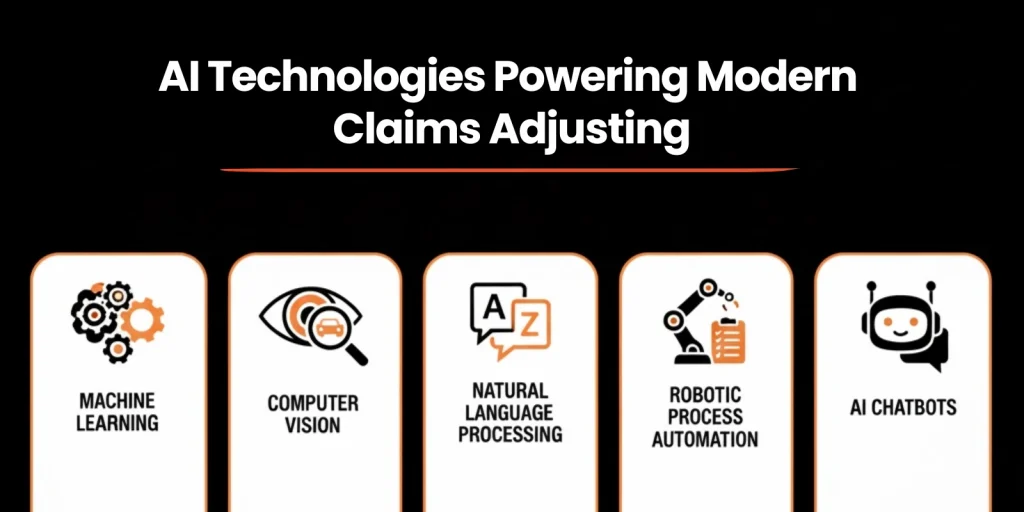
AI in claims adjustment comprises of many key technologies, some of these are mentioned below –
1. Machine Learning & Predictive Analytics
Machine learning in insurance claims works by studying past claim cases to understand what normal or risky claims look like; then checking how closely a new claim matches those patterns and giving it a score to show how safe or risky it is. Predictive analytics takes it a step further; it forecasts what is likely to happen: will the claim become complex or fraudulent?
2. Computer Vision for Damage Assessment
Automated claims adjusting systems, especially in AI claim fraud prediction, use computer vision to analyze photos and videos uploaded by policyholders. AI in insurance claims adjusting facilitates faster and more accurate loss estimation, speeding up the settlement process of claims (as is evident in the case of claims like property and vehicle claims)
3. Natural Language Processing (NLP)
Natural language processing (NLP) automates intelligent document processing. It extracts key data from unstructured sources such as policy documents and invoices. It further analyzes voice and text conversations during claim interactions, identifying sentiments, summarizing reports, and flagging anomalies.
4. Robotic Process Automation (RPA)
RPA bots in a custom insurance claims management system automate repetitive, high-volume administrative tasks. They automatically move data from incoming forms to core systems; reducing human errors and speeding up processing times.
5. AI Chatbots & Virtual Assistants
AI-powered chatbots give customers round-the-clock support by sharing instant claim updates and guiding them step-by-step through claim filing, including uploading photos, which reduces calls and makes the process faster and easier.
How AI Transforms the Claims Adjusting Workflow
Let’s have a look at how AI improves the claims adjustment workflow –
1. Automated Claim Intake & First Notice of Loss (FNOL)
AI in insurance claims adjusting automates claim intake by capturing and validating data from documents, forms, photos, etc. at the time of First Notice of Loss (FNOL). This functionality of insurance claims adjusting automation reduces manual entry errors; letting insurers to start claim processing faster, avoiding delays caused by incorrect details.
2. Intelligent Claim Assessment & Decision Support
AI in insurance claims processing analyzes claim data and damage evidence to assist adjusters in making error-free decisions. Automated claims adjusting system applies the learned patterns and the same rules to every claims ensuring that evaluations are consistent, fair, and standardized.
3. Fraud Detection & Prevention
AI in insurance claims adjusting automation; detects fraud by recognizing patterns from past claims to spot suspicious or unusual behavior. It flags high-risk cases early and compares new claims with known fraud indicators. This way; insurers can prioritize investigation, focus on genuine threats, and prevent fraud before losses occur.
4. Faster Settlements & Straight-Through Processing
Automated claims adjusting system enables the auto-approval of low-risk, routine claims by comparing them against policy data automatically. This capability of AI in insurance claims adjusting reduces settlement timelines, reducing it from weeks to minutes.
5. Real-Time Communication & Transparency
AI in insurance claims adjusting keeps customers informed at every stage of their claim without them needing to call time and again. Chatbots provide instant; round-the-clock updates on claim progress so customers always know what’s happening. This removes uncertainty, builds trust, and makes the claims experience smoother and more reassuring.
Benefits of AI-Driven Claims Adjusting
AI-based claims adjustment is beneficial in ways more than one –
i. Reduced claim processing costs
AI in insurance claims adjusting automates repetitive, labor-intensive tasks like document review and data entry, thereby lowering administrative expenses. Reducing manual intervention reduces errors and overall operational cost.
ii. Improved accuracy and consistency
AI algorithms, including computer vision, analyze data and images with accuracy. They remove human errors; and ensure the consistent application of policy rules.
iii. Enhanced fraud detection capabilities
AI in insurance claims adjusting analyzes vast datasets; based on these, it identifies subtle, non-linear patterns that human adjusters might not be able to see. AI flags inconsistencies by leveraging machine learning and predictive analytics.
iv. Better customer experience and retention
AI in claims adjusting provides 24/7 support, reducing resolution times from weeks to minutes. By tracking personalized communication and more accurate settlements, insurers boost customer satisfaction scores.
v. Scalability during peak claim periods
AI systems have the capability to process and route thousands of claims instantly. As a result, insurers can manage huge spikes in events like natural disasters without hiring temporary staff. This helps prevent bottlenecks and backlogs.
vi. Higher productivity for claims adjusters
AI automates repetitive; time-consuming tasks like data entry; document review, and initial damage estimates. It also flags anomalies by verifying information.
Challenges & Considerations in AI Adoption
While deploying AI in claims adjusting, you may encounter certain challenges, like the once mentioned below –
i. Data quality and availability issues
AI in insurance claims processing requires AI models that further need large volumes of clean structured data to operate effectively. However; insurance data is often fragmented across different databases. Poor quality data leads to inaccurate predictions and biased AI outputs.
ii. Integration with legacy insurance systems.
Many insurance firms use outdated IT systems that are not designed for AI in insurance claims adjusting. To overcome this, insurers may need to update old infrastructure to support real-time, data-driven decision-making.
iii. Need for explainable and transparent AI models.
AI models in AI-based automated claims adjusting system particularly deep learning; can act as “black boxes,”; making it difficult to understand how they reach decisions. This can further lead to ethical concerns. In insurance; it is crucial to explain to customers; why a claim was denied or adjusted.
iv. Regulatory compliance and data security
Insurers must navigate strict evolving data privacy laws (like GDPR); and AI regulations when handling sensitive, personal information. AI systems must comply with security standards; to protect against data breaches while ensuring algorithms do not violate fair treatment regulations.
v. Importance of human oversight in complex cases
AI and machine learning in insurance claims might be proficient in high-volume routine tasks. However, they lack emotional context for complex or unusual claims. This is where human oversight is needed, since it ensures ethical compliance and resolves AI biases.
How A3Logics Can Help Insurers Modernize Claims Adjusting
i. Custom AI-powered claims management solution development
As an insurance software development company; A3Logics builds tailored AI solutions that automate claim intake; processing, and decision-making based on each insurer’s workflows.
ii. Intelligent damage assessment and fraud detection systems
Using computer vision and machine learning, A3Logics enables faster damage evaluation and early fraud detection by identifying anomalies and risk patterns in claims data.
iii. AI chatbots and virtual claims assistants.
As an experienced AI development company; A3Logics deploys AI chatbots that provide 24/7 claim updates; guide customers through First Notice Of Loss; and reduce call center load.
iv. Seamless integration with existing insurance platforms
Our solutions integrate smoothly with legacy systems such as; CRMs, and policy administration platforms, ensuring minimal disruption.
v. Secure, compliant, and scalable cloud architectures
A3Logics designs cloud solutions that meet industry security standards; and regulatory requirements while growing easily with increasing claim volumes.
vi. End-to-end consulting, development, and support
From strategy and design to deployment and ongoing support, A3Logics partners with insurers throughout the entire AI transformation journey.
Conclusion
AI and machine learning are transforming claims management by automating routine tasks; such as document processing and initial damage assessment, which significantly reduces settlement times. By using predictive analytics to identify risks early, AI provides 24/7 service that enhances customer satisfaction.
However, adoption requires addressing challenges like data security, legacy system integration, and regulatory compliance to ensure trustworthiness and accuracy. Overcoming these, perhaps by starting with pilot projects, is essential. Ultimately, AI is the future because it transforms claims into a faster, more efficient, and user-friendly experience, making it indispensable for long-term competitiveness.