
The processing of claims is at the very core of the insurance operations. This is the test of time, whereby either the insurers will fulfill their end of the bargain, or they may lose market confidence. However, conventional methods of managing the claims are becoming tense. As the number of policyholders continues to grow, as well as digital-first customers and more complex products, insurers are under more operational strain than ever. This is where Insurance claims processing automation is coming out as a strategic focus and not a technological upgrade.
According to Precendence Research, the global AI in insurance market size is accounted at $10.82 billion. The market is expected to grow at a significant CAGR of 32.21% to achieve the valuation of $176.5 billion by the end of 2035. Let’s have a look how AI and insurance are fixing the biggest challenges in the insurance industry.
Understanding Traditional Claim Processing
The old system of traditional insurance activities depended on manual and formal procedures that contain numerous handoffs, documents verification, and approval levels. The traditional claim processes used to be initiated through notification of claims before the invention of Insurance claims processing automation, the traditional claim workflow used to be initiated by receiving the claims, gathering documents, validating claims, investigating claims, and finally, settlement. Although this formal method makes sure that there is compliance in procedures, it may not always be agile and real-time.
In the traditional models, manual intervention is a major factor. The claims adjusters examine documents, check policy particulars, and consult with customers and arrange with the third parties like surveyors or hospitals. The systems are frequently backed up by legacy systems which are siloed and do not allow free sharing of data across different departments. This leads to delays, repetitive data entry and an increase in error rates by the insurers. In the absence of in-built AI-powered claims processing, the decision-making process is to a large extent reliant on human efforts and rule-based systems.
The constraints of the conventional claim management models are becoming more pronounced. The insurers struggle to scale because of the long processing length, varied customer experiences and increased operational expenses. In addition, the low level of analytics can prevent fraud detection and performance optimization. In the modern competitive environment, these inefficiencies reveal the pressing necessity to transform the claims management process to increase its automation.
Key Challenges in Insurance Claim Processing
1. Manual and Paper-Based Workflows
Several insurers continue to use manual documentation, hardcopy and even email communication to handle claims. In case of the absence of Insurance claims processing automation, teams waste considerable time on gathering paperwork and confirming data and inputting it in various systems. Such disconnected processes reduce productivity and dependency on people. Organizations that remain on the paper-based working processes, despite the availability of emerging Claims management automation tools in the market cannot effectively scaled and satisfies current customer demands.
2. Slow Claim Settlement Cycles
Long claim settlement cycles are still considered to be one of the largest pain points of the traditional models. Approaches to manual approvals, back and forth communications and repeated validation checks slows down the results. This is because the insurers fail to speed up the decision making process due to the absence of streamlined Insurance claims processing automation frameworks. AI-powered claims processing can be extensive in reducing the turnaround time without which policyholders are typically frustrated with the long queues.
3. Data Inaccuracy and Processing Errors
Data entry in the manual system poses the danger of errors, duplications, and errors in processing. Even small errors may lead to rework, disagreements or compliance risks. In the absence of custom insurance claims management system, insurers do not have automated validation systems to guarantee consistency of data.
4. Lack of End-to-End Visibility
Separated legacy systems cannot allow real-time monitoring of claims status. Various departments are independent, which restricts the transparency of the lifecycle of claims. Without the interconnected automation of Insurance claims, management teams have difficulties extracting useful insights.
5. High Operational Costs
Manual work, monotony and long processing periods are a great contributor to the cost of operations. In the absence of Insurance claims processing automation, the insurers have to devote more human resources to routine duties.
6. Fraud Detection Limitations
Pattern recognition and sophisticated analytics are needed to identify fraud claims. The old systems are very manual in nature and therefore, the review process is time consuming and reactive. In the absence of Insurance claims processing automation, there will be inconsistency in the detection of suspicious activities.
7. Compliance and Regulatory Challenges
Insurance is a highly regulated industry; therefore, it requires strict control, proper documentation, and a clear audit trail. However, manual processes increase the risk of non-compliance because teams often fail to maintain records or report them consistently.
What Is Claims Processing Automation?

Insurance claims processing automation is the application of digital technologies, rule based engines, artificial intelligence, and workflow tools to automate and streamline the entire claims lifecycle. It eliminates manual repetitive operations and introduces automated procedures that have the ability to seize information, verify information, evaluate claims, and initiate decisions with minimum human intervention. In modern insurance, automation solutions integrate seamlessly with policy administration systems, CRM platforms, and third-party data providers. As a result, insurers create an interconnected, intelligent ecosystem that improves data flow, visibility, and operational efficiency.
The essence of automation revolutionizes the claims lifecycle. Between a first notice of loss (FNOL) and the ultimate settlement, automated systems can read information in submitted documents, check policy coverage in real time, identify inconsistencies and route cases by pre-established policies. As a result, automation removes bottlenecks caused by manual reviews and eliminates duplicated or redundant approval steps.
Intelligent automation is not merely important to perform tasks. The automation of Insurance claims is transformed into predictive and adaptive systems with the adoption of analytics and machine learning. Using AI-powered claim processing, insurers will be able to identify fraud trends, calculate risk profiles, and make data-driven decisions. In the current digital-first insurance environment, intelligent automation does not only increase operational efficiency but also improves compliance, lowers costs, and elevates customer satisfaction, in general.
How Automation Solves Claim Processing Challenges
1. Accelerated Claim Intake and Processing
Among the most visible benefits of automation in insurance claims processing, speed stands out as a critical advantage. To begin with, automated systems collect data through digital forms, emails, chatbots, and mobile applications, thereby eliminating manual hand-offs and delays. Moreover, insurance claims workflow automation automatically identifies claims and routes them to the appropriate teams based on predefined rules. As a result, insurers reduce friction points, accelerate turnaround times, ensure faster first notice of loss (FNOL) processing, and enable quicker claim settlements.
2. Improved Accuracy and Consistency
Automation in insurance claims processing minimizes the human reliance on human resource by verifying data in real time, cross checking policy details and indicating anomalies. Claims management automation will enable the insurers to impose uniform workflows and decision-making procedures that will guarantee consistency in similar cases.
3. Advanced Fraud Detection
Insurance companies are at a significant risk of fraud. Under the Insurance claims processing automation, advanced analytics and machine learning models can use past information, identify suspicious trends, and point out high-risk claims to investigate them. Using AI-powered claims processing, insurers will be able to detect anomalies in advance without having to access records manually. This enhances the fraud prevention system and helps to decrease the financial leakage.
4. Real-Time Visibility and Transparency
Through the integrated Insurance claims automation solutions the stakeholders are able to monitor claim progress, bottleneck and provide detailed reports. This openness increases the internal harmony and creates confidence with the policyholders by providing updates promptly.
5. Cost Optimization and Scalability
Automation of insurance claims processing decreases administrative overheads through automation of many repetitive tasks and also reduces human errors. Through scalable Automatized Claims management systems, insurers will be able to manage increasing claim volumes without having to correspondingly raise workforce expenses.
6. Enhanced Customer Experience
Speed, transparency and fairness are important aspects of customer satisfaction. With the use of Insurance claims processing automation, insurers will be able to offer quick approvals, notifications, and self-service. Making AI-driven claims processing can help in integration to provide personalized communication and faster resolution, which would lead to a smooth and customer-centric claims experience.
Key Technologies Driving Claims Automation
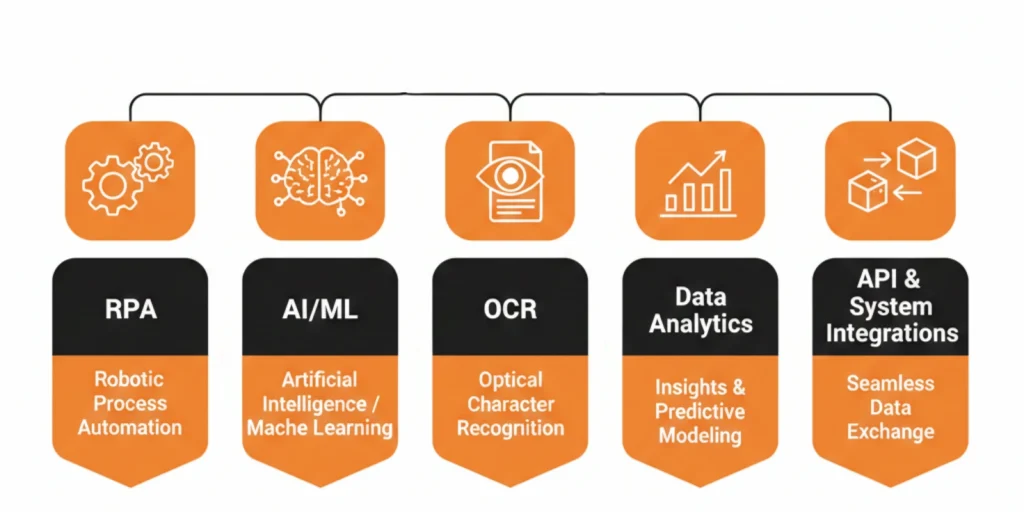
1. Robotic Process Automation (RPA)
Robotic Process Automation (RPA) involves repetitive processes that are rule-based, including data entry, claim status updates, policy verification, and document transfers between systems. In terms of Insurance claims processing automation, RPA minimizes human-facilitated work and speeds up administrative processes on a large scale. It guarantees high turnaround times and reduces errors in standard process.
2. Artificial Intelligence & Machine Learning
Claims decision-making is introduced by Artificial Intelligence (AI) and Machine Learning (ML). With the help of AI-based claims processing, the system is able to perform historical analysis, use predictions to determine the outcomes of claims, identify anomalies, and prioritize high-risk cases. These technologies also make dynamic decision support possible helping to improve fraud detection, risk assessment and automated approvals as part of larger Claims management automation systems.
3. Optical Character Recognition (OCR)
Optical Character Recognition (OCR) is used to extract structured information in scanned documents, medical bills, invoices and handwritten forms. In the Insurance claims processing automation, OCR gets rid of manual data entry by scanning unstructured documents. This highly accelerates the validation cycles and increases the accuracy of data throughout the claims workflow.
4. Data Analytics & Reporting
State-of-the-art analytics give practical insights into the trends of claims, processing durations and operational efficiency. Incorporated with Insurance claims automation solutions, data analytics will facilitate real-time dashboard, performance reporting and predictive modelling. Data-driven insights enable insurers to spot bottlenecks, streamline workflows and improve strategic decision-making.
5. API & System Integrations
APIs facilitate the smooth interchange of information between the main insurance platforms, third-party insurance software development services, and external databases. Powerful integrations make Insurance claims processing automation more robust as it will guarantee real-time data interchange and the absence of system silos. Such connectivity improves the entire Insurance claims processing automation, which provides quicker, more precise and coordinated claim processing.
Best Practices for Implementing Claims Automation
A strategic and carefully planned way is required to successfully implement Insurance claims processing automation. Although technology is an important factor, the success of implementation must be based on coordinating processes, individuals, and compliance systems. The use of the right Insurance claims automation solutions will secure long-term value and a quantitative operational change.
1. Analyze Existing Claim Workflows
Insurers need to evaluate their existing claims procedures carefully before taking it over to automation. Bottlenecks, repetitive processes, inefficiencies identification will assist in identifying areas where automation of Insurance claims processing may bring the most significant effect. Workflow analysis allows thorough analysis of workflow to make sure that automation does not make the current workflow more complex.
2. Prioritize High-Impact Automation Use Cases
Not all processes should be automatically carried out automatically. The first thing that should be undertaken by the insurers is high-volume, rule-based work which can be used to show ROI in a very short time. Introducing specific Claims management automation projects, which may include automated claim receipt or document authentication, will instill confidence and create the basis on which more comprehensive change can be initiated.
3. Ensure Smooth Integration with Legacy Systems
A large number of insurers are working on old systems that cannot be substituted in one day. An efficient Insurance claims processing automation should be able to connect with core systems via APIs and middleware. With proper integration in place, insurers eliminate data silos and strengthen overall insurance claims workflow automation. As a result, they ensure a continuous, uninterrupted workflow across systems.
4. Maintain Data Security and Regulatory Compliance
The insurance is very regulated and automation needs to ensure high level of compliance. Encryption, audit trails and role based access controls should be developed into robust Insurance claims automation solutions. This will make sure that the automated processes are safe, transparent, and in tandem with the changing regulatory factors.
5. Train Claims Teams to Work Alongside Automation
Automation does not replace human expertise; instead, it enhances it. Therefore, insurers must train claims professionals to interpret automated insights, handle exceptions, and oversee critical decisions. As a result, teams collaborate more effectively with AI-driven claims processing, which boosts both productivity and accuracy.
6. Continuously Optimize Automated Processes
Implementation does not take place at a single time. Monitoring performance measures, assessing results and optimizing processes should be a regular activity of insurers. Constant check of Insurance claims Processing automation provides scalability, adaptability and long term efficiency benefits within competitive insurance industry.
Business Impact of Claims Automation
Implementation of Insurance claims processing automation provides the quantifiable business value in the form of operation, financial, and customer experience indicators. Through the introduction of the current Insurance claims automation solutions, insurers are able to turn claims into an expensive burden into a competitive edge.
1. Faster claim settlement times
The most obvious advantages are faster settlement of claims. The automated process of data capture, validation, and routing has a greater impact on minimizing manual delays to allow faster approvals and payouts. This speed also improves efficiency, but also builds customer trust.
2. Reduced operational and administrative costs
Lower costs of operation and administration are a natural outcome. Through a simplified Claims management automation, the insurers will reduce the repetitive manual labor, reduce the error rates, and maximize the use of workforce. The effect of this is an improved cost control without affecting the quality of the service.
3. Improved fraud detection accuracy
Another essential benefit is the availability of improved accuracy in detecting fraud. By using the AI-assisted claims processing, elevated analytics serve to recognize suspicious patterns and indicate anomalies in the initial stages, which mitigates the financial leakage, and enhances the risk management capabilities.
4. Higher customer satisfaction and retention
AI in insurance brings clear communication, real-time updates, and quicker resolutions which lead to a higher customer satisfaction and retention. Automation guarantees uniform service experiences and these directly relate to brand loyalty.
5. Greater operational agility and scalability
Lastly, the higher levels of operational agility and scalability allow insurers to deal with the rising number of claims without a corresponding rise in costs. Automation in the processing of insurance claims makes organizations well equipped to respond promptly to market changes without compromising on performance.

How A3Logics Can Help Insurers Modernize Claims Processing
Off-the-shelf tools are not sufficient to make the most of Insurance claims processing automation in the modern insurers. As a leading AI development company, A3Logics plans to make insurers embrace scalable and future-proof Insurance claims automation solutions that suit their operations.
Development of Custom Claims Automation Solutions will assure that automation is consistent with the business processes, policy arrangements, and type of claims. The insurers receive custom systems, rather than generic ones created to achieve quantifiable effect.
Development of the AI-Driven Fraud Detection and Risk Scoring System will help insurers to deploy intelligent models to improve the AI-based claims processing. These systems compare behavioral patterns, history, and risk indicators to identify potential claims which are suspicious and minimize the exposure of finance.
With RPA-powered process optimization, insurers automate repetitive administrative tasks such as document validation, data entry, and claim routing. As a result, insurance claims workflow automation becomes more efficient, accurate, and consistent.
In fluent legacy system integration, insurers engineer new automation frameworks to interact seamlessly with existing policy administration and CRM applications. As a result, organizations advance digital transformation smoothly without causing operational disruption.
Lastly, a Compliance-Ready & Secure Architecture provides an assurance and innovation to the insurers in that all Insurance claims processing automation initiatives meet regulatory requirements, data privacy, and industry best practices.
Conclusion
In today’s competitive insurance environment, the speed and accuracy of claim settlements play a critical role in measuring operational efficiency and, more importantly, building customer trust.
Automation of insurance claims processing is no longer an investment in the future, it is the strategic requirement. With a smart technology and solid Insurance claims automation tools, insurers are able to save on time, minimize mistakes, enhance fraud detection and save on expenses.
More to the point, automation changes the claims process into a smooth, transparent and customer-focused process. Modern automation systems nowadays will enable organizations to grow their operations, comply with the requirements of the regulation, and ensure long-term development of business in the constantly more digitalized insurance environment.