
As organizations drive innovation, the challenges to protect their unique intellectual assets also increase. That’s where the need for intellectual property management arises. That said, in this digital era, it can be a challenge to track and secure all IP efficiently. That’s why there is a dire need for intellectual property management software, and more so, AI intellectual property management software, and here’s why –
In a legal scenario, for instance, where a law firm handling multiple patents may miss filing deadlines or lose track of patent statuses, a law firm IP management software ensures deadlines are easily tracked. Furthermore, filings can be automated, and disputes can be flagged before they are escalated.

An AI-driven intellectual property management software further adds predictive insights, helping legal teams assess risks and make smarter decisions to safeguard clients’ intellectual property.
What is Intellectual Property Management Software?
As the name suggests, an Intellectual Property Management Software is a specialized tool customized to assist organizations in safeguarding diverse intellectual properties such as works of art, patents, trademarks, copyrights, trade secrets, and more.
Intellectual Property Management Software Market – Key Statistics
- The global Enterprise Intellectual Property Management Software market size was USD 11.93 billion in 2025, and is projected to reach USD 13.36 billion in 2026.
- Strategic use cases dominated AI-enabled IP software adoption. Competitive intelligence accounted for 37% of usage, followed closely by research and discovery at 36%, and patentability and validity analysis at 35%.
- About 47% of organizations adopt AI-led IP tools.
- About 70% of large corporations use IP software to coordinate globally.

Types of Intellectual Properties Managed in Modern IP Systems
1. Patents
Patents are a form of intellectual property that grant inventors exclusive rights to their inventions, preventing others from making, using, or selling the inventions without permission for a limited time.
2. Trademarks
Trademarks are unique words, names, logos, or symbols that identify a company or brand. These are the aspects that distinguish a company’s products or services from others.
3. Copyrights
Copyright is a legal right protecting original creative works (books, art, music, software, etc), giving creators exclusive control over reproduction, distribution, adaptation, and public display.
4. Trade Secrets
Trade secrets are essential pieces of information regarding an organization’s products, processes, or services. They are not publicly shared and must be protected through careful secrecy; with disclosure only when necessary.
5. Licensing & Agreements
Licenses and agreements allow an IP owner to give others permission to use their patents, trademarks, copyrights, or trade secrets under clear rules like time, place, and payment.
Core Features of Intellectual Property Management Software
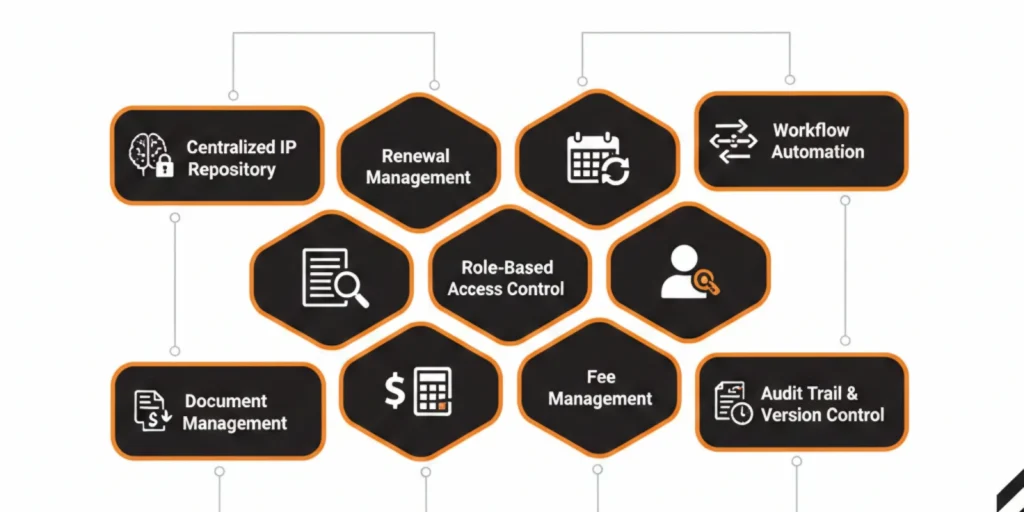
1. Centralized IP Repository
An intellectual property management software acts as a central repository for all IP assets. The software consolidates all data; statuses, and documents related to trademarks, patents, etc into a searchable and secure database.
2. Deadline & Renewal Management
Since IP rights expire or can be lost if fees or responses are missed; the legal IP management software automatically calculates deadlines, sends renewal reminders, and syncs them with calendars to prevent accidental loss of rights.
3. Workflow Automation
This feature of law firm IP management software replaces manual and repetitive tasks with automated processes. For instance, the intellectual property management software automatically alerts the staff when a deadline is approaching, or moves a patent application from drafting to filed.
4. Document Management
An AI intellectual property management software organizes; and secures all IP documents. It uses smart indexing and metadata to; categorize files by case, client, or type and ensures version control so users always access the latest document.
5. Role-Based Access Control (RBAC)
RBAC in legal IP management software preserves the confidentiality of intellectual property data, ensuring that users can only access information relevant to their role.
6. Cost & Fee Management
With the help of law firm IP management software, companies can manage intellectual property costs. With it, they can track filing and renewal fees, forecast expenses timely, and compare budgets, apart from handling invoices and ensuring accurate financial control.
7. Audit Trail & Version Control
Intellectual property management software comes with audit trail and version control. Where through audit trail, you can keep a detailed, and unchangeable log of all activities, version control helps keep a history of changes to documents. The latter also lets users view or revert to previous versions.
Advanced Features That Differentiate Enterprise IP Platforms
1. AI-Powered Prior Art Search
Intellectual property asset management software uses AI algorithms and semantic search to analyze an invention. They accordingly identify the most relevant existing patents.
2. NLP-Based Document Classification
This feature of intellectual property management software uses Natural Language Processing (NLP) to automatically categorize large volumes of patents, texts, etc based on content, subject matter and other attributes.
3. IP Portfolio Analytics
An intellectual property asset management software uses data analytics to get insights from an organization’s entire property portfolio. With this, teams can manage the overall value and importance of their intellectual property in the market.
4. Competitive Intelligence & Market Monitoring
These tools monitor emerging market trends, competitor activities, and emerging market trends. By transforming raw data into actionable intelligence; companies can anticipate competitive moves and maintain a strategic edge.
5. Global Jurisdiction Management
This feature of intellectual property asset management software helps manage the global scope and administration of intellectual property rights across different countries and regions. It takes into account patent office procedures; varying legal frameworks, and compliance requirements.
6. Automated Office Action Responses
With intellectual property management software development, there can be systems that help take action on document detailing issues with patent applications. They help draft or suggest responses.
7. Litigation Risk Assessment
A law IP management software uses predictive analytics to predict possible legal issues with a patent. To do that, it takes into account past cases, historical patent data and shows how patents might be challenged or copied.
Role of AI and Automation in Legal IP Management Software Development
AI and automation reduce manual work in legal IP systems. They help track deadlines; analyze patent data, flag risks early, and improve decision making. This makes IP handling faster – more accurate, and less error prone for teams.
A Legal Software Development Company uses AI; to build intellectual property asset management software that adapts to growing portfolios. Automation supports filings; compliance, and reporting so law firms and enterprises manage IP efficiently at scale.

Benefits of Intellectual Property Management Software
1. Centralized Control of IP Assets
Intellectual Property Management System (IPMS) stores all IP data tasks. This helps eliminate silos and teams gain access to accurate; up-to-date portfolio details that they can access from one place.
2. Reduced Risk of Missed Deadlines
Through Intellectual Property Management Software; individuals and companies can automatically track patents, trademarks, and other intellectual property. They can be reminded of renewals so that they can protect their rights and avoid costly lapses.
3. Improved Operational Efficiency
Law firm IP Management Software ensures that routine works such as docketings; filings and updates are automated.
4. Lower Legal and Administrative Costs
Through Legal AI chatbot development, systems can be created that cut manual workload and that reduce reliance on external counsel. This can save law firms and companies money that they would spend on IP upkeep.
5. Enhanced Decision-Making with Data Insights
When intellectual property disputes arise; arbitration is often preferred over court. By learning from past IP dispute outcomes; ADR software development helps parties assess risk and make smarter resolution decisions.
6. Stronger IP Compliance and Governance
One of the aspects of AI intellectual property management software is that it automatically learns and updates legal rules across different countries. Additionally; it flags compliance risks early and guides teams on necessary actions.
7. Faster Time-to-Market for Innovations
Law firm IP management software makes filing and approval of patents and trademarks faster. It helps legal teams keep track of progress and brings intellectual property to market more quickly.
8. Better Portfolio Optimization
Through Intellectual Property Management Software development; legal companies can develop systems that provide real-time status and analytics about assets. These can help identify high-value assets while pointing to low performing ones to reduce waste and maximize value.
9. Scalable Global IP Management
Cloud-based IP management platforms let law firms or companies handle more patents, trademarks, and other intellectual property as their portfolio grows. They can manage assets across different countries without needing extra servers, staff, or expensive infrastructure.
10. Enhanced Security for Sensitive IP Data
Secure storage with access controls protects confidential filings; and information from unauthorized access or breaches.
Step-by-Step IP Management Software Development Workflow
Step 1: Requirements Analysis
As in the case of legal client intake software development – developers define user needs and system goals for handling intellectual property; such as patent filing, renewal tracking, etc. tracking, etc.
Step 2: System Design
In this development step; the team designs the technical architecture and database for IP documents. They plan API integrations and map workflows, producing a complete blueprint and architectural documentation.
Step 3: UI/UX Design
This stage involves creating an intuitive, efficient interface for navigating complex IP portfolio data. Here, wireframes, prototypes, and user flows are designed that are focused on data visibility.
Step 4: Development & Integration
Developers write the code to build the Intellectual Property Management Software’s front-end; back-end, and database; so that it can handle trademarks, patents, and other intellectual property tasks. They also integrate the software with other tools – and systems such as docketing systems, patent office APIs, document management, etc.
Step 5: Testing & Validation
This phase includes conducting functional; security and usability testing to ensure that the software works as intended and without defects. At this stage, bugs are also fixed; to ensure accurate docketing deadlines.
Step 6: Deployment & Scaling
Finally, the legal IP management software is released to users. It is also ascertained that it can handle growing IP data volumes. Developers also migrate data, deploy to cloud servers and configure for scalability as the patent/ trademark portfolio grows.
Best Intellectual Property Management Software for Law Firms
1. Questel Equinox

It is a cloud-based, AI-powered Intellectual Property Management Software (IPMS) designed for law firms and corporations to manage intellectual properties like trademarks, patents, and designs. Since it is AI-powered; it streamlines IP workflows through automation. The platform boasts of 99.9%+ uptime and integrates; with patent and trademark offices and other IP services.
2. Patsnap

PatSnap is a global AI‑powered intellectual property and innovation intelligence platform used by companies and IP professionals to search, analyze, and manage patents and other IP data. It helps users find relevant patents quicker; and understand technology trends and risks.
3. Clarivate FoundationIP

Clarivate FoundationIP is a cloud-based software for law firms and IP professionals to manage patents, trademarks, copyrights, and other IP tasks in one place. It automates routine work like tracking deadlines, provides reliable data from over 300 countries, and gives easy-to-read dashboards to improve efficiency and decision-making.
4. AppColl

AppColl is a platform for law firms and corporations. It helps inventors submit ideas, attach documents, get feedback, and track progress. The PM module organizes IP portfolios and finances while allowing teams to manage budgets and forecast expenses.
Security, Compliance and Data Privacy in IP Platforms
IP data is highly sensitive. Enterprise-grade IP management software must include:
1. End-to-end Encryption
This is a secure communication feature in IP management software where only the sender and intended recipient can read messages. All IP-related data; documents, and filings are encrypted on the sender’s device and decrypted only by the recipient.
2. Role-based Access Control
RBAC ensures users access only what their role requires. It protects sensitive patents, trademarks, and trade secrets, and reduces risk from compromised accounts.
3. Audit Trails
In intellectual property management software, audit trails record every action taken on patents, trademarks, and filings. They show who edited documents, changed deadlines, or approved submissions, helping firms prove compliance and resolve disputes confidently.
4. GDPR and Regional Compliance
Intellectual property management software ensures that sensitive IP data; including patents, trademarks, and trade secrets, is stored and accessed securely. By following GDPR and other regional privacy laws, the software helps organizations protect confidential IP information and remain compliant globally.
5. Secure Backups and Disaster Recovery
Intellectual property management systems create reliable backups of all patents, trademarks, and related files. In case of system failure or disaster; they restore data quickly, ensuring that sensitive IP records remain safe and accessible without loss or interruption.
Future Trends in Legal IP Management Software Development
1. AI-driven IP Valuation
This involves using ML and AI models to analyze vast datasets, including market trends, patent documents, and financial reports, to predict the monetary value and future success of an IP asset.
2. Blockchain-based IP Ownership Tracking
Blockchain in Intellectual Property creates secure, transparent, and immutable records of ownership, creation, and licensing.
3. Smart Contracts for Licensing
Smart contracts are built on blockchain. They automatically enforce the terms of a licensing agreement when pre-defined conditions are met.
4. Generative AI for Patent Drafting
Generative AI and Large Language Models (LLMs) assist in the creation of patent applications; and related documents. These tools can draft responses to patent office actions; analyze historical cases, among other tasks.
5. Robotic Process Automation (RPA) for Workflows
RPA can automate parts of intellectual property management and patent application process. For instance; it can help in extracting information from invention forms, verifying it and automatically filing patent applications.
6. Voice & Conversational Interfaces
Conversational interfaces let IP professionals speak; or type in plain language to their management software. This makes it much easier to manage data; search for information; and perform tasks quickly and efficiently.

Why Choose A3Logics for Developing AI-driven Intellectual Property Management Software?
A3Logics, as a legal software development company; builds AI-powered IP management software that automates filings, tracks deadlines, and predicts risks; helping teams protect and grow their intellectual property effortlessly.
With our custom software development services; we create solutions tailored to your workflow, boost efficiency, ensure compliance worldwide, and turn IP data into actionable insights.
Conclusion
As companies, especially law firms, juggle complex IP rights challenges, intellectual property management software development is the need of the hour. Every business needs to protect and maximize its IP assets. The tools can streamline everything from filings, docketing, and renewals to portfolio tracking, reporting, and compliance. Partnering with; experts like A3Logics can help you unlock the full potential of AI-driven intellectual property management software.