
Speed without truth wins nothing in legal technology.
There are so many generative AI models that can draft in seconds. But when we use them for creating case laws, the results are terrible. In law, one mistake can break arguments or breach ethical lines. To solve this issue, legal professionals are opting for Retrieval-Augmented Generation legal solutions. The RAG market is already growing at a very fast rate. The RAG market is going to reach an astounding $74.5 billion by 2034, with 49.9% CAGR.
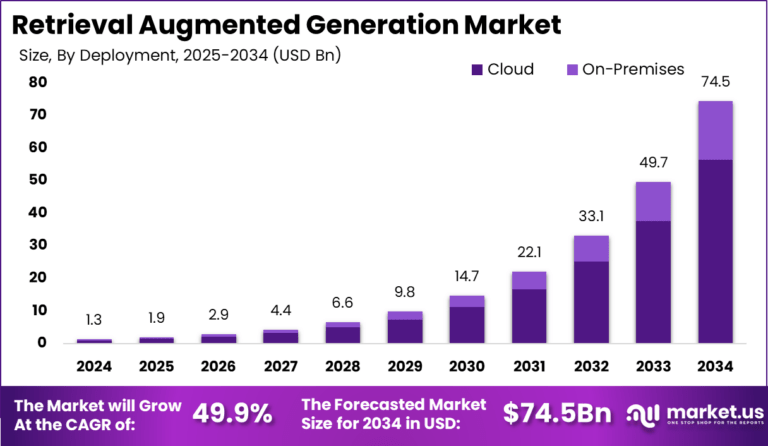
Now, real-time access to verified court documents helps AI stay accurate because it pulls from genuine cases. Instead of guessing, platforms such as Westlaw and Lexis+ AI pull directly from those sources. Lawyers using retrieval-augmented generation for law firms produce clearer drafts with fewer errors. RAG in legal settings is much more accurate compared to teams relying solely on standard large language systems.
This blog post breaks down how RAG for law firms sharpens legal searches: the inner workings, why it beats past approaches, real cases where it helps, and practical steps to put it to use. Let’s get started!
What Is Retrieval-Augmented Generation (RAG)?
RAG is an AI architecture that mimics the way human legal systems have always functioned. A RAG model is not totally reliant on the model’s pre-trained data. Instead, it first retrieves relevant pieces from a well-maintained corpus and then supplies that context to the LLM before generating text.
The method was first introduced by Facebook AI researchers in 2020 and has since been a major component of legal AI systems. By employing the Retrieval-Augmented Generation Legal methodology, attorneys get to collaborate with an AI assistant that provides real case law and statutes contextually. It considerably raises the level of factual accuracy and correctness of citations made by the base models.
How RAG Works: A Simple Breakdown for Legal Teams
1. User Query
A legal professional can kick off the process by typing a question in natural language. For example, “What are the statutory notice requirements for terminating a commercial lease in New York?”
2. Document Retrieval
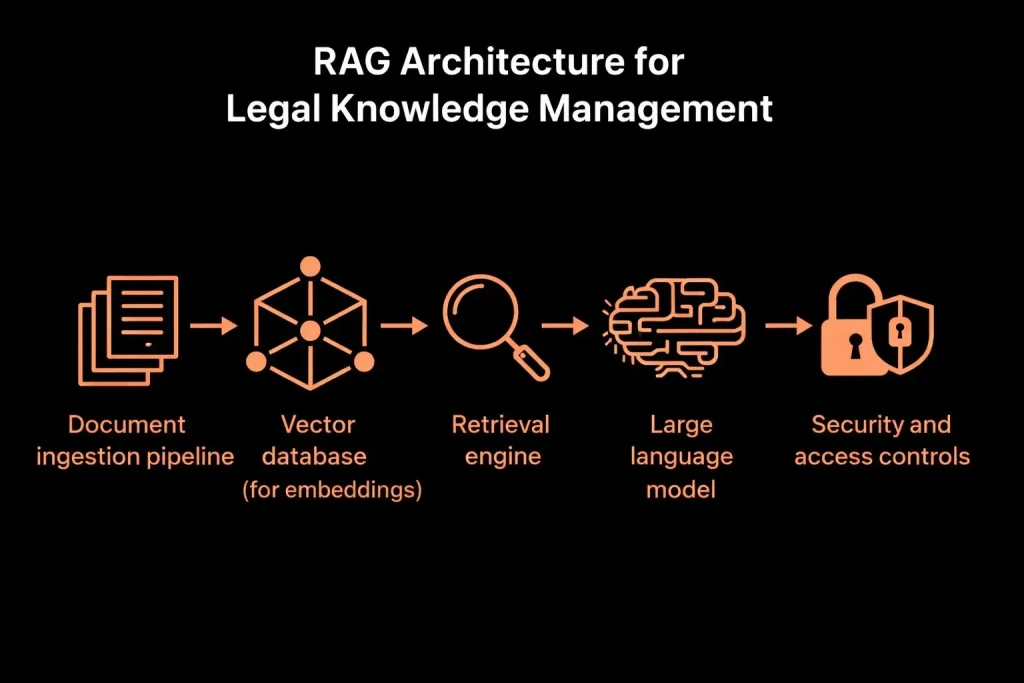
In short, the system interprets the question as a semantic embedding and then identifies the most pertinent document chunks from a vector database of legal texts. Retrieval-augmented generation for law firms systems makes use of dense embeddings to really understand the legal angle of a query. This is the reason the system is able to ensure semantic relevance instead of just matching keywords.
3. Context Injection
The retrieved documents are combined with the user’s query and put in the prompt window. So the LLM is able to provide an answer based on the injected new legal content rather than the general training data. The final answer’s correctness largely depends on the provided context.
4. Answer Generation
By using the embedded content, the LLM produces a response that features citations, summaries, and, occasionally, direct quotes from the source documentation.
RAG vs Traditional Legal Research Systems
| Feature | Traditional Legal Research | RAG-Based Systems |
| Process | Keyword or Boolean searches returning lists of documents | Automated retrieval + synthesis via LLM |
| Output | Requires human review and synthesis | Generates concise answers with cited references |
| Accuracy | High with skilled users, but prone to missed context | Grounded in documents, reducing hallucination |
| Knowledge Updates | Updated periodically by vendors | Continuously updated external databases |
| Efficiency | Time-intensive | Summarization and synthesis in seconds |
How RAG Improves Legal Search Accuracy
1. Grounded Responses
One of the chief benefits of Retrieval-Augmented Generation legal systems is grounding answers to each query in the source material. Hence, the AI “refers” to the law, the court’s decision, or the policy document when answering instead of just “guessing”.
2. Semantic Understanding
RAG in legal systems leverages dense semantic search to not only focus on keywords but also understand the legal context more profoundly. For example, the system recognizes that the phrase “termination clause” and “notice of cancellation” might be two ways of referring to the same legal concept. Such an in-depth level of consideration leads to more precise retrieval.
3. Source-Based Accuracy
In Retrieval-Augmented Generation legal systems, each output is inherently linked to its source. Hence, it becomes feasible to fact-check and even obtain legal approval. Unlike conventional LLMs that may sometimes randomly come up with wrong citations, RAG-based systems always have genuine extracts and references at the core.
4. Real-Time Knowledge Updates
Traditional AI systems have fixed knowledge cutoffs, whereas RAG for law firms uses an external database which can be updated live. So, by using a system like this, one is always in the know of the most recent laws, court rulings, and regulations.

Use Cases of RAG in Legal Research and Practice
1. Case Law Research
The primary application of RAG in the legal context is the discovery of case law. Instead of manually sifting through hundreds of results, lawyers can simply ask questions. The system finds the relevant rulings, summarizes them, cites them, and synthesizes the decisions.
2. Contract Analysis and Clause Extraction
Going through contracts to identify critical provisions is a job that requires intense labor. Retrieval augmented generation legal systems allow attorneys to first find and then analyze clauses such as “limitation of liability” or “early termination” in contracts. AI returns the clause text, highlights the discrepancies, and even identifies deviations from the standard templates of the firm.
3. Regulatory Compliance Checks
Whether it is a matter of ensuring compliance with GDPR or employment law, RAG is the one that makes the compliance review very easy. Based on an analysis of both the company’s documents and the regulations, the system produces a summary of the gaps or contradictions that have been identified. It is a significant time-saver for lawyers and reduces risk at the same time.
4. Legal Due Diligence
When two companies are merging, one company is acquiring another, or there is a legal dispute, it is very important that they carefully analyze the data that they have.
The lawyers who use RAG can easily find the risks in the data rooms, which have been indexed by asking the system questions such as “Which documents refer to the cases that have been filed but not yet decided?” or “Where are the clauses of non-standard indemnity?”. To get such a well-organized set of results manually would have taken many hours.
5. Internal Legal Knowledge Management
Over time, law firms accumulate a significant amount of memos, briefs, and opinions which, in most cases, are hardly used. Retrieval-Augmented Generation for law firms enables lawyers to use natural language to search the entire database of this institutional memory, thus getting the most relevant precedents and policy interpretations they need.
6. eDiscovery and Document Review
RAG tools are the reason for the drastic improvement of eDiscovery processes as they can find the most relevant documents and even separate the issues automatically. This kind of automation, combined with a good prioritization strategy during a massive-volume lawsuit, can guarantee optimum use of resources while simultaneously maintaining defensibility.
Benefits of RAG for Law Firms and Legal Departments
1. Faster Research
One of the biggest benefits of Retrieval-Augmented Generation for law firms is that it slashes the time lawyers spend on legal research. Instead of a lawyer or other legal workers reading line by line through multiple cases or policy documents, they are now able to get not only accurate answers but also citations within just a few seconds.
2. Higher Accuracy
Legal correctness is always at the top of the priority list. Retrieval-augmented generation legal systems get and display the exact wording of legal documents. Therefore, the answers are always the most accurate ones, with sources given that can be verified. The lawyer’s readability and the fact that the AI’s answer is not only correct but also can be ethically used is a big plus.
3. Reduced Operational Costs
Time-consuming tasks of attorneys and paralegals commonly involve legal research, contract review, as well as regulatory checks. RAG automates these processes and also ensures high-quality output. Law firms that have adopted such tools admit that they do not need to hire more staff for high-volume areas such as compliance and document review anymore.
4. Improved Client Outcomes
Clients greatly value the performance and accuracy of retrieval-augmented generation for law firms. Rapid result production and fewer mistakes result in clients being happy and having more trust.
5. Better Use of Institutional Knowledge
Law firms are repositories of a great deal of knowledge. However, most of this content is very badly indexed and therefore quite difficult to track down. RAG in legal apps allows firms to closely analyze their own document archives, hence finding and reusing old insights.
Challenges of Implementing RAG in Legal Systems
1. Data Privacy Concerns
Confidentiality of clients is non-negotiable in legal proceedings. Using Retrieval-Augmented Generation legal systems requires the implementation of very strict precautions like limited access, data encryption, and, in most cases, the use of on-premise or confidential computing environments. If RAG security settings are not properly configured, the system could unintentionally compromise professional secrecy or data protection laws.
2. Document Quality Issues
Retrieval Augmented Generation (RAG) can deliver high performance only up to the level of the documents it extracts information from. For instance, if it is provided with scanned documents that have been poorly OCR’d, inconsistent metadata, or old legal texts, the output will most likely be irrelevant or inaccurate.
3. Initial Setup Complexity
Having RAG for law firms is not really a plug-and-play solution. Essentially, a high-performance system will require indexing of legal texts, devising suitable chunking strategies, tuning vector databases, and creating effective prompt templates. Without the appropriate technical expertise, even the very first experiments can end with retrieval failure or poor synthesis.
4. Model Tuning Requirements
Pretrained LLMs do not always have sufficient understanding of the law’s nuances. Hence, fine-tuning is necessary for targeted legal tasks such as clause extraction and procedure instruction dissemination. Furthermore, prompts must be aligned with legal formats, citation rules, as well as ethical considerations.
Best Practices for Building RAG-Based Legal Search Solutions
1. Use High-Quality, Curated Legal Datasets
The law materials should be comprehensive, authoritative, and updated, forming a basis for the indexed documents. In this case, legal statutes, annotated case law, law firm memos, and guidance from regulatory bodies should be covered. To keep the results of the correct quality and relevance, internal audits should be carried out regularly.
2. Implement Strict Access Controls
Retrieval-augmented generation legal should be running in safe places with strong authentication and minimum access according to roles. To meet HIPAA, GDPR, and professional confidentiality standards, think about confidential computing solutions such as Intel TDX. It is crucial to connect with a skilled AI development company in this case.
3. Optimize Chunking Strategies for Legal Documents
RAG includes dividing docs into chunks that have semantic meaning. For example, when dealing with contracts, don’t just split the text by a fixed number of words, but by clause, article, or logical section. To maintain the context, add an overlap and keep testing the retrieval performance with the help of actual legal queries.
4. Regularly Update Indexed Content
Legal corpora need to be updated constantly. You should create automated pipelines for the collection of new laws, court decisions, or regulations and for the re-indexing of documents. Retrieval-augmented generation legal tools, unlike pre-trained LLMs, can deal with changes without the need for retraining. It is a big operational advantage.
5. Fine-Tune Prompts for Legal-Specific Queries
Prompts should be made in such a way that the AI will give legally compliant answers. Examples: “Cite your sources with page numbers,” or “Answer only based on the documents retrieved.” Prompt engineering is the main driver of both output quality and the level of legal conformance.
Future of Legal Research with Retrieval-Augmented Generation
1. Shift from Searching to Understanding
Traditional systems give a list of information that needs to be interpreted later. Retrieval-augmented generation in legal systems provides answers, explanations, and human-like reasoning that summarize the returned information. In a way, it makes human interpretation of the results largely redundant. Lawyers only need to look at the AI summary, check it, and that’s it.
2. Shift from Reading to Interpreting
RAG changes the way lawyers interact with legal materials. They are no longer required to go through entire judgments or documents; rather, they can check the AI summary and the associated source workflows. Not only does it accelerate the pace of work, but it also gives them the opportunity to attend to more matters.
3. Shift from Guessing to Verifying
As each RAG system-produced item can be linked to a real source text, lawyers become more inclined towards fact-checking rather than simply trusting the cases they handle. This corresponds to the requirement for human supervision of AI in legal practice. With the appearance of Agentic RAG tools, verification being a central aspect of the workflow will become standard practice.

Why Choose A3Logics for Building RAG-Based Legal Search Solutions?
At A3Logics, we bring over 20 years of experience delivering enterprise-grade solutions. We specialize in law firm software development services that address the complexities of modern legal workflows. Our secure, scalable systems are designed to meet the rigorous demands of the legal sector.
With proven expertise in AI for Legal Research, we build tailored RAG architectures that optimize chunking, embedding, and retrieval across contracts, memos, and regulations. From encrypted infrastructure to fine-tuned legal LLMs, we ensure accuracy, compliance, and long-term performance through continuous updates and expert support.
Conclusion
Retrieval-augmented generation legal systems are a significant leap forward in the way legal practitioners can locate and utilize information. By integrating retrieval with generation, RAG tools offer quick yet factually correct responses. Unlike typical research tools or standard chatbots, RAG gives law-specific, citation-supported insights that meet legal norms.
However, a major difference comes from deliberate execution. Clean data, a high level of security, and domain expertise are mandatory. At A3Logics, we understand what’s at stake. If your team is exploring modernizing your legal workflows, we’re here to help.
Let’s build something that truly works for your practice.