Deep learning frameworks are used by researchers, companies, and app developers to teach computers how to recognize patterns in aspects like speech, images, and text. PyTorch vs. TensorFlow are two of the popular frameworks known for building and training deep learning models that power AI applications.
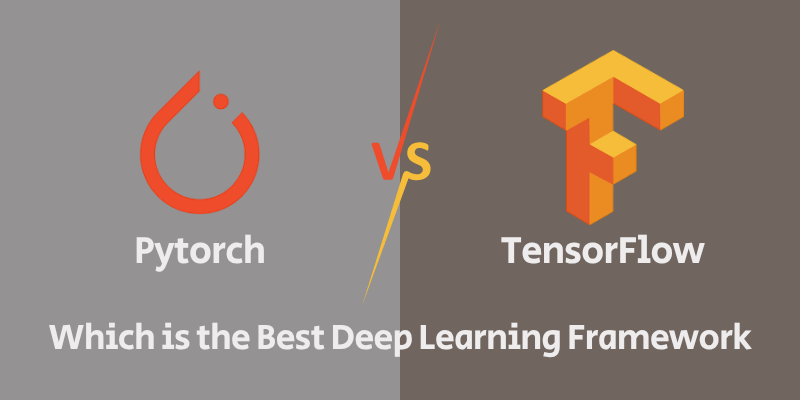
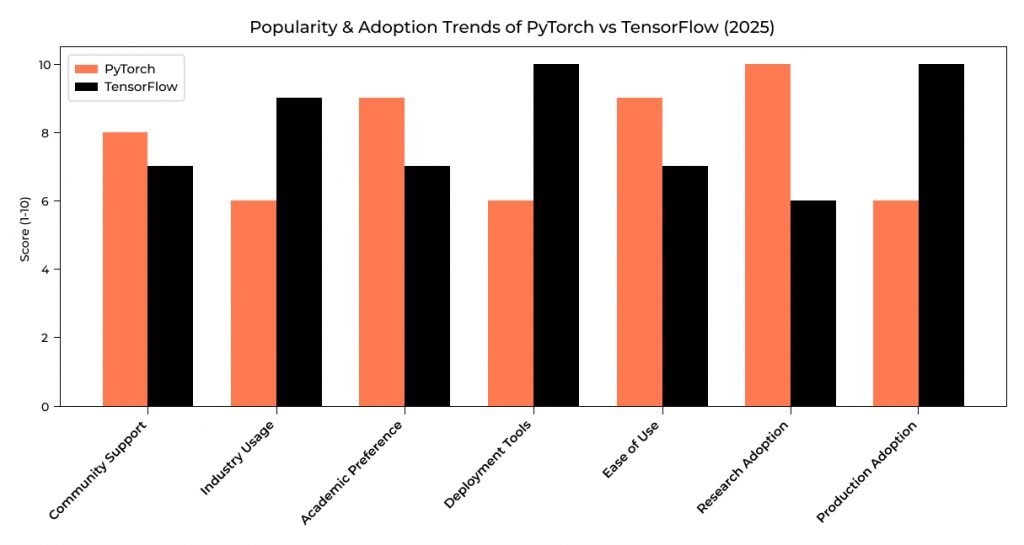
As for industrial adoption, TenSorFlow has a considerable market share in production environments, accounting for 38% as compared to PyTorch, with 23% share.
Where the TensorFlow AI agent framework offers a powerful and mature deep learning library, strong visualization capability, and various other options for high-level model development, the PyTorch AI agent framework is more Python-friendly and is recommended for research-oriented developers. It also offers strong community support.
In this post we’ll study both the frameworks head-to-head – PyTorch Vs TensorFlow so that you can choose the right project to build your AI projects faster.
What is PyTorch?
PyTorch is an open-source machine learning (ML) and deep learning framework based on Python. It is known for its ease of use and flexibility. It is ideal for prototyping, research, and dynamic projects.
Key features
1. Pythonic Nature
PyTorch is deeply integrated with Python, making it accessible and intuitive for Python programmers. It utilizes Python to make the coding experience more natural.
2. Dynamic Computational Graph
This feature is known as Autograd and lets you build flexible neural networks. It dynamically adjusts to updates and changes during the learning process.
3. Extensive Libraries and Tools
PyTorch offers a comprehensive ecosystem for deep learning, including libraries for natural language processing (TorchText) and computer vision (TorchVision).
4. Strong Industry and Community Support
PyTorch is backed by Meta, and it continuously evolves, thanks to contributions from both industry professionals and academic researchers. It is also backed by a vibrant community.
5. GPU acceleration support
PyTorch efficiently utilizes GPU hardware acceleration, making it well-suited for high-performance model research and training.
Key Libraries
One of the differences between PyTorch vs Tensor Flow is that PyTorch provides a wide array of libraries to facilitate the development of a deep learning framework. Let’s delve deeper into some of the key PyTorch libraries –
1. torch
This is the core library that provides fundamental functionalities like automatic differentiation, tensor operations, and neural network modules.
2. torch.nn
Contains classes and modules for including layers, building neural networks, loss, and activation functions.
3. torch.optim
Offers various optimization algorithms, including RMSprop, SGD, and Adam.
4. torchvision
Focuses on providing datasets, computer vision tasks, image transformations, and model architectures.
5. torchaudio
Designed for offering functionalities for transformations, audio I/O, audio processing tasks, and model architectures.
6. torchtext
Provides tools for natural processing tasks, including tokenizers, datasets, and text processing capabilities.
7. torch.library
This is a collection of APIs for extending PyTorch’s core library of operators.
8. torch.utils.data
Provides utilities for preprocessing and data loading, including Dataset and DataLoader.
9. PyTorch Geometric
A library for deep learning on irregular input data such as point clouds, graphs, and manifolds.
What is TensorFlow?
TensorFlow AI agent framework is an end-to-end open-source machine learning framework developed by Google Brain. It can be used to develop models for various tasks, including image recognition, natural language processing, handwriting recognition, and different computational-based simulations such as partial differential equations.
Advantages
Here are some of the notable TensorFlow Pros –
1. Support and Library Management
One of the TensorFlow pros is that it is backed by Google and often releases new features. One of the differences between TensorFlow vs. Pytorch is that TensorFlow is popularly used in production environments.
2. Data Visualization
Another TensorFlow pros is that TensorFlow provides a tool called TensorBoard that helps visualize data graphically. It reduces the effort of reviewing the entire code, allows for easy debugging of nodes, and effectively resolves the neural network.
3. Scalability
Scalability is yet another TensorFlow pros. This implies it is not limited to one specific device. The library is so well-defined that it works well on all complex devices as well as complex machines.
4. Better Data Visualization
TensorFlow has better data visualization compared to any other library. This aspect makes it easier to work on neural networks.
5. Keras Friendly
One of the key advantages of TensorFlow is its high compatibility with Keras. It allows users to code with high-level functionality. Keras provides system-specific functionality to TensorFlow, such as estimators, pipelining, and eager execution.
Disadvantages
While TensorFlow is advantageous as it streamlines the development of ML models, it also comes with some disadvantages.
1. Too Many Frequent Updates
One of the TensorFlow cons is that it undergoes frequent updates, every 2-3 months. This increases the overhead for a user to install it and cross-integrate it with the existing system.
2. Inconsistency
This is one of the major TensorFlow cons. It contains homonyms as names of its contents, which makes it difficult for a user to remember and use. For instance, tn.nn.conv2d, tf.nn.convolution, tf.layers.conv2d have varying meanings, and this may lead to inconsistency in usage.
3. Dependency
We don’t negate the fact that TensorFlow reduces the size of the program and makes it user-friendly; every code in the TensorFlow AI agent framework is dependent on a platform for execution.
4. Architectural Limitation
The TPU architecture of TensorFlow doesn’t allow its training and only allows execution of models.
5. Limited GPU Support
TensorFlow only has Python support for GPU programming and NVIDIA support for GPUs. It has limited GPU support because of several factors, such as compatibility, hardware requirements, and the specific API used for GPU interaction.
Key Features
Here are some of the key features of the TensorFlow deep learning framework –
1. Open Source
TensorFlow machine learning library is entirely open source; anybody can use it and introduce interesting things to the community.
2. Flexible
Offers easy modularity and flexible operations. Users can create some of the parts. standalone.
3. Large Community
TensorFlow has a large community of software engineers who work continuously for stability improvements.
4. TensorBoard
It extends visualization and tooling required for ML experimentation.
5. Responsive Construct
As opposed to SciKit or Numpy, users are able to visualize every aspect of a graph.
6. Visualizer
The visualizer in TensorFlow shows a convolutional network for classifying images.
7. Parallel Neural Network Training
What makes the models very efficient on large-scale systems is that TensorFlow offers pipelining in the sense that you can train multiple GPUs and multiple neural networks.
PyTorch vs TensorFlow: Key Differences
The way these models execute code is a distinctive point in PyTorch vs TensorFlow. To begin with, both frameworks work on Tensor, which is a fundamental data type.
The next PyTorch Vs TensorFlow aspect is data parallelism, where PyTorch optimizes performance by leveraging native support for asynchronous execution from Python. In contrast, TensorFlow requires manual coding and fine-tuning of every operation to be run on a specific device.
Let’s dive into more differentiating PyTorch vs TensorFlow points using a comparison table –
| Feature | PyTorch | TensorFlow |
| Ease of Use | Easy to debug as it contains more Pythonic syntax. | TensorFlow has a steeper learning curve that requires more boilerplate code. |
| Based on Library | It was made using Torch Library. | Developed on Theano, a Python-based library. |
| GPU Support | Multi-GPU support is easier to set up and use in PyTorch. | Multi-GPU support proves to be complex and requires a complex setup. |
| Ecosystem | Offers fewer tools and libraries as compared to TensorFlow. | Has an extensive library of prebuilt tools and models. |
| Community Support | Consists of a newer community that is growing at a fast pace. | Large and active community withVast resources. |
| Dynamic Computation Graph | The graph is easier to modify during runtime. | The static computation graph in TensorFlow requires recompilation for changes |
| Debugging | Easier to debug due to dynamic computation graphs and Pythonic syntax. | Debugging can be challenging because of static computation graphs. |
| Research | More apt for research due to the flexibility of use. | More suitable for production applications because of scalability and speed. |
| Math Library | Uses NumPy for numerical calculations and TorchScript for tensor manipulation. | Uses math library for both numerical computations and tensor manipulation. |
| Keras Integration | No native Keras integration. | Native Keras integration for simplified training and model building. |

Use Cases and Real World Applications
Both deep learning models – TensorFlow and PyTorch play an important role in bringing artificial intelligence into real-world applications. These deep learning frameworks power many of the tools we use daily. Let’s explore some practical examples where these models make a real-life impact –
PyTorch
- CheXNet
Utilizes deep learning and conducts radiologist-level pneumonia detection of chest X-rays.
- Toyota
Has implemented PyTorch in handling real-world use cases like video processing for autonomous vehicles.
- Pyro
It is a scalable, flexible, and deep probabilistic programming library built on PyTorch. It enables users to create complex probabilistic models, scale to large datasets, and perform Bayesian inference.
- Airbnb’s Dialogue Assistant
Demonstrates PyTorch’s applicability in service enhancement and customer interaction, leveraging its neural machine translation capabilities.
TensorFlow
- Speech Recognition
TensorFlow powers voice search in applications like virtual assistants.
- Autonomous Vehicles
TensorFlow plays an important role in enabling self-driving cars by making driving decisions and processing sensor data.
- Coca-Cola
Uses TensorFlow for product code recognition.
- Anomaly Detection
TensorFlow is used for identifying unusual patterns in data, such as sensor readings and network traffic.
Tools & Libraries Comparison
When considering PyTorch Vs TensorFlow, take into account the number of tools you want
Both PyTorch and TensorFlow come with an extensive set of tools and libraries that enhance development, deployment of models, and training. However, there is a slight difference in their ecosystem.
TensorFlow has a more extensive ecosystem. It has tools that support every stage of the ML lifecycle. Let’s have a look at some of the notable tools –
| Name of The Tool | Description |
| TensorFlow Lite | A lighter version that is used for mobile and embedded devices. |
| TensorBorad | It’s a visualization tool used for tracking and analyzing model performance. |
| TensorFlow Serving | A library for serving machine learning models in production |
| TensorFlow Hub | It is a repository that contains reusable machine learning models. |
PyTorch has a growing ecosystem, but still lags behind TensorFlow. Here are some of the notable tools –
| Name of The Tool | Description |
| TorchNext | This library handles NLP tasks and text data. |
| TorchVision | It is a package for offering datasets, computer vision tasks, transformation, and models. |
| PyTorch Lighning | This is an interface for PyTorch that helps reduce boilerplate. |
| ONNX | PyTorch can export models ONNX format that allows interoperability between frameworks and deployment in other systems. |
How To Choose Between PyTorch Vs TensorFlow?
First, and foremost, it’s important to decide what you want to build – If your aim s to experiment with new AI models as a student or researcher, PyTorch is a better choice since it is easy to debug, simple to write, and feels more like regular Python.
On the other hand, if your goal is to build full-scale apps that will reach thousands or millions of people, TensorFlow is usually a better pick. Tools like TensorFlow Lite and TensorFlow Serving make it easy to deploy models on the web, mobile, and even IoT devices.
PyTorch vs TensorFlow – What To Choose For Your Dream Project?
Choosing the right models is key for building successful deep learning frameworks. That’s where expert guidance comes into play.
A3Logics is a leading AI agent development company that helps businesses make the right choice between frameworks based on their project goals. We have years of hands-on experience in crafting powerful deep learning models that solve real-world problems.
From research-level experiments to production-grade apps, we know the pulse of each of these frameworks and know when to use TensorFlow for scalability and PyTorch for flexibility.

Conclusion
Deep learning is shaping the future of technology, but with so many frameworks available, it can get confusing for anyone planning an AI project. PyTorch and TensorFlow are two of the biggest names in this space. Knowing their strengths helps businesses save time, effort, and money while building powerful AI development solutions. Choosing the right one depends entirely on what you want to build and where you want to take it.
From the blog, we learned that each PyTorch and TensorFlow have unique strengths. PyTorch is flexible and Python-friendly, ideal for research and experimentation with dynamic computation graphs. TensorFlow is more mature, scalable, and better suited for production with static computation graphs and powerful visualization tools like TensorBoard. Both have extensive libraries and real-world applications, from self-driving cars to voice recognition. Choosing between them depends on the project’s goals—PyTorch for flexibility and quick prototyping, TensorFlow for large-scale deployment and optimized performance.