Currently, the business environment is highly regulated, and organizations have to deal with a wide range of issues related to compliance with changing laws, industry standards, and governance requirements. Doing business in compliance with the law is not feasible when done manually by a business due to the sheer number, complexity, and frequency of regulatory changes. The use of legal compliance management software infused with artificial intelligence is revolutionizing how businesses manage compliance, reduce risk, and maintain operational transparency.
Enterprises of today are quickly turning to AI in their legal compliance management to help them automate the monitoring of regulations, improve the accuracy of their compliance activities, and strengthen their governance structures. AI-driven legal compliance management software combines advanced analytics, automation, and intelligent data processing and thus, allows organizations in the compliance arena to transit from being reactive to proactive with their risk management activities.
This article discusses the working of AI for legal compliance management systems, the main use cases, business benefits, implementation methodologies, and future trends, thus helping organizations understand why intelligent compliance solutions are gradually becoming a must-have.
What Is AI-Powered Legal Compliance Management Software?
AI powered legal compliance management software still serves the same purpose as a traditional one but is more advanced, using artificial intelligence technologies to automate, monitor, and optimize compliance processes. Through it, enterprises can easily trace regulatory requirements, evaluate risks, manage policies, and create audit, ready documentation instantly.
In contrast with a traditional tool which depends on predetermined rule sets and manual inputs, an AI powered legal compliance management system is a system that constantly learns from data, adjusts to regulatory changes easily, and offers smart suggestions. It seamlessly combines legal compliance and risk management with everyday business activities, thereby making sure there is consistency and responsibility.
The AI, powered legal compliance management software sector is booming with the worldwide market forecasted to hit $19. 3 billion by 2033, growing at a CAGR of more than 29%.
They also operate the governance, risk, and compliance (GRC) strategies and at the same time allow the organizations to meet their legal obligations effectively not only department wise but also across different locations.
Core Technologies Behind AI-Based Compliance Management Systems
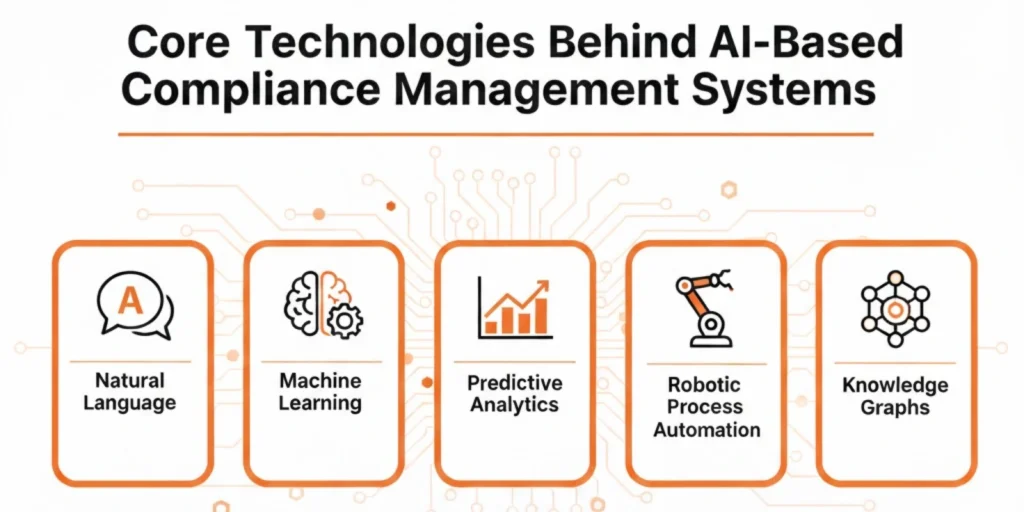
1. Natural Language Processing (NLP)
NLP allows a legal compliance management system to scan through, understand, and analyze legal documents, laws, contracts, and policy papers. It can pull out the main duties; find the relevant parts, and point out compliance gaps from unstructured materials.
2. Machine Learning (ML)
ML algorithms review past compliance data, audit reports, and risk incidents to detect trends. ML models become more accurate in risk prediction and decision making processes are getting automated as a result of time, learning, and experience.
3. Predictive Analytics
Legal Predictive Analytics combines historical and on the spot data to predict possible compliance violations, regulatory risks, and audit failures. This helps the company to implement the necessary preventive measures before they get into trouble.
4. Robotic Process Automation (RPA)
RPA is capable of automating monotonous tasks i. e. document checking, updating the report, gathering the pieces of evidence, and submitting regulatory forms. This not only helps to lessen the amount of manual work but also raises the level of operational efficiency.
5. Knowledge Graphs & Rule Engines
Knowledge graphs illustrate the connections among different regulations, policies, controls, and business processes. Rule engines use compliance rules to make sure that legal requirements are enforced consistently throughout the whole organization.
Key Challenges in Legal Compliance That AI Solves Effectively
1. Managing Regulatory Complexity and Frequent Changes
Across different industries and jurisdictions, regulations undergo changes quite often. Tracking these changes manually becomes a challenge. AI legal compliance management software can keep an eye on regulatory changes in real time and modify compliance frameworks automatically.
2. Manual and Time-Consuming Compliance Processes
Most traditional legal compliance management systems are based on spreadsheets, emails, and manual reviews. With AI, workflows can be automated thus reducing the need for human intervention.
3. Lack of Real-Time Compliance Visibility
Since there are no centralized dashboards, companies are not aware of the compliance status. AI for legal compliance management gives real time updates and notifications.
4. Identifying and Mitigating Compliance Risks
By getting behavioral, operational, and transactional data; AI first detects risks and then suggests ways of getting rid of them.
5. Handling Large Volumes of Compliance Data
Contemporary enterprises produce enormous amounts of data related to compliance. AI is capable of processing both structured and unstructured data sets – on a large scale very efficiently.
6. Ensuring Policy Adherence Throughout the Organization
AI will keep an eye on – employees’ actions, workflows, and documentation to make sure that policies are uniformly adhered to.
7. Audit Preparation and Regulatory Reporting
AI automates the gathering of evidence, generation of reports, and documentation thus making audits not only quicker but also more precise.
8. Multi-Jurisdiction and Global Compliance Management
Global businesses need to comply with a wide range of local laws. AI-powered legal compliance management software can integrate multi-country compliance necessities into a single platform.
9. Low Precision and Human Mistakes
Hand operated processes tend to be fraught with mistakes and inconsistencies. AI raises the level of correctness by means of standardized decision making.
Top Use Cases of AI-Powered Legal Compliance Management Software
AI usage among legal professionals is already significant; with 47% utilising it in 2024 and the figure expected to exceed 60% by 2026. Here are some of its top use cases.
1. Regulatory Change Management
Artificial intelligence continuously scours regulatory agencies, legal portals and government documents. It is capable of locating relevant changes, determining their impact and even carrying out necessary updates of compliance policies automatically.
2. Automated Risk Assessment & Scoring
By examining operational, financial, and legal data; AI-based legal compliance and risk management is able to generate up- to, date risk scores. These scores are utilized to identify the riskiest spots and figure out where to allocate compliance resources for maximum impact.
3. Policy & Contract Compliance Monitoring
By reviewing contracts, agreements, and company policies – AI ensures their compliance with regulatory standards. It notifies of any deviations and offers the right solution to the problem.
4. Audit Readiness & Continuous Compliance
Rather than preparing only when an audit is scheduled; AI enables a company to stay compliant at all times. It ensures that all documentation and evidence are always audit ready.
5. Third, Party & Vendor Compliance
AI in Legal Practice Management monitors supplier certifications, contractual obligations, and regulatory compliance. This helps to reduce the risk associated with third party relationships.
6. Fraud Detection & Anomaly Identification
ML algorithms detect: irregular transactions, alteration of documents a:nd suspicious behavior patterns. As a result, the level of fraud prevention is greatly improved.
AI Compliance Software vs Traditional Compliance Tools
| Feature | AI Compliance Software | Traditional Tools |
| Regulatory Monitoring | Automated, real-time | Manual updates |
| Risk Assessment | Predictive & dynamic | Static scoring |
| Data Processing | Handles big data | Limited capacity |
| Accuracy | High, standardized | Human-dependent |
| Scalability | Highly scalable | Resource-intensive |
| Reporting | Automated | Manual preparation |
| Adaptability | Self-learning | Rigid rules |
Real-World Business Benefits of AI-Powered Legal Compliance Software
i. Curtail Compliance Expenditures by Means of Automation
AI supported legal compliance management software solutions are capable of automating monotonous and time consuming tasks such as: document review, regulatory reporting, and regulatory tracking resulting in a complete operational cost cut down. Thus, there is less human labor involved and consequently fewer errors and rework, hence the administrative overhead is lowered even further. The companies thus are able to deploy the saved resources into more productive and strategic functions and simultaneously uphold the compliance standards.
ii. Minimize the Risk of Regulatory Non-Compliance and Penalties
Thanks to vigilant monitoring and smart risk detection, organizations have the ability to detect and resolve compliance issues on time before they grow out of control. AI powered devices analyze data, detect irregularities, and provide the violators with the early warning signals.
iii. Quicker Adaptation to Regulatory Changes
AI based solutions keep an eye on the regulatory changes all the time and, without human intervention, apply the new rules to the current processes. This gives the organization the power to rapidly and accurately make necessary changes in policies. Besides that, quick adjustments help to keep the compliance levels, avert the disruption of operations, and thus guarantee continuous compliance with the changing legal requirements of different jurisdictions.
iv. Improved Transparency and Accountability
Centralized dashboards, automated audit trails, and detailed decision logs provide increased transparency into compliance activities. Stakeholders can always see who is responsible for what, who has given an approval, and what has been done to correct deviations. This openness helps the company stay internally well, governed, makes it easier to handle audits, and extends the culture of accountability to every corner of the organization.
v. Scalable Compliance for Global Operations
AI compliance systems are capable of supporting multi, language, multi, region, and multi, regulatory environments. They can be used by organizations to handle a variety of legal requirements on one single platform. Such scalability is the key to businesses being able to operate internationally without their compliance matters getting too complicated. In addition, the businesses can maintain uniform standards at all the locations where they operate.
vi. Stronger Governance and Stakeholder Trust
Good and consistent compliance ensures good corporate governance and builds good relationships between the corporation and regulators, investors, and other stakeholders. Systems that are AI powered are the ones that will be used to show the regulators that the company is committed to operating ethically and to fulfilling its regulatory responsibilities. In the long run, such a scenario works like a positive cycle, it increases a company’s brand credibility, thus getting more investor confidence, and eventually, the company’s good reputation is secured.
Implementation Strategy: How to Adopt AI Compliance Software Successfully
A smart rollout includes:
i. Clear Compliance Goals
Define business objectives, regulatory priorities, and expected outcomes before implementation.
ii. Data Readiness Assessment
Ensure data quality, accessibility, and integration readiness across departments.
iii. Integration with Existing Systems
Connect the compliance platform with ERP, CRM, HR, and document management systems.
iv. Pilot Programs and Phased Adoption
Start with limited deployments to validate performance and refine workflows.
v. Training Legal and Compliance Teams
Equip teams with skills to interpret AI insights and manage automated processes.
vi. Continuous Optimization
Regularly update models, workflows, and governance frameworks to maximize ROI.
Custom vs Off-the-Shelf Legal Compliance Software: What Should You Choose?
Off- the shelf solutions enable quicker deployment and come with lower initial costs, however, they offer limited personalization. They are suitable for small or medium organizations having standard compliance needs.
On the other hand, the development of tailor made legal compliance management software gives you custom, made workflows, features specific to industry, and deeper integration of the system. Large enterprises with complex regulatory environments, in general, gain more from customized platforms that are developed by an experienced Law Firm Software Development Company and specialized AI Development Services provider.
The decision depends on the complexity of the regulations, the budget, the need for scalability, and the long, term digital strategy.
The Future of Legal Compliance Management Software: Trends to Watch
i. Shift from Reactive to Continuous Compliance
More and more organizations are ditching periodic, checklist, based audits and instead adopting continuous compliance monitoring. Real time, AI, powered systems track both regulatory requirements and activities within the company, which makes it possible to spot risks very early. As a result, this change decreases last minute fixes, raises consistency, and facilitates compliance management that is proactive, rather than reactive, throughout the business operations.
ii. Advanced Predictive and Prescriptive Analytics
The compliance platforms transitioning to the future will not only be able to identify risks but also to suggest proper actions. Forecasting potential violations by using predictive analytics based on historical data, while prescriptive analytics will provide the best possible solution to the problem. Having such a tool at one’s disposal will enable them to deal with compliance shortcomings more efficiently and to make wiser decisions based on the information obtained.
iii. Greater Use of Generative AI in Compliance
In the compliance area, generative AI will increasingly be utilized to produce clear regulatory summaries. Additionally, it will be used to support the drafting of internal policies with greater accuracy. Moreover, complex legal-level requirements will be explained more clearly through these AI-driven tools. As a result, fewer documentation tasks will be performed manually across compliance teams. Consequently, improved consistency and uniformity will be achieved throughout compliance processes.
By making content generation automatic, companies have the ability to fast track their compliance endeavors and also enhance the exchange of knowledge among the members within their teams.
iv. Association with Enterprise GRC and Legal Tech Ecosystems
Compliance platforms will be collaborating more and more with enterprise governance, risk, and compliance systems, contract management tools, and litigation technologies. The combination of such solutions as AI powered litigation software, AI in legal practice management, and legal predictive analytics will make it possible to have single workflows and comprehensive risk oversight both at the legal and operational levels.
v. Explainable and Transparent AI for Compliance Decisions
To facilitate compliance management, AI will have to be explainable. Explainable AI models demonstrate to what extent systems base their decisions on particular information and how they come up with certain recommendations. This enhances the regulatory acceptance, meets the audit requirements and thus, stakeholder trust is established as the accountability and interpretability of automated compliance processes are ensured.
Why A3Logics Is the Right Partner for AI-Powered Legal Compliance Management Software Development
A3Logics delivers comprehensive legal compliance management software solutions tailored to modern regulatory environments. With expertise in AI, data engineering, and enterprise integration, A3Logics helps organizations build secure, scalable, and compliant systems.
Key Strengths Include:
- Custom AI and ML model development
- Advanced compliance automation
- Secure cloud and on-premise deployment
- Regulatory-ready architectures
- Ongoing optimization and support
By partnering with A3Logics, businesses can modernize compliance operations while ensuring long-term regulatory resilience.
Conclusion
AI based Legal compliance management software is changing the face of how organizations handle their regulatory obligations. These platforms – which blend automation, predictive analytics, and intelligent workflows; diminish risks, heighten accuracy, and increase operational efficiency.
Businesses that employ smart compliance systems will outperform their rivals as regulations keep changing. They can expect to have better control, be more transparent, and grow sustainably in a complicated legal landscape.
Implementing AI based compliance measures is not just a choice anymore it is a smart move for organizations looking to be prepared for the future.