
Innovation speeds up, and so does the rush to defend it.
When IP assets are key to competitive advantage, managing them manually is a serious handicap. Hence, it causes missed deadlines, lack of visibility, and disruptive workflows that endanger the most valuable patents. As the size and complexity of portfolios increase, companies require systems that not only track assets but also help in making smarter decisions.
Different companies require solutions that bring data together, automate processes, and are flexible enough to be used across various jurisdictions. Modern IP portfolio management software does exactly that. It integrates isolated IP operations and transforms them into a unified, strategic business function.
The worldwide IP Management Software Market is expected to grow to $20.75 billion by 2032. Tech, pharma, law, and manufacturing companies are finding that IP portfolio management software is a fundamental requirement for managing high-value innovation at scale.
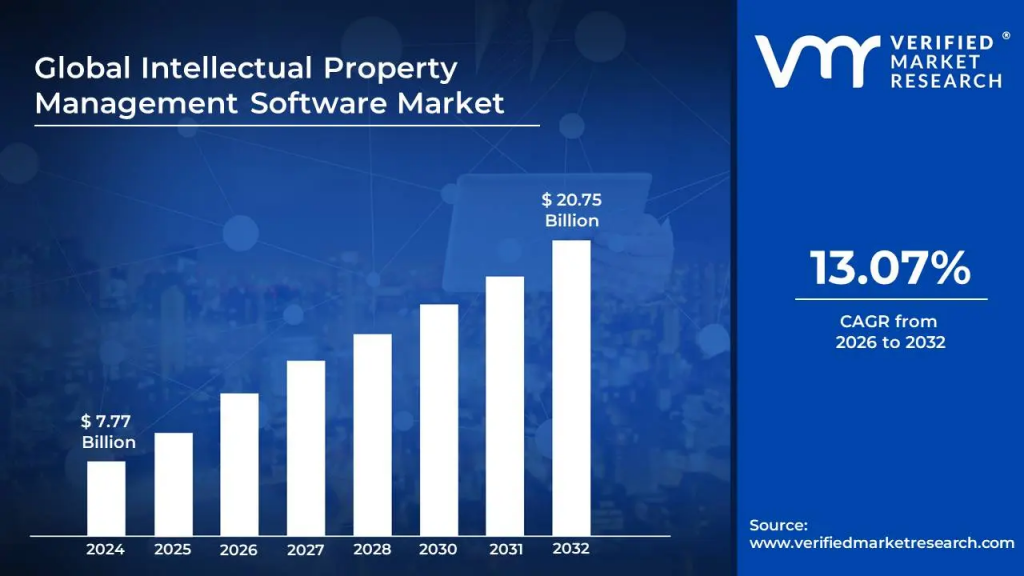
With the growth in volume of portfolios, manual tracking doesn’t ensure compliance or return on investment. Today’s platforms and AI automation offer a comprehensive control center for filings, renewals, analytics, portfolio performance, and risk management.
In this blog we will discuss the software architecture, major features, and industry case studies of top IP management software, primarily focusing on practical applications. So, let’s dive right in!
What Is IP Portfolio Management Software?

IP portfolio management software represents a class of specialized digital platforms that are designed to centralize, keep track and manage the lifecycle of IP assets. These assets are patents, trademarks, copyrights, and trade secrets. Rather than just simple docketing systems, these software programs integrate data from various jurisdictions worldwide and provide analytics features as well.
Instead of keeping renewal schedules in spreadsheet files, these programs will send you instant notifications, allow you to customize your dashboards and invite your executive team members for collaborative work. Through having all their IP in one central place, companies are able to see clearly, lower their exposure to the risks, and tailor the ways of IP protection to their business needs.
Core Components of IP Portfolio Management Software Architecture
1. Presentation Layer (User Interface & UX)
The presentation layer features role-based dashboards that are customized for the different roles of IP professionals. Among them are patent attorneys, patent paralegals, R&D heads, and top management. The dashboards provide intuitive access to the statuses of filings, schedules of renewals, the overall health of the portfolios, and patent analytics.
2. Application Layer (Business Logic & Workflow Engine)
This layer contains the main business logic and IP workflows like automated docketing, renewal alerts, approval hierarchies, and AI modules. The application layer allows internal processes and external regulations to be followed. Besides, it is the place where AI features are utilized for novelty search, portfolio scoring, and risk analysis which are key functions in the next-gen AI for IP portfolio management.
3. Data Layer (IP Databases & Repositories)
At the core of advanced legal IP portfolio management software lies a centrally hosted database of IP. This layer is a place where you can find a collection of filing records, legal status update information, and inventor metadata and document archives from different jurisdictions in one place. Partnerships with USPTO, EPO, JPO, and WIPO help to synchronize the patent statuses in real-time. Graph databases allow patent family consolidation and full-text search functionality.
4. Integration Layer (APIs & Third-Party Systems)
On this layer, uninterrupted data exchange is facilitated between the IP Portfolio Management Software and the different enterprise systems around it. Whatever the system is – contract lifecycle management, ERP, or CRM, strong APIs and pre-built connectors guarantee interoperability of the whole ecosystem.
5. Security & Compliance Layer
They prevent data leaks through encryption of data at rest and in transit, SOC 2 Type II compliance, audit trails, and MFA. Role-based access control limits access only to those employees who need particular IP assets to fulfill their work.
Cloud-Based vs On-Premise IP Portfolio Management Systems

With a few exceptions, the vast majority of deployments today are cloud-based because of their scalability, price, and speed of implementation. The service providers grant storage when you need it, providing easy and almost unlimited access as well as auto backup. Top vendors offer cloud-native architectures to implement integrations, security audits, and AI module updates.
On the other hand, companies that have very sensitive IP (e.g., in the defense or pharmaceutical industry) might still prefer on-premises systems for reasons of control over the infrastructure and data locality. Although such solutions allow more profound customization, they also generate more costs of infrastructure and support. For law firms and manufacturers that are considering these trade-offs, a hybrid deployment model can often be the best solution.
Key Features of Modern IP Portfolio Management Software
1. Centralized IP Asset Repository
Modern IP portfolio management software centralizes all IP assets into a single source of truth across global teams and companies. The repository enables cross-functional teams to see the entire IP landscape in one place.
2. Automated Deadline and Renewal Tracking
Without human intervention, the system monitors key dates and sends warnings at multiple intervals (e.g., 6 months, 30 days). It significantly reduces the risk of missed deadlines by eliminating manual tracking. Especially in IP portfolio management for law firm, this helps avoid client liability and reputational damage that can occur when deadlines are missed.
3. Multi-Jurisdiction Support
The software supports legal filings in more than 100 IP offices, including USPTO, EPO, CNIPA, and JPO. The legal status of an asset, its renewal, and relevant rules are derived automatically based on jurisdiction. For enterprises and law firms handling filings in the United States, Europe, and Asia, this is highly beneficial.
4. Portfolio Analytics and Reporting
Internal data analytics systems monitor a business’ filings by geography, expenses associated with the assets, renewal costs, and citation strength. AI-powered IP portfolio management software development provides functionalities such as dashboard creation, whitespace analysis, and patent clustering. Some systems can also compare portfolios with competitors, thus uncovering licensing opportunities.
5. Role-Based Dashboards
Personalized dashboards guarantee that each user gets the relevant metrics and tasks. While the legal teams have sight of deadline queues and client portfolios, the executives obtain views of high-value patent clusters and strategic risks. Such a modular view helps keep compliance and productivity, especially in situations that require specifically designed legal IP portfolio management software interfaces.
6. Collaboration Tools for Legal Teams
Today’s platforms feature in-platform messaging, annotation, shared workspaces, and task commenting. In the context of IP portfolio management for law firm setting, this allows attorneys and docketing clerks to be in sync regarding deadlines and strategies. The tools also connect with Outlook, Google Workspace, and legal DMS platforms to make communication easier.
Advanced Workflow Automation for IP Lifecycle Management
1. Auto-Triggering Tasks Based on IP Events
The system automatically generates tasks as soon as an office action is received or the patent application status changes from “pending” to “granted.” For example, a patent grant may initiate entries such as maintenance fee payments, recording of assignments, and notifications to inventors. This is a valuable feature when scaling IP portfolio management software development for high-volume portfolios.
2. Sending Alerts for Renewals and Filings
Notifications may be set in advance and adjusted according to jurisdiction, asset type, or user role. For instance, the trademark department may be notified at 12, 6, and 1 month pre-renewal. AI components help determine the most suitable renewal strategy based on the past value of the asset. This is an application of AI for IP portfolio management that supports cost efficiency.
3. Managing Approvals Across Teams
Workflow engines route invention disclosures through IP committees, and at each stage, the committee members digitally sign off. The person(s) responsible for approving the next step receive a notification either by email or through in-platform prompts. The record of all actions is saved to the file, which serves as an audit trail. This helps clients using legal software development services build custom compliance workflows.
4. Standardizing IP Processes Globally
Automated workflows help global organizations present the same processes across their various locations. Whether the process is patent filing intake or trademark clearance, standard templates, approval chains, and filing rules are enforced. This leads to a reduction in human errors and greater compliance in cross-border IP operations.

AI Use Cases in IP Portfolio Management Software
1. AI-Powered Patent Search & Prior Art Analysis
One of the major innovations driven by AI for IP portfolio management is semantic patent search and prior art detection. In contrast to simple keyword-based searches, AI systems rely on ML models trained on millions of patent records to perform contextual analysis.
2. Predictive IP Risk Assessment
AI-powered tools evaluate the risk of patent infringement or challenges by analyzing relationships between citations and the history of lawsuits. This risk-prediction feature enables legal and IP strategists to maintain a competitive edge. IP portfolio management software in the hands of a law firm harnesses predictive IP scoring to lower exposure to post-grant contests.
3. AI-Based Portfolio Valuation & Scoring
AI systems combine various data points, such as the number of citations, family size, relevance of the technical field, and market adoption, to score patents. These models are used to recognize the assets a company should retain for strategic growth and those that can be discarded. This is helpful for clients using legal IP portfolio management software for audits or preparing their portfolios for M&A or licensing.
4. Smart Renewal & Deadline Management
AI models can propose the best renewal strategies by evaluating the performance of the asset and the business relevance. The system, instead of renewing all patents in the same way, points out underperforming assets or recommends bundling the high-performing ones for licensing. This capability to optimize costs is highly significant in IP portfolio management for law firm practices that are managing diverse client portfolios.
5. Competitive Intelligence & Patent Landscaping
With the help of AI-powered landscape analysis, one can portray the technology clusters, white spaces, and competitor activity. For instance, AI can spot the overloading of a particular technology class or monitor the patent coverage expansion by rivals. In fact, it directs R&D to the right investment and helps the general counsel or IP heads in making filing decisions.
Industry Use Cases Across Legal, Pharma, Tech & Manufacturing
1. Legal Firms
IP portfolio management for law firm has huge amounts of data to handle. The use of renewal tracking and collaboration dashboards helps firms cut down on manual effort and risk. SOC 2-compliant platforms guarantee confidentiality and secure workflows. Besides, AI for IP portfolio management opens the way to premium services such as competitive analysis and infringement alerts.
2. Pharma
Pharmaceutical companies rely on IP portfolio management software to establish and follow product-to-patent relationships and to keep track of global expiration timelines. Since revenue mainly comes from exclusivity, IP visibility becomes indispensable. It involves tailoring intellectual property management software development to pharma compliance workflows.
3. Technology Companies
Tech companies cannot do without stable platforms to get their IP in line with rapidly changing innovation cycles. AI modules detect white space as well as filing strategies for new kinds of inventions such as generative AI or quantum computing.
4. Manufacturing
Manufacturers who hold big patent portfolios typically employ IP portfolio management software to oversee renewals, handle design registrations, and integrate IP with PLM tools. Such integrations bring the legal and engineering teams in line. The legal IP portfolio management software should be able to facilitate multi-country compliance, CAD linkage, and cost forecasting.
How to Choose the Right IP Portfolio Management Software?
1. Scalable Architecture
Without the performance getting worse, the platform should be able to support thousands of assets and users. Cloud-native systems with microservices-based architecture are the best choice for worldwide deployments.
2. AI-Driven Analytics
Make sure the supplier has well-developed domain-specific AI functionalities. For example, applications based on machine learning trained on patent data provide far better output than generic ones. AI for IP portfolio management solutions should at least comprise patent scoring, risk assessment, and intelligent search features.
3. Integration Capabilities
The platform should be able to work together with different document management systems, CRM, billing, and regulatory data sources. The vendors that come with flexible APIs or those that can provide custom integrations through legal software development services are more likely to satisfy enterprise needs.
4. Strong Security Framework
Verify that the software complies with enterprise standards such as SOC 2 Type II, ISO 27001, and data encryption. Role-based access and audit logs are notably crucial for platforms that manage IP portfolio management for law firm operations.
5. Vendor Expertise in IP Law
Select vendors or development partners with rich domain experience. Grasping the IP lifecycle, litigation risk, and industry-specific requirements is core. Whether it’s legal client intake software development or analytics tools, domain knowledge guarantees relevant features and compliance.
Future Trends in IP Portfolio Management Technology
1. Generative AI for IP Strategy Planning
Generative AI models are expected to aid in drafting patent claims and running simulations for IP strategies more and more. These models need to be thoroughly trained to be very specific to the field and to be safe from hallucination-related risks. Probably, their use in IP portfolio management software will be a common thing within five years.
2. Blockchain-Based IP Records
Distributed ledgers may work like a clock for the filing of documents and a system for automatically granting licenses through smart contracts. Despite being a nascent technology, blockchain has the potential to provide an unalterable record of IP ownership. Such abilities are probably going to be part of the next generation of IP portfolio management software development.
3. Predictive Litigation Analytics
Artificial intelligence (AI) systems that can scrutinize case law and forecast the risk of litigation will turn into features that are baked in. With the help of these tools, companies can take a look at their potential liability in advance, and if necessary, they can modify their enforcement strategies.
4. Voice-Enabled IP Search
Natural Language Processing combined with voice technology could facilitate hands-free interaction with the IP portfolio; e.g., one might ask voice assistants, “Which are our pending applications in Europe?” These innovations are consistent with the growing popularity of conversational AI and enhanced accessibility.
Why Choose A3Logics for Developing AI-Powered IP Portfolio Management Software?
A3Logics brings over 20 years of experience in enterprise-grade IP portfolio management software development. With deep expertise in legal workflows and cybersecurity, we build tailored platforms for law firms, pharma companies, and global enterprises.
Our team delivers secure, scalable systems with AI modules for search, risk analysis, and valuation. As a law firm software development company, we understand the demands of legal operations, from multi-jurisdiction compliance to SOC 2 protection.
Clients choose us for our strong domain knowledge and advanced tech capabilities. Whether you are building a custom platform or embedding AI, A3Logics is your strategic partner in digital transformation.

Conclusion
Managing IP requires more than just keeping a calendar and sending renewal reminders. It involves strategic control, automation, and AI-driven analytics. By using IP portfolio management software tools, companies can gather their IP assets in one place, simplify compliance processes, and discover the value of their portfolio.
We acknowledge that your IP challenges are unique to your organization, whether it’s going global, staying compliant, or using AI for portfolio decisions. For over 20 years, we have worked with legal and enterprise teams to create solutions that fit their unique workflows.
If you’re exploring how to bring clarity and intelligence to your IP operations, our team at A3Logics is here to help.