




































Claim Fraud Prediction for Insurance Carrier

Detect suspicious insurance claims earlier with AI-powered fraud prediction.

Analyze historical and real-time claims data using intelligent machine learning.

Identify hidden fraud patterns before they create unnecessary payout leakage.

Prioritize high-risk claims and accelerate evidence-based investigation decisions.

Trusted By Global Leaders

Proven Expertise, Globally Accredited

AWS Advanced Consulting Partner
Microsoft Gold Partner (Data & AI)
Google Cloud Premier Partner
ISO 27001 Information Security Certified
SOC 2 Type II Compliant
500+
Projects Delivered
21+
Years Experience
91%
Repeat Clients
350+
Tech Experts

AI-Powered Claim Fraud Prediction

Insurance fraud becomes harder to identify as claims volumes increase.

Organized fraud networks continuously adopt more sophisticated operating patterns.

Static rules often recognize known fraud but miss emerging behavior.

AI-driven fraud prediction enables earlier, evidence-based risk identification.

Real-Time Fraud Detection

Real-Time Fraud Detection

Fraud analysis can begin during First Notice of Loss.

  • Models evaluate available claim information before investigations move downstream.
  • Historical and real-time data strengthen early fraud identification.
  • Potentially suspicious claims receive immediate risk signals for review.
  • Early intervention helps prevent fraud before claim payouts occur.

Intelligent Risk Scoring

Intelligent Risk Scoring

Machine learning evaluates fraud likelihood across individual insurance claims.

  • Risk scores help separate higher-risk claims from cleaner submissions.
  • Claims teams can prioritize investigations using model-backed risk indicators.
  • Bulk scoring supports efficient analysis across larger claim portfolios.
  • CSV-based workflows can evaluate many claims within one process.
Advanced Fraud Intelligence

Advanced Fraud Intelligence

Models uncover patterns beyond traditional static business rules.

  • Behavioral anomalies can indicate suspicious claimant or transaction activity.
  • Network analysis can identify relationships between connected fraudulent entities.
  • Document analysis extends detection into invoices and medical bills.
  • Models adapt as fraud techniques and claim behaviors evolve.
Data-Driven Investigations

Data-Driven Investigations

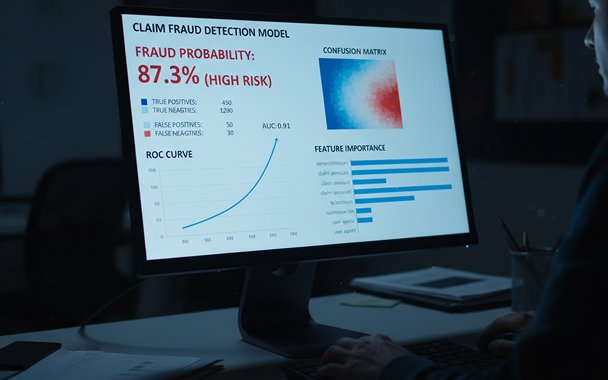
Interactive dashboards provide clear fraud probability information.

  • Claims teams receive actionable recommendations alongside model-generated scores.
  • Investigators can validate anomalies before committing broader investigation resources.
  • High-risk claims move toward specialist review more efficiently.
  • Lower-risk claims can continue through cleaner processing workflows.
Connected Claims Workflows

Connected Claims Workflows

Fraud models integrate with existing claims management environments.

  • Secure APIs support real-time and near-real-time fraud scoring.
  • Event-driven pipelines connect intelligence with operational claims processes.
  • SIU tools can consume prioritized fraud information directly.
  • CRM and workflow platforms can receive fraud decision signals.
Continuous Model Improvement

Continuous Model Improvement

Fraud performance requires monitoring after production deployment.

  • Data drift monitoring identifies meaningful changes in incoming information.
  • Prediction stability tracking identifies changes in model behavior.
  • Performance benchmarks help teams evaluate effectiveness over time.
  • Controlled retraining keeps models aligned with changing fraud patterns.

Why Choose A3Logics for Fraud Prediction?

Combine insurance expertise with intelligent fraud prediction capabilities. Deploy explainable AI across connected claims investigation workflows.
  • Deep insurance domain expertise for claim fraud prediction
  • Strong data engineering and governed MLOps foundations
  • Explainable and compliant AI fraud prediction models
  • Seamless integration with existing claims management workflows
  • Real-time, near-real-time, and batch fraud scoring
  • Custom machine learning models aligned with business rules
  • Cloud, hybrid, and on-premise deployment support
  • Model monitoring and retraining for evolving fraud patterns
350+
CERTIFIED ENGINEERS & EXPERTS

AI Fraud Prediction Technical Capabilities

Apply machine learning across the complete fraud prediction lifecycle. Detect suspicious activity earlier using connected claims intelligence. Prioritize investigations through explainable, data-backed fraud risk scoring. Continuously monitor models as fraud patterns and behaviors evolve.

Fraud Detection

Detect potentially fraudulent claims during intake and adjudication. Combine historical patterns with current claims information.

  • Real-Time DetectionAnalyze claims during FNOL before downstream settlement activities. Enable earlier fraud intervention and investigation prioritization.
  • Pattern DetectionUse machine learning to uncover hidden fraudulent claim patterns. Detect behaviors static rule-based systems may overlook.
  • Risk ScoringAssign dynamic fraud scores across incoming insurance claims. Prioritize high-risk cases for focused investigation activity.
  • Fraud DashboardsMonitor fraud probabilities through interactive operational dashboards. Support claims teams with model-backed decision information.

Risk Intelligence

Evaluate fraud likelihood across individual and bulk claim portfolios. Give investigators actionable insights for faster claims decisions.

  • Individual ScoringEvaluate one claim using relevant fraud risk indicators. Return clear fraud likelihood for focused case review.
  • Bulk AnalysisScore multiple insurance claims through CSV-based processing. Accelerate fraud analysis across larger claims portfolios.
  • Risk PrioritizationIdentify high-risk and medium-risk claims for investigation. Focus specialist resources where fraud exposure appears strongest.
  • Actionable InsightsProvide model-backed recommendations with each risk assessment. Help teams validate anomalies using supporting fraud intelligence.

Data Engineering

Build dependable data foundations for accurate fraud prediction. Prepare claims information for scalable AI model processing.

  • Secure IngestionSupport secure batch and streaming claims data ingestion. Feed fraud models with reliable operational information.
  • Data CleansingNormalize incoming claims information before model processing. Improve consistency across different insurance data sources.
  • Feature EngineeringCreate and enrich predictive features from claims information. Strengthen model signals used for fraud identification.
  • Data LineageTrack data quality, lineage, and processing dependencies. Improve reliability and governance across fraud analytics workflows.

Claims Integration

Connect fraud intelligence with existing insurance technology environments. Embed risk scoring directly inside operational claims workflows.

  • Claims SystemsIntegrate models with core claims management platforms. Deliver fraud scores where claims teams already work.
  • SIU ToolsConnect prioritized risk information with investigation systems. Help SIU teams focus on potentially fraudulent claims.
  • Data PlatformsIntegrate with data warehouses and enterprise data lakes. Use centralized claims information for predictive fraud analysis.
  • Workflow PlatformsConnect CRM and workflow platforms through secure APIs. Automate fraud signals across broader claims operations.

Model Operations

Maintain reliable fraud models after production deployment.
Monitor changing patterns through governed MLOps processes.

  • Drift DetectionMonitor changes across incoming data and model features. Identify conditions requiring additional model evaluation.
  • Stability MonitoringTrack prediction stability throughout ongoing production usage. Detect unexpected shifts in fraud scoring behavior.
  • Performance BenchmarkingMeasure model performance consistently across changing claim patterns. Support informed decisions about future model improvements.
  • Model RetrainingRetrain models when defined drift thresholds are exceeded. Maintain alignment with emerging insurance fraud behavior.

Advanced Detection

Extend fraud prediction beyond structured claims information. Identify suspicious documents, behaviors, and connected entities.

  • Document FraudAnalyze suspicious invoices, bills, and supporting documentation. Extend fraud detection into document-based claim evidence.
  • Behavioral AnomaliesIdentify unusual behavior across claimant and transaction patterns. Surface fraud indicators beyond predefined business rules.
  • Network AnalysisAnalyze relationships between entities involved in insurance claims. Expose potentially organized or connected fraud activity.
  • Hybrid DecisionsCombine machine learning, business rules, and manual overrides. Align fraud decisions with internal investigation policies.
Technology Stack

Cloud and AI Fraud Technology Stack

Deploy fraud prediction using scalable AI and cloud technologies. Support real-time scoring, data engineering, and governed model operations.

AWS SageMaker

Supports machine learning development and deployment for fraud prediction.

Amazon Redshift

Supports analytics across structured enterprise insurance datasets.

Amazon S3

Stores scalable datasets used across model and analytics workflows.

Azure Machine Learning

Supports model training, deployment, and lifecycle management.

Azure Synapse

Supports integrated analytics across enterprise claims information.

Google Vertex AI

Supports development and deployment of machine learning models.

Google BigQuery

Enables scalable analytics across large insurance data volumes.

Machine Learning Analyzes claims information and predicts potential insurance fraud risk.

Semi-Supervised Learning

Supports model development where historical fraud labels remain limited.

Predictive Risk Scoring Ranks claims using model-generated fraud likelihood information.

Feature Engineering

Creates enriched variables supporting more accurate fraud predictions.

MLOps Governs model deployment, monitoring, retraining, and lifecycle management.

Drift Detection Identifies changes affecting production fraud prediction model performance.

Behavioral Anomaly Detection Finds unusual claimant and transaction patterns associated with fraud.

Network Analysis Evaluates connected entities and relationships across claims activity.

AI Governance & Compliance

Explainable and Compliant Fraud Prediction

Fraud prediction requires secure data processing and governed AI models. A3Logics supports explainable models, secure integration, and model monitoring. Controlled MLOps strengthens traceability across evolving fraud prediction workflows.

Intelligent Claim Fraud Prediction Solutions

Deploy AI fraud intelligence across claims intake and investigations. Support earlier detection, prioritization, and evidence-based operational decisions.

Fraud Scoring

Predict fraud likelihood across individual insurance claims in real time. Prioritize suspicious submissions before unnecessary payouts occur.

  • Real-time scoring
  • FNOL detection
  • Risk ranking
  • Fraud probability
  • Early intervention
  • Claims prioritization
Fraud Scoring

Risk Dashboard

Give claims teams visual fraud scores and actionable recommendations. Support rapid assessment of high-risk and medium-risk claims.

  • Fraud meter
  • Risk visualization
  • Actionable insights
  • Investigation support
  • Priority alerts
  • Decision guidance
Risk Dashboard

Bulk Analysis

Evaluate multiple claims efficiently through portfolio-level fraud scoring. Support large investigation workloads using structured bulk processing.

  • CSV uploads
  • Bulk scoring
  • Portfolio analysis
  • Risk segmentation
  • Faster review
  • Claims filtering
Bulk Analysis

Data Engineering

Create dependable data pipelines supporting production fraud prediction. Prepare insurance data for scalable machine learning workflows.

  • Secure ingestion
  • Data cleansing
  • Feature enrichment
  • Feature stores
  • Quality checks
  • Data lineage
Data Engineering

Claims Integration

Embed AI fraud intelligence within existing insurer technology environments. Connect scores directly to operational claims and investigation workflows.

  • Claims systems
  • SIU integration
  • Secure APIs
  • Event pipelines
  • CRM integration
  • Workflow automation
Claims Integration

Model Monitoring

Continuously evaluate deployed fraud models and changing data patterns. Maintain reliable predictions through controlled MLOps processes.

  • Drift detection
  • Stability monitoring
  • Performance benchmarks
  • Model retraining
  • MLOps governance
  • Lifecycle control
Model Monitoring

Advanced Detection

Expand fraud analysis beyond standard structured claims information. Identify suspicious documents, behaviors, and connected entities.

  • Document fraud
  • Behavioral anomalies
  • Network analysis
  • Entity relationships
  • Pattern discovery
  • Adaptive models
Advanced Detection
Testimonials

Trusted Partnerships Built on Proven Expertise

Their distinct flexibility and their strong communication were the project’s main assets.
Zuben Mathews
Co-Founder & CEO - Brigit
Their software has proven essential in the construction sector.
Alexander Le Roux
Co-Founder & CTO - ICON
They ensured our collaboration went well by providing timely items and responding quickly to our requests.
David Cusatis
Co-Founder & CTO - Range
Their technical expertise and reactivity were excellent.
Arjan Verbeek
Co-Founder & CEO - Perenna
The collaborative team we’ve worked with has shown great flexibility and excellent project integration.
Peter Foley
Founder & CEO - Let’s Get Checked
Their thorough inquiry and engagement with our team reflect their commitment to understanding our requirements.
Denise Varga
Operations Manager - Lime

Are Tech Deficiencies Slowing Down Your Operations?

Fill out the form below to connect with our senior solution architects, receive a transparent project scoping breakdown, and accelerate your commercial engineering initiatives.

Share Your Project's Vision

    • In just 2 mins you will get a response

    • Your idea is 100% protected by our Non Disclosure Agreement

    FAQ

    Frequently asked questions

    An AI-driven claim fraud prediction model uses machine learning to analyze claim, policy, behavioral, and historical data to identify potentially fraudulent claims early—often before payout—helping insurers reduce loss leakage and improve investigation efficiency.

    What types of insurance claims can the fraud model support?

    Our models support multiple insurance lines including:

    Each model is customized based on business line and fraud patterns.

    What data is required to build a fraud prediction model?

    The model typically requires the following datasets:

    We can also build models with limited labels using semi-supervised learning techniques.

    How do you handle data engineering for fraud prediction?

    We design a robust data engineering layer that includes:

    This ensures scalability, reliability, and model accuracy.

    How long does it take to develop and deploy the fraud model?

    Development timelines vary depending on scope and data readiness:

    Prototype quickly and scale safely with governed MLOps pipelines.

    Can the model score claims in real time?

    Yes, we support multiple scoring approaches:

    This allows fraud intervention before claim payout.

    How does the model integrate with existing claims systems?

    We integrate seamlessly with:

    Integration is handled via secure APIs or event-driven pipelines.

    Which cloud platforms do you support?

    Our solutions support leading cloud platforms:

    On-premise and hybrid deployments are also supported.

    How do you manage model monitoring and drift?

    We continuously monitor model performance through:

    Models are retrained when drift thresholds are exceeded.

    How often does the fraud model need retraining?

    Retraining is typically done:

    This process is governed through controlled MLOps pipelines.

    Can the fraud model be customized for our business rules?

    Yes, we combine:

    This ensures alignment with internal fraud policies.

    How does AI fraud prediction improve SIU efficiency?

    AI prioritizes claims by risk, enabling SIU teams to:

    This leads to higher productivity and better outcomes.

    Can fraud prediction be extended to documents and behavior?

    Yes, we support advanced fraud detection including:

    These capabilities enhance fraud detection coverage.

    How is AI fraud prediction different from rule-based systems?

    Rule-based systems detect known fraud patterns, whereas AI models continuously learn, identify hidden anomalies, and adapt to evolving fraud behaviors—providing significantly broader and more accurate coverage.

    What makes your fraud prediction services different?

    Our fraud prediction services stand out due to:

    An AI-driven claim fraud prediction model uses machine learning to analyze claim, policy, behavioral, and historical data to identify potentially fraudulent claims early—often before payout—helping insurers reduce loss leakage and improve investigation efficiency.

    Our models support multiple insurance lines including:

    What data is required to build a fraud prediction model?

    We can also build models with limited labels using semi-supervised learning techniques.

    We design a robust data engineering layer that includes:

    How long does it take to develop and deploy the fraud model?

    Prototype quickly and scale safely with governed MLOps pipelines.

    Yes, we support multiple scoring approaches:

    How does the model integrate with existing claims systems?

    Integration is handled via secure APIs or event-driven pipelines.

    Our solutions support leading cloud platforms:

    How do you manage model monitoring and drift?

    Models are retrained when drift thresholds are exceeded.

    Retraining is typically done:

    Can the fraud model be customized for our business rules?

    This ensures alignment with internal fraud policies.

    AI prioritizes claims by risk, enabling SIU teams to:

    Can fraud prediction be extended to documents and behavior?

    These capabilities enhance fraud detection coverage.

    Rule-based systems detect known fraud patterns, whereas AI models continuously learn, identify hidden anomalies, and adapt to evolving fraud behaviors—providing significantly broader and more accurate coverage.

    Our fraud prediction services stand out due to: