Almost every second, investigators all around the world collect massive volumes of digital data. From surveillance cameras and mobile devices to social media and IoT systems, they want to manage this mass volume of data.
However, managing such evidence is one of the biggest challenges during modern investigations. In fact, the global market for such modern digital evidence management solutions is projected to reach $10.46 billion in 2026, which is driven by the rising need for secure and scalable evidence handling systems.
This is where digital evidence management software plays a critical role. A robust management system for digital evidence also enables the leading law enforcement agencies, legal teams, and skilled corporate investigators to securely capture, organize, analyze, and share digital evidence while maintaining proper, strict chain-of-custody standards.
What is Digital Evidence Management Software (DEMS)?

Digital evidence management software (DEMS) is an advanced and specialized technology platform that is particularly designed to collect, store, organize, analyze, and securely share digital evidence used in proper investigations and different legal proceedings.
Nearly 70% of investigators say they cannot review all digital evidence in their cases due to data overload. This is where such advanced software can assist law enforcement agencies, legal teams, and investigators in easily managing various forms of digital data.
Key Functionalities of a Digital Evidence Management System
1. Centralized Storage
The system allows for the storage of all digital evidence in one secure location to prevent the chances of loss or misplacement.
2. Chain of Custody Tracking
It helps to store proper logs while maintaining a clear and verifiable custody record.
3. Security and Access Control
The system assets also assist with role-based access, proper encryption, and activity monitoring that prevent unauthorized access.
4. AI-Powered Search and Tagging
It helps to deal with automatic classification and tags evidence that enable fast and accurate searches.
5. Compliance with Legal Standards
It also supports better compliance with proper regulations such as CJIS, GDPR, and HIPAA throughout the evidence lifecycle.
Furthermore, by implementing a modern and digital evidence management system, organizations, when involved in proper evidence handling, can improve efficiency while ensuring digital evidence remains completely secure and admissible in court.
Digital Evidence Management Market Trends
The digital evidence management software market is expanding rapidly as law enforcement agencies, legal institutions, and enterprises increasingly rely on digital data during investigations.
Key Digital Evidence Management Market Trends in 2026
1. Rapid Market Expansion
The digital evidence management system is expected to reach a CAGR of around 9–11% CAGR through the next few years.
- Industry projections predict that the market will reach $22 billion by 2034 as digital investigations become increasingly vital to criminal justice systems.
2. Increasing Digital Evidence Volumes
- Modern investigations rely heavily on certain digital sources, including CCTV footage, body-camera recordings, and smartphone data.
- As a result, organizations are deciding to adopt certain innovative and advanced digital evidence management platforms that allow them to properly manage a massive amount of datasets.
3. Cloud-Based Evidence Management Adoption
- Cloud-based deployments are also becoming an excellent and dominant model due to greater scalability and secure remote access.
- Cloud platforms also allow investigators, prosecutors, and legal teams to properly access and share data evidence.
4. AI Integration in Evidence Analysis
Artificial intelligence is transforming AI digital evidence management by enabling:
- Automated video analysis
- Proper facial and object recognition
- Speech-to-text transcription
- Smart evidence linking
5. Growth in Body-Camera and Surveillance Data
- The global body-worn camera market alone has already reached $8.5 billion in 2025 and is expected to grow significantly.
- These devices strongly generate huge volumes of proper video evidence.
6. Rising Cybercrime Driving Demand
- Risks of digital fraud, increasing cybercrime, and online investigations are pushing governments and corporations to invest in advanced law enforcement digital evidence management technologies.
- Secure handling of digital forensic data is also vital for investigations and proper courtroom proceedings.
As digital investigations become much more complex, organizations are investing heavily in scalable digital evidence management software development. This also allows managing proper evidence securely and in compliance with certain legal standards.
Key Features Required in Modern Digital Evidence Management Software Development
Modern investigations usually generate massive volumes of digital data. As the digital evidence management software development market continues to grow rapidly, organizations require advanced platforms that are capable of securely collecting, analyzing, and managing digital evidence throughout its lifecycle.
Below are certain key features that are a must-have within such software to align perfectly with the increasing needs.
1. Automated Evidence Ingestion
Automated evidence ingestion enables a digital evidence management platform to collect digital files from multiple sources. These include – CCTV systems, body-worn cameras, smartphones, and multiple forensic tools. Such tools eliminate the chances of manual uploads while accelerating investigations.
As per reports, AI tools can analyze almost 60 hours of jail phone recordings within minutes, drastically reducing evidence review time.
2. Chain of Custody Tracking
Chain of custody tracking is an advanced process. It ensures that each and every action is performed well on digital evidence. This feature also successfully preserves evidence integrity while maintaining legal admissibility. It also assists with a transparent record that proves the evidence remained secure throughout the investigation lifecycle.
3. Role-Based Access Control (RBAC)
Role-based access control also allows skilled administrators to properly assign permissions based on complete user roles, investigators, prosecutors, forensic analysts, or reliable legal teams. This security mechanism also prevents unauthorized access while handling sensitive files.
4. AI-Powered Tagging & Search
AI-powered tagging and search capabilities allow different organizations, particularly law firms, to properly analyze different images, videos, and audio to generate accurate metadata. These include proper faces, objects, and timestamps so that investigators can quickly locate certain evidence across massive datasets.
5. End-to-End Encryption
End-to-end encryption successfully protects digital evidence. From data checking to storage and complete sharing, advanced encryption protocols can ensure that sensitive investigation data cannot be misused. This also supports secure digital evidence management solutions.
6. Secure Evidence Sharing
Secure evidence sharing allows the authorized users to easily exchange the right files with prosecutors, defense attorneys, or courts. This can be done with secure and encrypted portals. However, certain features also eliminate the chances of insecure transfers, enabling seamless collaboration.
7. Audit Trails & Reporting
Comprehensive audit trails also record every activity that is performed within the system. These include uploads, downloads, edits, and proper user access. Also, detailed reports provide investigators and the skilled compliance teams with transparent documentation. These assist with handling certain procedures while supporting regulatory requirements.
8. Video Redaction Tools
Video redaction tools allow investigators to blur faces, license plates, or confidential information from the footage. In some cases, it is necessary to do that before sharing evidence publicly or in court. This capability also protects the overall need for privacy while maintaining the evidentiary value.
9. Cloud Scalability
Cloud-based architecture also enables modern digital evidence management systems to scale efficiently as the evidence volumes increase. Furthermore, with such a rapid growth of surveillance data and multimedia evidence, cloud scalability also ensures excellent and high storage capacity with remote accessibility.
10. Compliance Readiness
Compliance readiness also ensures that the software perfectly aligns with regulatory frameworks, for example, CJIS, GDPR, and other legal standards. These allow governing digital evidence handling. Furthermore, modern built-in compliance tools also help organizations maintain secure evidence storage while enforcing strict access controls.

How to Develop a CJIS-Compliant Digital Evidence Management System?
When it comes to developing a CJIS-compliant platform, it is essential for agencies handling criminal justice information. A secure digital evidence management system follows certain strict security standards that help protect sensitive investigation data.
1. Enforce Multi-Factor Authentication
Multi-factor authentication is actually considered a fundamental requirement for CJIS-compliant digital evidence management solutions. Users can successfully verify multiple factors through this. These include – passwords, biometric verification, or one-time authentication codes, while reducing the chances of unauthorized access risks, while strengthening security.
2. Use Advanced Encryption Standards
CJIS guidelines also require strong encryption for data during rest and in transit. The innovative software for digital evidence management implements AES-256 encryption with some secure protocols. These protect digital evidence from interception, unauthorized access, or tampering during storage, sharing, and proper data analysis.
3. Maintain Detailed Audit Logs
CJIS-compliant systems also maintain proper, comprehensive audit logs that help track different activities performed within multiple modern systems. These logs also record user access, evidence uploads, and downloads. The logs also provide better transparency during investigations and courtroom proceedings.
4. Restrict Physical and Digital Access
Strict access control policies are also essential for law enforcement’s digital evidence management. CJIS standards require limiting both physical server access and digital system permissions. Hence, the role-based access control successfully ensures that only authorized personnel can view or modify evidence while protecting sensitive investigation data.
5. Conduct Regular Vulnerability Assessments
Routine security testing also helps organizations identify weaknesses before attackers actually exploit them. CJIS-compliant software for digital evidence management also includes periodic vulnerability assessments and proper system updates. These ensure that the platform remains resilient against certain evolving cyber threats.
AI-Powered Digital Evidence Management Software Use Cases
Modern AI digital evidence management platforms using the advancements of machine learning, computer vision, and natural language processing can successfully identify multiple patterns, process multimedia evidence while supporting investigators in making faster and data-driven decisions during criminal investigations.
1. Automatic Transcription of Interrogation Recordings
AI-powered speech-to-text systems also automatically convert interrogation recordings, witness different statements, and courtroom testimony into proper and searchable transcripts. This also helps to deal with documentation accuracy while speeding up case preparation.
2. Facial Recognition in Surveillance Footage
AI-driven facial recognition also analyzes CCTV and body-camera footage. This helps identify certain suspects by comparing facial features with criminal databases. This capability also significantly improves suspect identification and proper investigation efficiency within law enforcement digital evidence management platforms.
3. Object Detection in Crime Scenes
Computer vision algorithms also automatically detect different modern objects, such as weapons, vehicles, or suspicious items, in surveillance images and crime scene footage. These systems also help investigators quickly locate proper critical evidence within massive video datasets.
4. Smart Evidence Linking Across Cases
AI systems can also correlate proper evidence across investigations. Furthermore, by analyzing metadata, multiple digital communication records, and behavioral patterns, AI digital evidence management platforms can assist investigators in uncovering hidden connections. These are necessary to handle multiple suspects and criminal activities.
5. Predictive Analytics for Investigation Patterns
Predictive analytics tools also properly analyze historical crime data to forecast potential criminal activities. Furthermore, by combining machine learning with multiple large investigation datasets, digital evidence management software development platforms also help law enforcement agencies to properly allocate resources.

Cost to Build a Secure Digital Evidence Management System in 2026
If you want to develop a modern digital evidence management system, it requires significant investment because the modern platform supports multiple aspects. From secure storage to large-scale multimedia processing, the cost actually depends on overall complexity and better compliance requirements.
| Cost Component | Estimated Cost Range for 2026 |
| Core Platform Development | $250,000+ |
| Cloud Infrastructure & Storage | $75,000 – $150,000 |
| Security & Compliance Implementation | $50,000 – $120,000 |
| Hardware & Network Infrastructure | $160,000+ |
| AI & Analytics Integration | $50,000 – $500,000+ |
| Third-Party Integrations | $30,000 – $120,000 |
| Maintenance & System Updates | $150,000 – $200,000 annually |
Factors Affecting Cost
Multiple technical and operational factors influence the cost of building a modern digital evidence management software development platform. From the complexity of certain features to proper maintenance and upgrades, there are multiple aspects that significantly impact the total development budget.
1. Feature Complexity
The complexity of some of the latest features directly affects the overall development cost. Also, certain functionalities, such as automated evidence ingestion, real-time data analytics, and multimedia processing, require accurate and extensive engineering resources. These increase the chances of the overall cost for developing a scalable system for digital evidence management.
2. AI Integration
Integrating modern AI capabilities with AI digital evidence management, for example, facial recognition, automated transcription, and intelligent evidence search, also increases the overall development complexity. These are essential for digital evidence management while enabling investigators to analyze large amounts of data.
3. Blockchain Implementation
When it comes to enhancing transparency within a modern digital evidence management platform, blockchain implementation works. The advanced technology increases the chances of architectural complexity, resulting in more development costs.
4. Cloud Hosting Infrastructure
Cloud hosting infrastructure also plays a vital role in storing massive volumes of video, audio, and digital records. When adding this infrastructure within the digital evidence management platform, it supports high availability with rapid access to evidence data.
5. Compliance Certifications
Compliance requirements and meeting certain regulatory standards also add significant development costs with proper security. Meeting these overall standards also ensures that the leading law enforcement digital evidence management platforms can successfully help maintain secure evidence storage while meeting certain strict legal data protection requirements.
6. Third-party Integrations
Modern solutions for digital evidence management require seamless integration with multiple forensic tools, surveillance systems, and modern case management platforms. These kinds of seamless integrations increase the cost of development.
7. Maintenance & Upgrades
Ongoing maintenance and adapting certain new technologies, such as cybersecurity threats, and meeting proper compliance as well as strict policies can increase the cost of developing a modern and advanced software for digital evidence management.
Real-World Applications of Digital Evidence Management Software
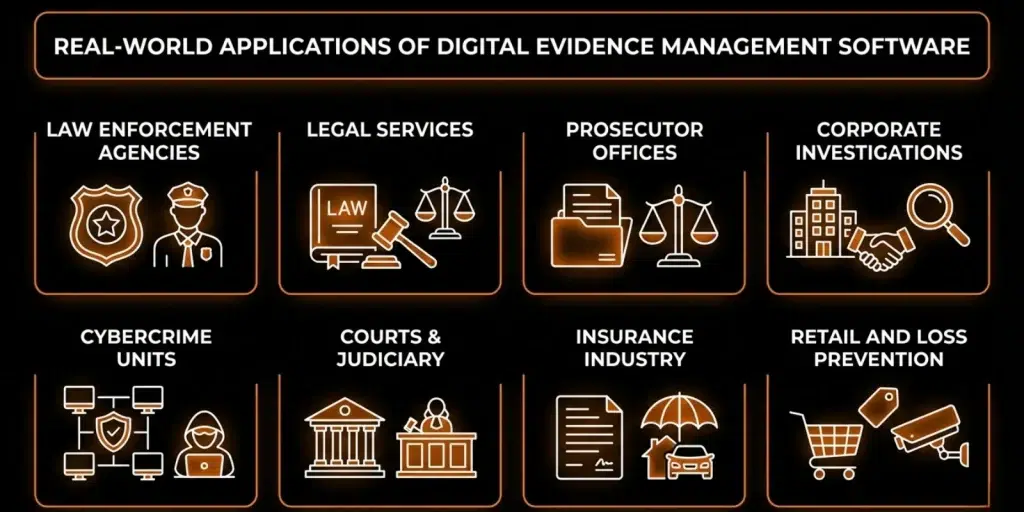
Due to the rapid growth of digital data from surveillance systems, mobile devices, and online platforms, a larger number of organizations across multiple industries are adopting digital evidence management software development that allows managing investigation data efficiently.
1. Law Enforcement Agencies
Law enforcement agencies rely on digital evidence management platforms to store and analyze camera footage, CCTV recordings, and forensic data.
- For example, in the U.S., more than 70% of large police departments have already adopted body-worn cameras, which signals the need for digital evidence management systems.
2. Legal Services
Law firms using modern and innovative systems can organize different case files, digital documents, and multimedia evidence. These platforms also streamline different legal workflows, often integrated with AI-Powered eDiscovery Software.
- The global eDiscovery market is projected to exceed $25 billion by 2030, reflecting the increasing need for AI-driven analysis of handling legal evidence and digital documents.
3. Prosecutor’s Offices
Prosecutor offices also use digital evidence management platforms that let them review proper case evidence, share files with complete investigators, and prepare certain courtroom presentations.
- Studies show over 90% of criminal cases now involve digital evidence, making digital evidence systems essential for prosecutors.
4. Corporate Investigations
Enterprises also use some modern digital evidence management solutions during internal investigations. These include handling fraud, intellectual property theft, or certain regulatory violations.
- Organizations worldwide have already lost around 5% of annual revenue to fraud, increasing the overall demand for digital investigation and evidence management systems.
5. Cybercrime Units
Cybercrime investigation teams also rely on modern software. This allows managing digital forensic data collected from certain hacked systems, servers, and mobile devices.
- Global cybercrime damages are estimated to reach $10.5 trillion annually, highlighting the increasing demand and overall importance of digital forensic investigation platforms.
6. Courts & Judiciary
Courts are also increasingly using different modern systems that allow the review of electronic evidence during legal proceedings. Furthermore, secure evidence portals also allow judges, attorneys, and clerks to properly access such verified digital records.
7. Insurance Industry
Insurance companies also use such modern platforms during fraud investigations and claim verification. Digital evidence, such as different accident photos, CCTV footage, and proper legal documentation, is also stored and analyzed to properly detect fraudulent insurance claims.
- As per data, almost 40% of cybercrime complaints reported to the U.S. Federal Trade Commission were for identity theft. The number also signals the increasing demand for digital evidence analysis.
8. Retail and Loss Prevention
Retail organizations using modern digital evidence management solutions can successfully analyze surveillance footage and investigate employee theft.
- Cybercrime losses have nearly reached over $1.2 trillion worldwide in 2025. This strongly reflects the need for digital investigation and evidence management tools.
Benefits of Digital Evidence Management Platform for Attorneys
As a greater number of legal cases increasingly rely on digital files, videos, and electronic records, modern digital evidence management software has become more essential to take part in legal practice.
These platforms also help attorneys securely organize, analyze, and handle evidence while improving overall case efficiency, seamless collaboration, and better regulatory compliance.
1. Centralized and Organized Evidence Management
The digital evidence management system provides attorneys with a proper and centralized repository where they can easily store videos, different legal documents, emails, and records. This organized structure helps legal teams quickly retrieve case evidence while avoiding fragmented storage.
2. Stronger Chain of Custody Protection
Maintaining a complete and verifiable chain of custody is considered very critical in legal proceedings. The software for digital evidence management also automatically records every action that is mainly performed based on evidence. This also ensures better transparency while protecting the overall integrity of digital records.
3. Faster Case Preparation
Attorneys can also rapidly locate and review some critical files while using intelligent search and metadata tagging. This also reduces the overall need for manual evidence review time while accelerating the chances of preparation for hearing and court presentations.
4. Enhanced Collaboration with Legal Teams
Strong and secure evidence sharing is also considered necessary because it assists attorneys, paralegals, and investigators in collaborating. An agency having expertise in law firm software development services can successfully implement custom evidence management platforms that not only support real-time document access but also seamless team collaboration.
5. Improved Courtroom Presentation
Digital platforms allow attorneys to present different multimedia evidence. These include videos, audio recordings, and documents. Such organized digital evidence also improves clarity during trials while strengthening arguments with well-structured and different supporting materials.
6. AI-Powered Evidence Analysis
AI for law firms, with the advancement of evidence analysis, helps to automatically analyze large amounts of data, identify certain patterns, and detect vital aspects. This also helps attorneys uncover proper insights faster while improving legal strategies based on accurate data-driven analysis.
7. Better Compliance and Data Security
Advanced encryption, access controls, and greater compliance features also ensure that sensitive case information remains protected. Hence, the digital evidence management solutions help legal professionals to meet regulatory standards with controlled evidence access.
8. Cost Savings in the Long Run
By eliminating the need for certain manual processes and reducing the chances of physical storage requirements, the evidence management platforms allow law firms to lower their operational costs. Hence, they can take part in faster case preparation while reducing the need for administrative workloads.
Future Trends in Digital Evidence Management Software Development
The future of digital evidence management software development is being significantly shaped by some rapid technological advancements, such as artificial intelligence, cloud infrastructure, and smart surveillance ecosystems. Organizations focusing on investing in advanced platforms are also capable of processing massive volumes of digital investigation data securely and efficiently.
1. AI-Driven Automation
AI-driven automation is significantly transforming the concept of digital evidence management systems by processing large volumes of multimedia evidence. Furthermore, the machine learning algorithms can also categorize different files, detect certain patterns, and highlight relevant evidence, which helps investigators analyze data faster while accelerating criminal investigations.
2. Real-time Video Analytics
Real-time video analytics also enables such platforms for digital evidence management to analyze surveillance footage instantly. Law enforcement agencies are also increasingly relying on such modern AI-powered analytics. It is because AI digital evidence management solutions help detect suspicious behavior while identifying different suspects and extracting proper actionable insights.
3. Edge Computing for Evidence Processing
Edge computing also allows digital evidence to easily process the data from surveillance cameras or IoT devices. This reduces the chances of latency while improving data privacy and enabling faster evidence analysis.
4. Zero-Trust Security Frameworks
The software for digital evidence management adopting zero-trust security architectures can continuously verify every data access. This approach not only minimizes the chances of cybersecurity risks but also ensures strict data protection by taking part in sensitive investigations.
5. Integration with Smart City Infrastructure
Smart city initiatives are also generating massive volumes of surveillance and IoT data that significantly support investigations. However, by integrating such advanced law enforcement digital evidence management platforms, agencies can also gain access to traffic cameras, public sensors, and urban surveillance systems. These assist with faster and better incident analysis.
6. Blockchain Integration
Blockchain integration is another emerging yet powerful method that helps secure digital evidence. By creating such tamper-proof records, blockchain can also successfully strengthen chain-of-custody tracking. This also ensures greater transparency and reliability during court proceedings and investigations.

Why Choose A3Logics for Law Enforcement Digital Evidence Management Software Development?
Organizations that want to develop secure and scalable digital evidence management software need an experienced technology management partner. Hence, partnering with A3Logics, a legal software development company, can deliver such custom software solutions.
Below are the key reasons why A3Logics is a trusted partner for developing modern digital evidence management systems.
- Founded in 2003, A3Logics has more than 20 years of experience delivering enterprise software solutions across industries.
- The company offers full-cycle digital evidence management solutions that align perfectly to meet the specific needs of law enforcement agencies.
- A3Logics provides some specialized AI consulting and enterprise AI development services that help organizations to successfully implement intelligent automation, data analytics, and multiple evidence processing systems.
- Their cloud consulting services also help organizations to design and deploy secure and advanced cloud environments that are capable of storing and managing massive volumes of digital evidence and surveillance data.
Conclusion
The rapid growth of collecting digital data from surveillance systems, mobile devices, and multiple online platforms has made the process of efficient evidence management essential for modern investigations.
In such cases, implementing an advanced digital evidence management software assists law enforcement agencies, legal professionals, and organizations in securely collecting, storing, and analyzing data.
With multiple emerging technologies such as AI, blockchain, and cloud computing shaping the future, investing in such scalable and compliant digital evidence platforms has become more important than ever. Hence, partner with the right team for the best software for digital evidence management that supports accurate and transparent legal outcomes.