
Law firms can no longer be assessed based on performance in court or legal knowledge. The client experience, speed of response and relationship management are all equally crucial in growth today. Potential customers are seeking timely action, effective communication and hassle free onboarding. As firms evolve, fulfilling these expectations manually is almost impossible.
That is where CRM legal software comes in. It is designed with legal professionals in mind, assisting them to handle leads, foster relationships with clients, track matters, and simplify communication within a single central repository. Rather than juggling spreadsheets, emails, and sticky notes, legal teams have an organized and digital way of handling the business side of law.
What is Legal CRM Software?
Legal CRM software is a client relationship management software tailored to the operational and compliance requirements of law firms. In contrast to generic CRM tools, CRM software for law firms aims at handling legal enquiries, client intake, consultations, and long-term relationships in an orderly and secure way. It consolidates client and prospect information, so that all interactions, documents and follow-ups are captured and readily available within their lifecycle.
Legal CRM software links marketing, intake, and legal teams together on one platform by combining intake management, communication tracking, and case/matter association. This will enable the firms to answer questions quicker, be better organized and have full visibility of client relationships. Consequently, law firms will be able to enhance their clients’ experience, decrease the workload on their administrative side, and make evidence-based decisions that will contribute to sustainable growth and retention of clients.
Why Do Law Firms Need Legal CRM Software Today?
Law firms have a highly competitive business environment whereby speed, responsiveness and professionalism may prove to be very crucial. The majority of the companies continue to monitor inquiries with the help of manual procedures, fragmented emails, or basic spreadsheets. This normally translates to delayed responses, follow-ups and lost opportunities.
CRM software for legal services assists in tracking down all leads, structuring communications, and not letting a single potential client slip through the cracks. In a recent survey by Thomson Reuters 79% of firms expect significant GenAI integration by 2027, with tax and accounting professionals demonstrating the most dramatic shift in GenAI attitudes—71% now believe the technology should be applied to their daily work, up from 52% in 2024.
Beyond intake, modern firms require enhanced transparency on performance and customer relationships. Legal CRM systems offer well-structured work processes, automatic reminders, and transparent information about the current status of each prospect or client. This will ease the administrative burden on lawyers and enhance service delivery consistency. With the increasing needs of transparency and fast communications, these systems allow companies to be more effective, develop stronger customer confidence, and make effective business choices.
Core Features of Modern Legal CRM Software

1. Client Intake and Lead Management
This feature is the core of client intake and CRM software for legal firms because it streamlines all inquiries within a single centralized system. Call, web, and referral leads are automatically captured and allocated. Organized pipelines assist companies to react quicker to more opportunities and transform more prospects into sustained clients.
2. Contact and Communication Management
Any interactions with clients such as emails, phone calls, meetings and notes are stored in one contact profile. The legal teams are able to see the history of conversation immediately without the need to engage. This enhances professionalism, minimizes miscommunication, and provides uniformity in services all over the client lifecycle.
3. Case and Matter Association
Legal CRM systems associate contacts and leads with specific cases or legal issues. Such connection maintains the alignment between business development and legal work within the same system. Staff are quickly able to comprehend the context of individual relationships without having to switch between databases.
4. Reporting and Analytics
In-built reporting features provide companies with real-time data about the sources of leads, conversion rates, and productivity of the team. Much like the visual dashboards, they show trends and indicate the process bottlenecks. These analytics serve to make smarter decisions, more effective marketing investments and keep intake and client management strategies optimized.
5. E-Signature and Document Generation
Modern legal CRMs also simplify the process of onboarding with automated document generation and secure e-signing. Templates can create engagement letters, agreements, and intake forms within seconds. This simplifies the hiring procedure and provides the clients with a digital experience that is faster, and more convenient.
Advanced Features in AI-Powered Legal CRM Software
1. AI-based Lead Scoring
AI-based lead scoring uses previous intake history, past case performance, and behavioral characteristics to determine the correct level of lead of each new query. It assigns priority scores based on the conversion potential and estimated value of the case. This allows the firms to focus on high intent leads, and not to respond to all leads equally.
2. Predictive Analytics for Case Conversion
Predictive analytics uses historical data of past client experience, communication, and conversion history to predict which leads will most likely sign. It also calculates the most appropriate time and channel to follow up. These insights assist companies in resource distribution and enhancing the overall performance of intake.
3. Automated Follow-ups Based on Behavior
Automated follow-ups occur when a prospect accomplishes specific tasks such as opening emails, clicking links or even leaving forms without completing. The system automatically balances timing and messaging based on the behavior of the user. This maintains uniformity in communication as it eliminates paperwork and lost chances of engagement.
4. Natural Language Processing for Communication Insights
NLP analyzes emails, chat messages, and call summaries to identify sentiment, urgency, and intent.
As a result, it reveals trends such as confusion, frustration, or strong client interest.
The lessons can help organizations to maximize the relevance of communication-related strategies and improve customer experience at the intake and engagement stages.
5. Smart Reminders
Smart reminders analyze the timelines of cases, client activity, and workflow steps to remind about the next steps in time. The system can automatically suggest the follow-ups, document requests, or consultation scheduling. This minimizes the missed work, improves responsibility, and ensures that a probable issue is moving forward without frequent human intervention.
6. Agentic Intake Automation
An important breakthrough in custom CRM development is agentic intake automation, which involves intelligent agents managing dynamic intake conversations. Such agents pose pertinent questions, confirm answers, and qualify leads on the spot. Consequently, companies can extract precise data more quickly and direct opportunities in the most efficient way.
Benefits of Legal CRM Software for Law Firms
1. Higher Client Conversion Rates
Legal CRM software allows quick reactions to the new inquiries due to the automation of the intake processes and prompts. Formal pipelines ensure teams monitor all the leads meticulously and do not lose such promising opportunities. As visibility is maintained with follow-ups, companies are able to continuously turn more prospects into paying customers.
2. Improved Client Satisfaction
Attorneys receive a comprehensive background of client information before each discussion or status update. Automated messages and notifications ensure clients remain updated and do not add any additional administration. Such proactive interaction establishes trust, lessens anxiety, and makes the overall service experience a smoother affair.
3. Better Team Collaboration
A centralized CRM system provides real-time access to centralized client data access upon attending lawyers, paralegals, and intake staff. Everyone operates under the same information, which decreases misunderstanding and removes unnecessary work. Through this alignment, coordination becomes better, internal processes are accelerated and overall service delivery is enhanced.
4. Increased Revenue Predictability
CRM software for law firms have dashboards, which give a real-time view of performance in leads, consultations, and conversion. Companies are able to see the trends in customer attraction and find out what is working to generate steady income. With this visibility, it is easy to make correct predictions, smarter budgeting and long-term planning is confident.
5. Reduced Administrative Burden
Repetitive processes such as data entry, follow-up email and appointments can be automated. Employees are no longer wasting hours in manual coordination or searching far and wide to get client details. The time saved can enable the legal professionals to focus on the billable work and higher value tasks.
6. Risk Mitigation
By using centralized records, teams securely store all interactions, documents, and updates; therefore, they can easily track every change.
Standard working practices decrease the risk of late deadlines, overlooked follow-ups or unpredictable processes. This structure assists companies to fulfill ethical requirements and reduce operational or compliance risks.

Legal CRM Software Development – Use Cases for Law Firms
1. Client Intake and Lead Management
Legal CRM systems receive inquiries made by calls, forms, chat, and email into a single organized pipeline. Smart routing, automation of qualification and tagging means that each lead is delivered to the appropriate staff member on time. This systematic flow of intake is frequently streamlined with legal client intake software development, which minimizes wait time and increases the conversion rates.
2. Client Relationship Management
A legal CRM retains a full log of emails, calls, meetings, notes, and consultation records. Such a cohesive timeline assists lawyers to know what clients like, what has been done, and how they communicate in real-time. Affirmative tracking of relations helps with personalized service, enhanced trust, and long-lasting client interaction.
3. Case Tracking and Matter Management
Profiles of clients within the CRM could be directly connected to cases at hand and individual legal issues. This relationship provides context to teams as they review messages, documents, deadlines, and other significant milestones. Improved visibility enhances coordination, minimizes errors, and assists firms to provide more systematic handling of cases.
4. Marketing Campaign Management for Law Firms
Legal CRM systems monitor the activity of ads, email campaigns, referring partners, and web requests. A built in analytics will give insights as to which channels are producing qualified leads and eventually signed clients. Companies are able to streamline budgets, alter communication and invest more decisively in strategies that generate growth.
5. Compliance and Data Security Management
Legal CRMs have role based access, encryption, audit logs and rigid permission controls. Sensitive client records are kept secret and firms retain their awareness of who accessed or modified information. These controls contribute to compliance objectives that are commonly in line with legal case management software development.
6. Client Retention and Engagement Analytics
CRM analytics track the frequency, response time, and trends of engagement during the client lifecycle. Businesses can know about idle contacts, send follow-ups and reconnect with consumers at the right time. These kinds of understandings promote trust, referrals, and repeat work when problems are solved.
7. Billing, Invoicing and Revenue Tracking
Certain legal CRMs integrate with billing systems to bridge the gap between acquisition client information and revenue collected. The firms can measure their income by source of lead, attorney or practice area to obtain better understandings of profitability. This financial transparency helps in making predictions, pricing choices and more foreseeable growth in the long term.
8. Task and Workflow Management
Workflow tools automatically allocate assignments, due dates and reminders depending on case stages. Team members are fully aware of responsibilities without having to receive manual emails or verbal follow ups. Organized procedures enhance responsibility, minimize oversights and ensure the legal proceedings are running well.
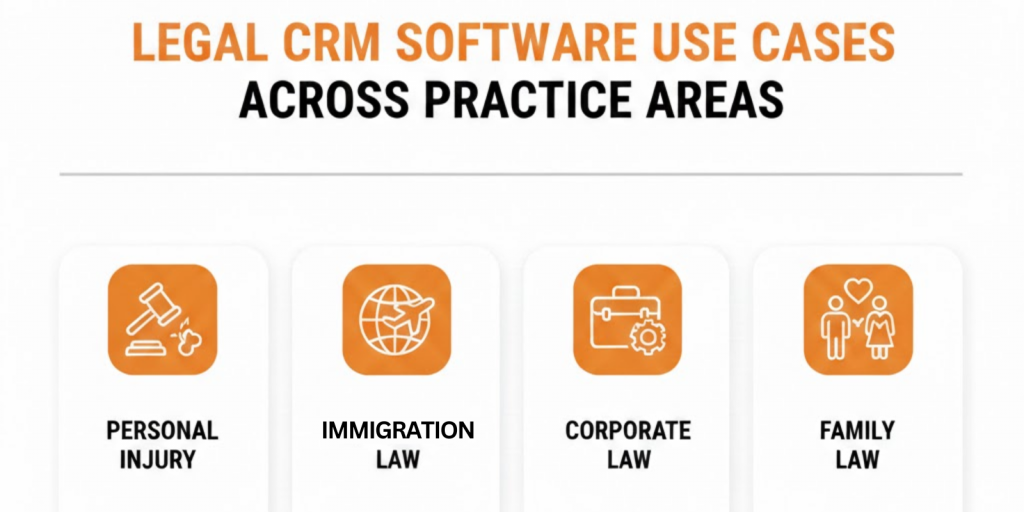
Legal CRM Software Use Cases Across Practice Areas
1. Personal Injury Law
Personal injury firms address big volumes of enquiry and time-limited cases, and thus speed of intake and follow-up is needed. The CRM software for the legal industry enables the prioritization of those leads that are urgent, keep track of the referral sources, and not miss out on any promising client.
2. Immigration Law
The immigration practices handle long timelines, frequent communication with clients, and document-intensive cases. A legal CRM consolidates client data, automatizes prompts, and monitors case milestones to lessen delays and enhance transparency.
3. Corporate Law
Corporate law firms are interested in long-term relations, repeat business, and multiple stakeholders of a client. Legal CRM software keeps a comprehensive record of the communication history and assists in managing relationships based on accounts across teams.
4. Family Law
Family law issues are sensitive and have emotive interaction. Legal CRM facilitates a structured contact, regular feedback, and safe management of client information in the lifecycle of a case.
Custom Legal CRM Software Development vs Off-the-Shelf Solutions
Off-shelf legal CRM systems are favored due to their speedy implementation and are less expensive to acquire in most cases. Their standard features of contact management, tracking of intakes and simple automation can be useful to small or mid-sized companies with simple procedures. Nevertheless, such systems usually involve the companies to alter their work processes to accommodate the software rather than the other way round. Customization can be less, and more extensive integrations with internal tools or unique practice requirements can be challenging or costly to obtain.
Custom legal CRM software development, instead, is focused on the creation of a system that is tailored to a particular workflow, practice area and compliance requirements of a given firm. It facilitates tailored intake processes, customized reporting, and compatibility with the current legal and business applications. Initial investment is higher, but custom solutions may be more efficient, scalable and value-driven in the long term as the company progresses and matures.
Best Legal CRM Software in 2026 to Inspire Your Idea
1. Clio Grow

Clio Grow pays attention to client intake, appointment scheduling, and automated follow-ups specific to the law firms. By integrating with Clio Manage, firms gain a seamlessly connected system that supports lead capture through complete case handling.
2. Lawmatics

Lawmatics is a law-specific legal CRM with a particular marketing automation. Bespoke intake processes, tracking campaigns and custom email and text messaging sequences assist teams to cultivate leads and turn them into conversions regularly.
3. Litify

Litify is a Salesforce-based application that enables intensive customization of large firms with a complex workflow and a large number of cases. The platform is highly suitable to the legal operations of an enterprise, due to the unified CRM, matter management, and analytics tools.
4. Law Ruler

Law Ruler focuses on lead tracking, automation of intake, and intensive performance marketing attribution of law firms. Strong reporting capabilities can also enable companies to quantify advertising ROI and sustain follow-up with qualified prospects in a consistent and timely manner.
5. Pipedrive

Pipedrive is a general sales CRM, which even small law firms modify to do simple lead and pipeline tracking. The intake processes and the follow-up management are supported by a visual sales pipeline and simple automation tools.
Considerations When Choosing a Legal CRM
i. Defining Your Firm’s Specific Needs and Budget
Begin by determining the areas of practice, volume of intake, team size and long term growth plans of your firm. A definite needs analysis will guarantee that the CRM software for law firms fits your procedures without overspending on features that are not essential.
ii. The Importance of Integration
A legal CRM ought to be integrated with practice management software, email systems, billing, and document management. Powerful integrations eliminate manual data entry, eliminate information silos and develop a more effective, interconnected workflow throughout your firm.
iii. Evaluating Ease of Use and Adoption Potential
Even feature rich systems cannot succeed when attorneys and staff consider them challenging or time consuming to use. Selecting user-friendly CRM legal software, which has an intuitive onboarding and a straightforward navigation promotes frequent use and easier adaptation throughout the firm.
iv. Assessing Security, Compliance and Vendor Support
Law firms deal with sensitive data of their clients, and thus high-grade encryption, permission controls, and standards of compliance are necessary. Strong vendor support, frequent system maintenance and transparent service contracts contribute to ensuring long term stability and less operational risk.
Future Trends in Legal CRM Software Development
i. AI-driven Personalization
Through AI-driven personalization, legal CRMs tailor communication, follow-ups, and service suggestions based on each client’s behavior, history, and preferences; consequently, they automatically adjust messaging style, timing, and recommendations to deliver more relevant, meaningful client experiences.
ii. Deeper Analytics
The next generation CRM systems in the law firm will provide more in-depth analytics beyond the standard lead tracking and conversion reports. Companies will achieve foresight information about the revenue patterns, customers lifetime value, and performance gaps to assist in smarter strategic planning and resource allocation.
iii. Voice-enabled CRM
CRM tools will enable resource scheduling, record updates, and client information access through easy voice authentications. This will save time, particularly to the attorneys who have to take notes in a short time, during the timeframe between meetings or attending court.
iv. Unified Legal Tech Ecosystems
Legal CRM systems will become more integrated with case management, billing, document automation, and communication solutions than before. This interrelated ecosystem will remove information silos, duplicate entries, and give organizations one cohesive picture of clients and business.
Why Choose A3Logics for Developing Custom Legal CRM Software?
1. Deep Understanding of Legal Workflows
Being a professional law firm software development company, A3Logics has good domain expertise on how law firms process intake, case management, and communication with clients. Their experience assists CRM systems to match actual legal processes rather than compelling teams to adapt to generic software frameworks.
2. Tailored CRM Architecture
Custom platforms are fully tailored based on practice areas, internal processes, and long-term development strategies of a firm. Individual solutions embrace defined intake phases, approval processes and reporting needs without adding unwanted complexity.
3. Advanced Automation Capabilities
Smart procedures automate follow-ups, reminders, document requests, and task assignments throughout the firm. These automations eliminate human effort, enhance response time, and have a role in ensuring that no lead falls through the cracks.
4. Seamless Integration with Legal Tech Stack
A3Logics ensures seamless CRM integration with practice management, billing, email, and document management systems; as a result, this unified platform standardizes data, reduces silos, and eliminates duplication across connected systems.
Conclusion
Legal CRM software is not just a database of contacts but a powerful engine of growth, efficiency and client satisfaction. Starting with organized consumption to AI-driven insights, contemporary systems are helping firms compete in a highly-paced and customer-focused legal marketplace. Investing in the appropriate CRM legal software can help the company to get more conversions, enhance the quality of services, and establish long-term relationships with clients.