
Why should two drivers with completely different driving habits pay the same insurance premiums? This question increasingly defines the future of auto insurance. Traditionally, pricing models rely on fixed factors like age, location, and vehicle type. However, these models fail to consider how often drivers use vehicles or how safely they drive. As driving behaviors continue to diversify, this one-size-fits-all approach no longer meets customer expectations. Consequently, insurers must shift toward fairer, behavior-based pricing models to remain relevant and competitive.
Modern mobility trends, such as remote work and flexible commuting, clearly expose gaps in conventional underwriting models. As a result, many policyholders now drive far less than before. However, insurers often continue charging them the same premiums. Consequently, this growing mismatch pushes insurers to reassess risk evaluation methods. Moreover, it accelerates the need for more accurate, personalized, and usage-based insurance pricing strategies.
Insurers are responding by scaling up their investments in usage-based insurance platform development. Through telematics and real-time driving data, usage based pricing enables the premiums to be dependent on the actual car usage and driving behavior. This not only enhances pricing fairness, but also underwriting accuracy and prepares the insurers to compete on a long-term basis in a fast changing market.
What Is the UBI Usage-Based Insurance Model in Auto Insurance?
The UBI insurance model is a modern auto insurance method wherein the premiums are determined based on real-life driving information instead of demographics factors which are usually fixed. Rather than using age, place, or type of vehicle as the only criteria, insurers judge the real usage of the vehicle and driving habits of the driver. Telematics data may be gathered via mobile applications, OBD devices, or embedded OEM. This allows insurers to price risk more fairly and offer premiums based on how much and how well a customer drives.
Technologically, the usage-based insurance model relies on constant data recording, analytics, and scoring systems. During usage-based insurance model development, insurers develop systems that transform raw driving information into meaningful data like, mileage trends, driving scores and risk profiles. These insights enable dynamic pricing, personal discounts, and better underwriting decisions as well as increased transparency and trust with policyholders.
PAYD vs PHYD vs MHYD – Key Model Differences for Auto Insurers
Before starting to develop an UBI insurance platform, it is important to understand various UBI models. All models project a different business goal and market niche.
1. Pay-As-You-Drive Insurance Model
PAYD model is a rating method that charges auto insurance depending on the extent of the vehicle usage, making mileage the most dominant factor in its prices. Drivers that travel less are charged lower premiums, and this brings a clear sense of fairness relative to traditional fixed pricing. This model is very appropriate for city drivers, retirees, or people with limited or infrequent vehicle use.
Implementation wise, PAYD is the simplest form of usage-based insurance model. Primarily, insurers collect data based on distance traveled and trip frequency, which simplifies overall analysis. In addition, they perform minimal behavioral assessment to streamline data processing. As a result, insurers gather telematics data through mobile applications, OBD devices, or embedded vehicle systems.
For auto insurers, PAYD is a convenient place to start with usage-based insurance platform development. It allows penetrating the market in a short time, enhances the perception of fairness in prices among customers, and assists to test telematics strategies and then transition into more advanced models of usage.
2. Pay-How-You-Drive Insurance Model
The PHYD model uses driving behavior to calculate premiums and not distance. It measures the safety of a driver by examining the likelihood of over speeding, hard braking, acceleration, cornering, and high-risk time driving. Lower premiums are offered as a reward to safer behavior.
PHYD needs more advanced data analysis than PAYD. Under usage-based insurance software development, insurers deploy behavior identification, scoring algorithms and risk identification logic. These systems convert raw telematics data into actionable insights that indicate individual driving risk.
For insurers, PHYD allows more accurate risk segmentation and underwriting. It not only promotes a safer driving culture, but also assists insurers in distinguishing their services by customized pricing plans.
3. Manage-How-You-Drive Insurance Model
The MHYD model is aimed at proactively controlling and enhancing driver behavior rather than using data to price. Drivers are provided with constant feedback, safety warnings and recommendations to encourage safer driving behavior in the long term.
MHYD needs high-level processing and involvement. Usage-based insurance software development for this model includes instant event detection, mobile notifications, gamification, and AI-based recommendations that steer drivers to safer behavior.
For auto insurers, MHYD brings long-term value by lowering the frequency of claims and enhancing customer relationships. It places insurers as active safety partners and represents a mature evolution of the UBI insurance model within a broader digital insurance strategy.
Usage-Based Insurance Market Size and Statistics
The usage-based insurance market is growing at a very high pace as auto insurers adopt the concept of using data to set the prices of policies. The global usage-based insurance market is projected to be about $82.7 billion in 2025, as opposed to almost $63 billion in 2024. The trend is being fueled by the rising use of telematics, penetration of connected vehicles, and an increasing demand by consumers to receive personalized and fair insurance premiums.
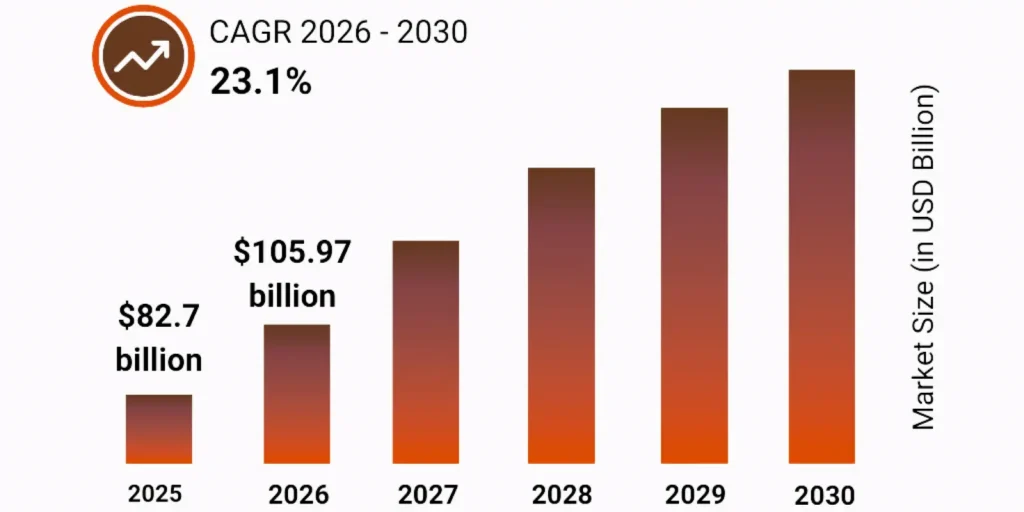
With a CAGR of 25.7%, the market size of usage-based insurance will grow exponentially to reach $206.14 billion in 2029. Simultaneously, the insurance telematics market that promotes UBI expanded to almost $4.7 billion in 2025, as more insurers invested in data infrastructure.
From a regional perspective, North America leads global adoption and is expected to maintain over one-third of the total market share in 2025. Embedded OEM telematics is also emerging as the fastest-growing data source, accelerating the need for scalable usage-based insurance platform development initiatives.
Top UBI Platform in the Market to Inspire Your UBI Software Development Roadmap
1. Progressive Snapshot

One of the oldest and most developed UBI programs in the market is Progressive Snapshot. It relies on the OBD devices and apps to gather in-depth driving behavior information. Some of the measures that the platform targets are miles, braking, acceleration, and driving time. Snapshot illustrates the potential of data-driven pricing to improve risk selection and retain customer transparency.
2. Allstate Drivewise
Allstate Drivewise focuses on customer interaction and safe driving rewards. The platform is based on smartphone-based telematics to monitor driving behavior in real-time. The drivers are given feedback, rewards and possible discounts on safe habits. Drivewise underlines the need to apply gamification and behavioral insights to increase retention and reduce claims.
3. State Farm Drive Safe & Save

State Farm Drive Safe and Save incorporates beacon and mobile technology to record accurate driving information. The program focuses on simplicity and premium discounts based on safe driving patterns. It is closely connected with State Farm policy and CRM systems. This platform demonstrates that smooth integration may enable the implementation of UBI on a massive scale among varying customer groups.
Core Capabilities Every Auto Insurer Needs in a UBI Platform
1. Driving Behavior Analytics and Scoring
The platform ought to use raw data of telematics to detect the driving events such as harsh braking, speeding, and forceful acceleration. These events are then converted to driver behavior scores based on rules or AI models. Proper scoring is a guarantee of a fair risk assessment and pricing.
2. Mileage and Usage Tracking
Mileage tracking is a fundamental need, particularly with PAYD insurance models. The system should be able to compute the distance covered in various driving environments with a great degree of precision. Stable mileage data has a direct effect on the premium calculations and the accuracy of billing.
3. Telematics Data Collection and Ingestion
A UBI ecosystem should be in a position to gather high frequency driving data through various sources including mobile applications, OBD, and OEM. Real-time and batch processing should be supported to deal with the different data volumes. One of the pre-requisites of an effective usage-based insurance platform development is reliable ingestion.
4. Policy Rating and Pricing Engine
A powerful pricing engine uses the underwriting regulations and rating logic on telematics-based risk scores. It should facilitate dynamic premium adjustment, discounts and incentives. Pricing flexibility assists the insurers to promptly respond to the change in the market or regulations.
5. Customer Engagement and Digital Experience
The UBI platform must offer convenient mobile and web interfaces to policyholders. Customers should be able to see driving scores, trip history, and possible savings with ease. Transparency is enhanced through clear visibility and fosters safer driving.
6. Integration and API Management
Seamless integration with policy administration, CRM, claims, and billing systems remains essential for modern insurance platforms. Moreover, an API-based architecture enables smooth data flow across internal and external platforms. As a result, strong integration reduces operational silos and significantly improves system scalability.
7. Data Security, Privacy, and Compliance
UBI platforms handle sensitive driving and personal information which needs to be safeguarded securely. The system must have encryption, consent controls, and role-based access controls. Compliance with regulations is necessary to ensure trust and sustainability of the platform.
Key Features of a Usage-Based Insurance Platform for Auto Insurers
1. Telematics Data Collection and Management
A UBI platform should be able to handle various sources of data including mobile applications, OBD devices, and embedded systems within OEMs. This information is monitored in real-time with high security measures. Stable data ingestion is the core of usage-based insurance platform development.
2. Trip Analysis and Driving Event Detection
The system shall automatically recognize the trips and capture instances like harsh braking, rapid acceleration, and speeding. Such incidences are examined to learn about driving habits. Proper event detection allows fair and behavioral pricing.
3. Driver Scoring and Risk Assessment Engine
A scoring engine is a configurable system which transforms raw driving data into viable risk scores. These scores indicate consistency, safety and general driving behavior. Usage-based insurance software development revolves around scoring models.
4. Integration with Core Insurance Systems
The platform should be connected to CRM, policy administration, billing, and claims. API-based integration provides a smooth data flow and operational consistency. This is required for scalable UBI insurance platform development.
5. Compliance, Data Privacy, and Security Controls
Consent management, encryption and audit trails protect sensitive data of drivers. The platform should coincide with the local data protection laws. Good governance will guarantee sustainable credibility for the usage-based insurance model.
Benefits of Implementing a Usage-Based Insurance Model
1. More Accurate Risk Assessment and Pricing
The usage-based insurance model allows the insurance companies to base their policy pricing on factual information about the actual driving rather than on assumptions. This enhances underwriting quality because it captures actual mileage and driving habits. Consequently, the premiums are more reasonable and closer to proportionate risks.
2. Reduction in Claims Frequency and Loss Ratios
Insurance companies will be able to detect dangerous trends at an early stage and promote safer driving by tracking behavior. Feedback of drivers, alerts, and incentives encourage responsible driver behavior in the long run. This change of behavior can help in reducing the number of accidents and the loss ratios in general.
3. Improved Customer Engagement
Usage-based programs create continuous interaction between policyholders and insurers. Rewards, mobile apps, and driving scores keep customers constantly active during the policy lifecycle. Greater involvement means more trust, better satisfaction, and greater rates of policy renewal.
4. Competitive Differentiation in a Crowded Market
UBI insurance software development for AutoInsurer helps carriers to be differentiated through personalized and transparent pricing. Customers are more inclined to insurers who provide control over premiums depending on driving habits. Such differentiation will help to attract low-risk drivers and tech-savvy buyers.
5. Enhanced Fraud Detection
During the investigation of claims, telematics information shows objective evidence. During loss, insurers are able to confirm the timelines, location and behavior of the driver involved in the accident. This helps eliminate fraudulent claims, decrease investigation periods, and enhance efficiency in processing claims.
Telematics Data Inputs That Drive Auto UBI Premium Models
Telematics data for auto UBI includes several commercial data inputs. Each input contributes to premium precision. Below are the most converting data inputs used in UBI software.
- Mileage/Odometer Data: via OBD, GPS, and mobile SDK
- Speed Pattern: average speed, peak speed, speed variance
- Braking Behavior: harsh braking count, braking intensity
- Acceleration Behavior: aggressive acceleration frequency
- Cornering: lateral G-force risk indicators
- Crash Signals: sudden impact detection, airbag triggers
- Trip Timing: night driving risk multipliers
- Location Data: risk zones, traffic density correlations
- OBD Diagnostics: engine load, RPM spikes, anomaly checks
- Driving Score Inputs: normalized behavior index
These inputs fuel premium engines commercially. They also fuel AI scoring engines. IoT data must remain encrypted. It must also remain consent-bound. Data governance is key for commercial adoption.
Integration Requirement for UBI: OEM, OBD, CRM & Claims Systems
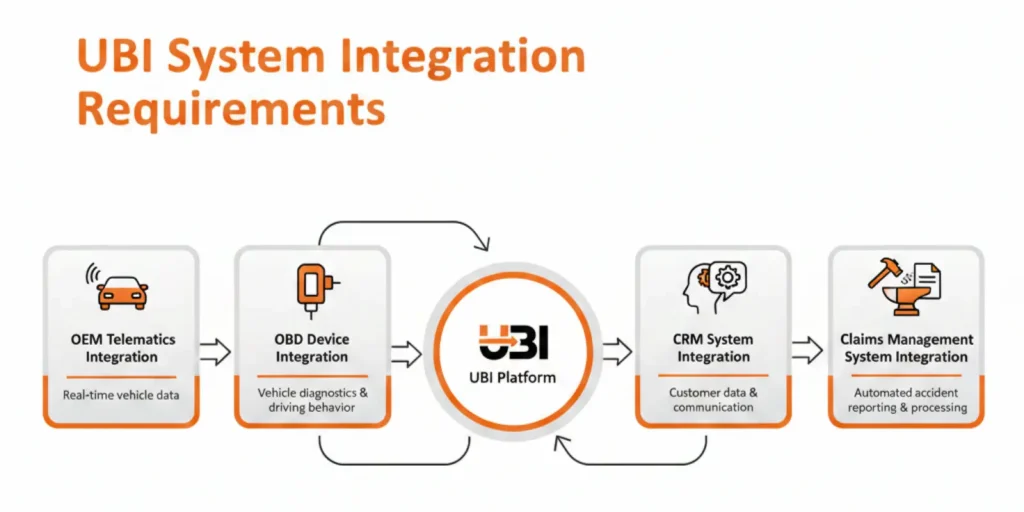
1. OEM Telematics Integration
OEM integration enables the insurers to gain access to embedded vehicle data without having to install external devices. It provides accurate real-time data like miles traveled, speed and health status of the vehicle. These data foundations allow usage-based insurance platform development to be scaled and UBI to be adopted over the long term.
2. OBD Device Integration
OBD integration connects aftermarket devices installed in a vehicle’s diagnostic port to capture driving data. Specifically, these devices record acceleration, braking, trip distance, and driving time. As a result, this data proves especially valuable during early UBI implementation when OEM access remains limited.
3. CRM System Integration
CRM integration brings together telematics knowledge with customer profiles and engagement processes. It allows customized communication, personalized rewarding, and policy updates depending on usage. These abilities enhance customer experience and enhance long-term policyholder relationships.
4. Claims Management System Integration
Claims system integration connects driving data to accident events and loss history. It assists in justifying allegations, resolving possible fraud, and evaluating the severity of accidents more objectively. This will enhance the efficiency of claims and also make it easier to make better underwriting and risk assessment decisions.
UBI Software Architecture for Auto Insurers
1. Data Collection Layer
This layer collects raw driving information across several telematics sources such as OEM embedded systems, OBD devices, mobile applications and IoT sensors. The significant parameters are speed, mileage, braking, acceleration, location, and the duration of the trip. Good data accuracy at this stage guarantees good analysis in subsequent processing layers.
2. Data Ingestion Layer
The ingestion layer safely delivers high data volumes of telematics to the UBI platform either in real-time streams or batch processes. Message queues and validation pipelines are technologies that preserve the data quality and continuity. Data normalization assists in normalizing inputs among various devices and vendors.
3. Analytics and Scoring Layer
This layer processes driving data to determine behavior patterns and risk score. Actuarial rules, machine learning models, and statistical techniques are combined to assess the risk of drivers. The scores obtained facilitate underwriting, segmentation and predictive loss modeling.
4. Business Logic Layer
The business logic layer translates the risk scores into the insurance results as price changes, discounts, rewards or surcharges. Underwriting policies, rating equations and compliance regulations are used uniformly across policies. This architecture makes telematics insights consistent with the business goals specified by the insurers.
5. Integration Layer
This layer allows easy integration of the UBI platform and core insurance systems such as CRM, policy administration, claims, billing and partner services. AI-based integrations ensure safe information transfer and synchronization in real-time. Effective connectivity within the systems enhances efficiency and customer satisfaction.
6. Presentation Layer
The presentation layer provides information in the form of dashboards, web portals, and mobile applications to the insurers and the policyholders. Driving scores, trip details, rewards and notifications are shown visually. Good presentation enhances engagement, transparency and trust.
AI-Driven Capabilities in UBI Software
1. Predictive Risk Scoring and Pricing Optimization
AI models use historical and real-time data of drivers to determine the probability of accidents and claims. Risk scores are constantly improved as the driving patterns and conditions change. This is the core of usage-based insurance software development, as it allows more accurate, behavior-driven scale pricing.
2. Real-Time Incident and Crash Detection
The AI-driven technologies recognize the probability of accidents by the abrupt shift in velocity, force of impact, and sensor indicators. The intensity of an accident can be predicted in a couple of seconds. Quick detection assists in initiating claims faster, responding to emergencies, and enhancing customer experience.
3. Fraud Detection
AI constantly tracks telematics and claims information to detect abnormal or unusual activity. Behaviour is compared with set driving baselines to identify potential fraud. Early reporting lowers false claims and enhances efficiency of investigations among the insurers.
4. Personalized Driver Coaching and Engagement
AI engines offer customized safety insights and driving suggestions to particular policyholders. Guidance is adjusted according to the history of driving and long-term improvement. Personalized feedback will promote safe driving and reinforce customer interaction as well as retention.
5. Continuous Model Learning and Optimization
UBI platforms use AI models that continuously learn as new driving and claims data becomes available. Consequently, risk algorithms automatically recalibrate to reflect evolving patterns. Moreover, continuous optimization ensures long-term accuracy, regulatory compliance, and model reliability.
Tech Stack for UBI Software Development
A modern usage-based insurance platform development tech stack typically includes:
- Big data frameworks like Apache Kafka and Spark
- Machine learning libraries for risk modeling
- API gateways and microservices architecture
- Mobile SDKs for Android and iOS
- Data visualization tools for dashboards
- Security frameworks for encryption and compliance
Cost of Developing UBI Usage-Based Insurance Software for Auto Carriers
1. Basic UBI Platform Development (Pilot Level)
A simple UBI platform is concerned with tracking mileage, basic driver scorecard, and few integrations only. The cost of development is between $150,000 – $300,000. This level is optimal for proof of concept applications and controlled market pilots.
2. Mid-Level UBI Platform Development (Growth Stage)
Mid-level platforms in usage-based insurance platform development support PAYD and PHYD models with advanced analytics, mobile applications, and CRM connectivity. Depending on AI complexity and integration depth, costs typically range between $400,000 and $900,000. As a result, this level enables broader implementation and more accurate risk differentiation.
3. Advanced Enterprise UBI Platform Development (Full-Scale)
Enterprise grade platforms will have real time analytics, AI-based scoring, OEM integrations, and automation of claims. Costs of development vary between $1.2 million to $3 million, depending on scale and regulatory range. Large carrier and multi-region deployment is supported at this level.
UBI Software Development Approaches: In-house vs Outsource
1. In-house development
When auto insurers develop their UBI platform internally, they have full control of the products, ownership of data, and intellectual property. By having internal teams, the solution could be closely aligned to underwriting rules, compliance requirements and long-term business strategy. Nevertheless, in-house usage-based insurance software development would necessitate high initial investment, infrastructure, and analytics capabilities.
2. Outsourced development
Outsourcing UBI insurance platform development is an option that enables insurers to find the expertise of a specialist in the field of telematics, data analytics, and insurance technology. Established suppliers will have time tested structures, accelerators and best practices that can dramatically shorten time to market. This strategy reduces initial capital investment and the risk of technology while facilitating quicker experimentation.
Selecting the Right UBI Insurance Software Development Partner Is Important
1. Proven UBI and Telematics Experience
A reliable partner should have practical experience working on UBI insurance platform development and actual telematics application. This experience indicates excellent knowledge of driving data subtleties, scoring logic, and platform scalability issues. It also assists in reducing implementation risks and time to market.
2. Deep Understanding of Insurance Regulations
UBI solutions should be in accordance with the strict data privacy, consent, and insurance regulations nationwide. An informed partner uses regulatory requirements as a part of platform design and workflows. This will help in facilitating easier approvals and minimizing risks of long-term compliance.
3. Advanced AI and Analytics Capabilities
Modern usage-based insurance software development is largely based on AI-powered risk models and behavioral analytics. A skilled partner uses machine learning to enhance scoring and insightful data. These abilities have a direct impact on the accuracy of underwriting and claims.
4. Post-Launch Support
Once launched, UBI platforms need to be regularly tuned, updated and performance monitored. A reliable partner will offer continuous support, optimization of analytics, and feature upgrades. Ongoing optimization enables the platform to respond to changing driver behavior and market conditions.

In Conclusion
Usage-based insurance is transforming auto insurance coverage by basing the premiums on actual driving behavior rather than making assumptions. For auto insurers, usage-based insurance platform development allows fair pricing, improved visibility of risks, and increased customer confidence. It also assists insurers in improving their underwriting accuracy and promoting safer driving practices. With the increasing rate of digital adoption, UBI-driven strategies are already becoming a necessity for long-term competitiveness.