The field of AI in Medical Imaging redefines the principles of diagnostics, and it is impossible to overestimate the changes that this phenomenon brings to the healthcare sector.
The strong algorithms have now enhanced radiologists, clinicians, and health care researchers by speeding up and providing greater accuracy in analyzing the complex medical scans than ever before. AI in Medical Imaging has already sped up, improved the accuracy and uniformity of the diagnostic procedure through X-rays and MRIs, as well as CT and PET scans.
As per the report published by Grand View Research, the global market for AI in medical imaging was valued at approximately USD 1.36 billion in 2024 and is expected to surge to around USD 19.78 billion by 2033, representing a compound annual growth rate (CAGR) of 34.67% between 2025 and 2033.
Previously, radiologists were forced to look through thousands of scans manually, and they were frequently time-constrained and lacked a lot of assistance. The industry of AI medical imaging can automatically segment and detect irregularities in images, and, more importantly, it is capable of forecasting the advancement of a disease, which can provide a physician with a priceless lead in making treatment decisions.
AI healthcare systems enable hospitals to integrate smart tools into current workflows for enhanced diagnostics. Moreover, they combine human intuition with machine accuracy to improve patient outcomes. This shift not only increases convenience but also saves lives through early diagnosis and patient-focused treatment.
What is Medical Imaging Intelligence?

Medical imaging intelligence is simply the use of AI algorithms to analyze medical images more accurately and efficiently. Medical Imaging AI uses large volumes of annotated scans to train itself to understand the ways diseases present visually.
Deep learning powers medical imaging by training neural networks to identify patterns and abnormalities like the human brain. Moreover, it enhances accuracy and speeds up the diagnostic process for better clinical outcomes.
AI medical imaging intelligence converts diagnostic medical imagery in motion. AI systems not only show what is in front of them, but they can also detect what is below the surface such as subtle tissue alterations, emerging tumors, or vascular abnormalities which may not be seen by the human eye.
Training models on a wide range of data will make AI provide equitable diagnostic outcomes based on the demographics of patients and the type of imaging.
Medical Imaging AI is not only important in clinical use. It reinforces medical research and drug finding, as well as remote care provision. Rural hospitals can ship scans to be analyzed by AI to overcome shortages in the number of specialists. Medical imaging intelligence will serve as a foundation of next-generation AI-based healthcare systems that will bring equity in health worldwide.
How AI Works in Medical Imaging?
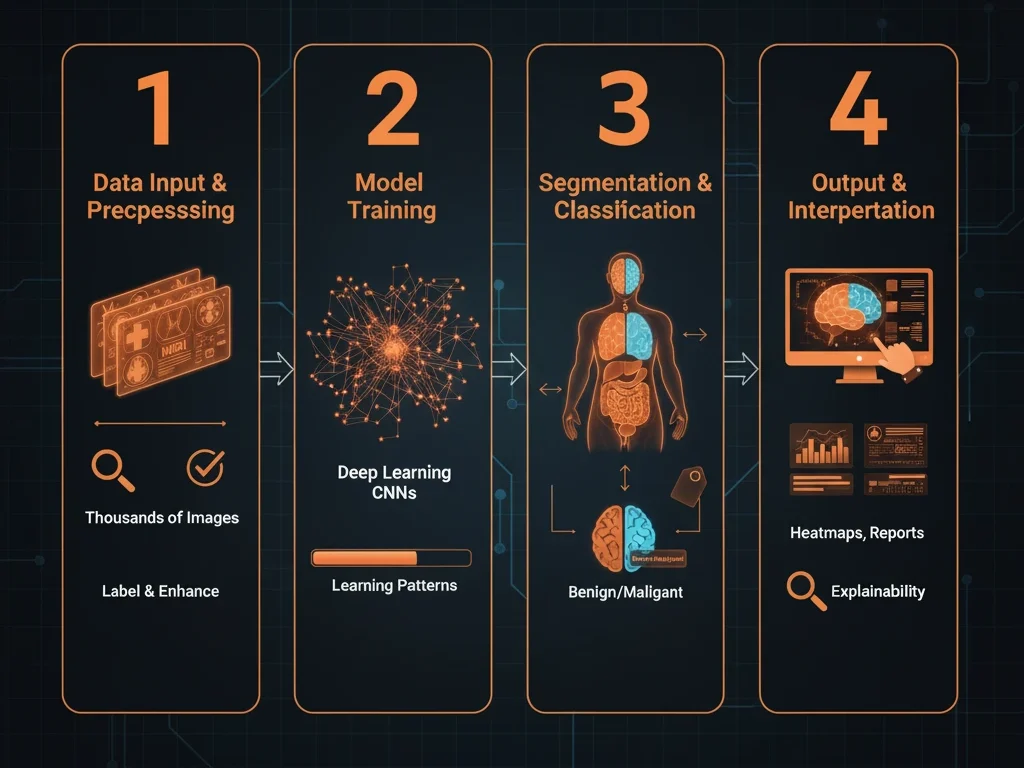
The insight into the functionality of AI in Medical Imaging reveals the complexity of the current diagnostic technologies. The steps followed are usually in four significant phases:
1. Data Input & Preprocessing
AI models thrive on data. They obtain thousands of CT, MRI, and X-ray images and label them with known results (i.e., whether there is a disease or not). The data are preprocessed before training, that is, removing noise, normalizing, and enhancing images, so as to maintain consistency.
An example of the CT dataset of lungs may contain scans from various machines and hospitals. Preprocessing is a process that brings all pictures to a unified standard of quality. This is so that the AI in the Medical Imaging model gets to learn authentic disease patterns as opposed to the irrelevant variations in brightness or resolution.
2. Model Training
Then, there is the deep learning of medical imaging. Convolutional Neural Networks (CNNs) are neural networks that are trained to recognize tumors or other lesions or structural deformities. The model learns the pattern of pixels that represent particular conditions gradually through labeling the images millions of times.
The models gain radiologist proficiency over time. To illustrate, a trained AI model in Medical Imaging will be able to identify lung nodules in CT scans or micro calcifications in mammograms- frequently before they could be identified by a human eye.
The period is essential in the AI diagnostics software development because it dictates the capability of the system to extrapolate results to real-world scenarios.
3. Segmentation & Classification
Segmentation subdivides an image into meaningful parts, e.g., verifying tumors and healthy tissues, whereas classification assigns a diagnostic name (e.g., benign or malignant). Intelligence of AI medical imaging automates this stage at an exceptionally high level, greatly decreasing the number of man-hours.
Examples of AI in Medical Imaging tools include specifying the boundaries of tumors on MRIs in oncology to guide surgeons to execute minimally invasive surgery. In medical imaging with deep learning, the segmentation accuracy keeps improving with richer and more diverse datasets.
4. Output & Interpretation
Lastly, the model provides results in readable formats – probability maps, heatmaps, or reports. These insights are combined with clinical judgment to allow the physicians to make a final diagnosis.
The current AI applications in Medical Imaging tools focus on explainability, unlike black-box algorithms. They emphasize image elements that drive actions, enhance physician trust, and improve communication with patients.
With the implementation of this into hospital systems with the help of AI solutions for healthcare, clinicians will have the chance to look at results in their current radiology workflows, thus saving precious time and promoting interaction between units.
Top Use Cases of AI in Medical Imaging Intelligence
The use case of AI in healthcare is felt across virtually all areas of specialization. The following are some of the innovative applications that are changing diagnostics:
1. Cardiovascular Disease Analysis
Cardiovascular diseases have been a major cause of death across the globe. Medical Imaging AI assists in the early detection of heart defects, valve disorders, and artery blockages. With the assistance of AI medical imaging intelligence, cardiac scans can be examined to calculate the ejection fraction, detect arrhythmias, and even forecast a stroke.
The AI diagnostics software development provides an AI model that automatically analyzes coronary CT angiography images to identify plaque formation or limited blood circulation and saves hours of analysis, which would otherwise take minutes.
This will enable cardiologists to provide quicker and more precise treatment regimens, particularly during emergencies.
2. Neurological Disorder Detection
Neurological disorders like Alzheimer’s, Parkinson ‘s, and multiple sclerosis are difficult to diagnose because of the slight structural changes in the brain. AI in Medical Imaging is able to identify tiny changes in the white or gray matter, which enables early diagnosis.
The intelligent imaging systems in medicine are based on AI that performs an examination of MRI scans of the brain to determine biomarkers that can be the cause of symptoms, but years earlier. Medical imaging through deep learning allows the system to identify the patterns of aging and disease development as healthy or disease-related.
The interpretation of MRI images by AI has assisted clinicians in the detection of early Alzheimer’s disease up to 90 percent, and years before clinical manifestation.
3. Cancer Detection and Screening
Oncology is one of the most noticeable applications of AI in Medical Imaging. The AI models learn to analyze mammograms, CT, and MRI scans and identify cancers at an early stage, which increases the rate of survival considerably.
AI medical imaging intelligence detects too small microcalcifications in breast cancer screening that the human eye cannot. AI is used to identify pulmonary nodules in patients with low-dose CT scans in lung cancer. These results not only accelerate the process of diagnosis but also minimize the false negatives.
With the AI diagnostics software development more sophisticated tools are now a part of the radiology workflow, and radiologists now have automatic warnings of suspicious areas in the process of analysis.
4. Brain Tumor Identification
MDI In neuro-oncology, AI in Medical Imaging supports the differentiation of benign and malignant tumours, their growth, and surgical operations.
The deep learning models of medical images give accurate segmentation maps, which inform neurosurgeons to plan tumor excision to limit the destruction of healthy tissues.
Case Study: EfficientNetB2, a deep learning architecture and one of the AI healthcare solutions with medical imaging capabilities, exhibited a substantial performance enhancement in tumor detection by demonstrating validation accuracies of 99.83%, 99.75%, and 99.2% on BD-BrainTumor, Brain-tumor-detection, and Brain MRI images for brain tumor detection datasets, respectively.
5. Orthopedic & Fracture Detection
The emergency departments are usually challenged by time limits that do not allow them to detect small fractures. Medical Imaging AI identifies fractures in X-rays, CTs, and alerts the doctors.
AI medical imaging systems analyze bone density and track osteoporosis progression with high precision. Furthermore, they help doctors monitor changes early and improve treatment effectiveness. AI diagnostics software development tools can now differentiate between acute and healed fractures, which helps to make better trauma tests.
This not only speeds up the process of care, but also makes sure that no injury escapes notice.

Benefits of AI-Powered Medical Imaging
Implementation of AI in Medical Imaging has quantifiable positive results on the clinical, operational, and patient experience levels as listed below:
1. Improved Diagnostic Accuracy
The AI systems always perform better than the conventional approaches in detecting complicated pathologies. Intelligence in AI medical imaging gets rid of errors caused by fatigue and makes the quality of interpretation consistent across various healthcare organizations.
2. Reduced Diagnosis Time
What once would have taken hours would now take minutes. Medical Imaging AI will be able to scan thousands of images quickly, which will enable clinicians to spend time discussing and treating their patients.
3. Personalized Treatment Plans
AI insights allow the physician to create patient-specific therapies with the help of patient-specific data. The AI healthcare solutions will allow precision medicine, adjusting the intensity, dosage, and monitoring of particular disease progression.
4. Predictive & Preventive Care
Deep learning in medical imaging is not used to diagnose; it predicts. Algorithms have the ability to predict possible complications to enable clinicians to act early.
5. Operational Efficiency
The hospitals enjoy simplified work processes and less manual work. The AI diagnostics software development promotes the management of data, reporting, and interdepartmental interaction, which contribute to the effectiveness of the organization.
Real-World Examples of AI Medical Imaging Intelligence
Several pioneers demonstrate the real-world value of AI in Medical Imaging which are listed as follows:
1. Google Health

Google Health uses AI medical imaging intelligence to analyze mammograms and other imaging data. Its AI models have been able to identify breast cancer with the same accuracy as the top radiologists, and this has allowed early detection of the cancer, reducing false positives and enhancing patient outcomes across the world.
2. Mount Sinai Health System

Mount Sinai is also adopting AI healthcare solutions, which are used to evaluate cardiac CT scans to determine the risk of cardiovascular diseases in patients. Through studying finer anatomical and functional patterns, AI will help clinicians in making an early diagnosis, planning treatment, and optimizing preventive cardiology strategies.
3. DeepMind (Google)

DeepMind uses deep learning in medical imaging to identify diabetic retinopathy and macular degeneration based on retinal scanning. AI detects disease patterns invisible to the human eye, helping ophthalmologists achieve accurate and timely diagnoses. Furthermore, it enhances patient care through data-driven precision.
4. Siemens Healthineers / GE Healthcare
Siemens and GE use AI in Medical Imaging on CT, MRI, and X-ray machines to improve image quality, support the process of report creation, and conduct remote diagnostics. Their AI applications simplify the workflow and enhance its precision, as well as assist radiologists with intricate imaging issues.
These instances demonstrate how AI is changing diagnostics to be a proactive rather than a reactive field.
Challenges in Adopting AI in Medical Imaging
Despite significant potential, adopting AI in Medical Imaging faces several challenges. Below are the major challenges that can be faced during AI in medical imaging:
1. Data Privacy and Security
The information about a patient is very confidential, and any unauthorized access may lead to disastrous outcomes. Healthcare platforms must encrypt AI systems and implement access controls to ensure secure data storage, transmission, and processing. Moreover, they should comply with HIPAA or GDPR standards for maximum data protection.
2. Model Bias and Accuracy
Models of AI developed with unbalanced or non-representative data might give biased or inaccurate results. Diversity of training data, frequent validation, and constant monitoring are essential to ensure that the diagnosis is accurate and that disparities in the outcomes of the treatment of the patients do not exist.
3. Integration Barriers
Most of the hospitals use legacy systems that are not compatible with the current AI tools. The seamless integration will involve custom interfaces, standardization of data, and workflow realignment, which will help to make sure that AI-driven diagnostics complement the current processes and do not interfere with clinical work and treatment of patients.
4. Regulatory and Ethical Constraints
The use of AI in healthcare should be strict and controlled by regulatory requirements in order to be safe and effective. Developers and healthcare teams validate, test, and ethically evaluate all systems before implementation.
They also ensure patient consent, maintain accountability, and address bias-related issues for safe diagnostic use.
5. Cost and Skill Gaps
The installation of AI diagnostics needs significant investments in hardware, software, and cloud computing. Furthermore, hospitals will have to recruit or educate qualified staff that is capable of creating, sustaining, and interpreting AI outputs to achieve as many benefits as possible and minimize mistakes and operational hazards.
Healthcare institutions must address these barriers effectively to unlock AI’s full diagnostic potential. Moreover, proactive measures can ensure smoother adoption and better clinical integration.
Partnering with A3Logics AI Development Company
To overcome these issues successfully, healthcare institutions need to partner with an AI Development Company they can rely on, such as A3Logics.
The A3Logics offer an end-to-end AI Software Development Service that assists hospitals, diagnostic centers, and research institutions in introducing AI into the Medical Imaging process without difficulties. Our offerings include:
- Cyber-plastic AI model design to achieve specific imaging objectives.
- Individual training and fine-tuning of AI models.
- Development of AI agent to automate the workflow.
- HIPAA and FDA ready deployment.
This is because of our profound understanding of AI medical imaging intelligence, which makes each solution scalable, secure, and clinically validated.
Moreover, A3Logics is providing custom AI Solutions to Healthcare that enhance diagnostics, manage image automation, and make decisions informed by data.
Conclusion
Data science, radiology, and clinical care convergence have introduced the age of AI in Medical Imaging. Developers created imaging intelligence that offers physicians advanced insights using predictive analytics and autonomous image interpretation. Furthermore, it delivers capabilities that were once unimaginable in diagnostics.
AI healthcare solutions are transforming the treatment of patients by integrating the analytical accuracy of the machine with the skills of human clinicians, allowing them to diagnose patients faster, provide individualized treatment, and conduct more productive operations.
Healthcare institutions may leverage this potential by partnering with experts such as A3Logics, one of the industry leaders in the provision of AI Software Development Services. A3Logics develops custom AI diagnostic software and workflow automation to lead your organization toward smarter medical imaging. Moreover, our solutions ensure seamless integration and a more connected healthcare future.
In the coming decade, AI in Medical Imaging will not be supportive anymore; it will be a clinical partner, so that every scan has a whole story of Wellness, recovery, and hope.