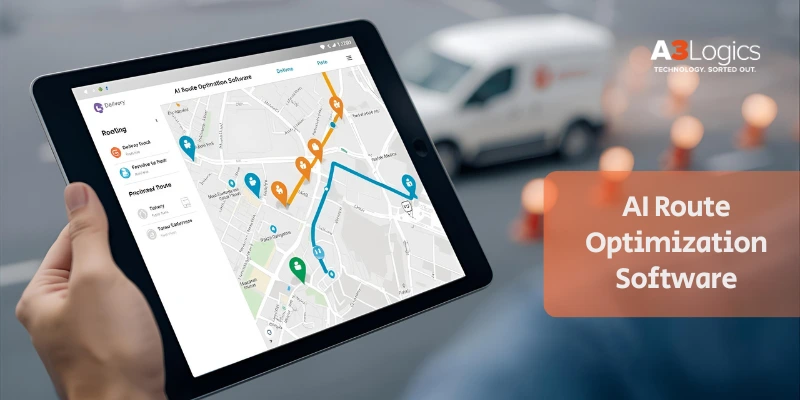
AI route optimization systems are changing logistics and supply chain strategies, enabling businesses to deliver faster, save money, and solve real-world routing problems. With AI in the mix, businesses in various industries can utilize real-time data and machine learning to be more effective than off-the-shelf route optimization applications.
Here in this post, you will learn all the basics you need to know about an AI Route Optimization Software Development, benefits, functionality, cost estimates, industry trends, and professionals who responded to frequently asked questions.
What is AI Route Optimization?
Route optimization is using algorithm computations based on artificial intelligence to make optimal driving routes for vehicles. AI Route Optimization systems differ from conventional methods in two important ways; firstly, AI systems are capable of constantly updating real-time data, traffic, weather, vehicle capacity and so on, which is factored into calculating the most optimal route.
Secondly, AI algorithms built into AI Route Optimization systems acquire knowledge from both previous trips and real-time trips. Most importantly, you will realize over time that AI route optimization software learns and becomes more effective as the vehicle incurs a trip. AI in route optimization means better, cost-effective delivery management in real-time.
Why Do Businesses Need AI Route Optimization Software in 2025 and Beyond?
As we look ahead to 2026, the logistics space is experiencing unprecedented competitiveness, meaning we will see smarter delivery networks. AI Route Optimization Software has experienced an increase in global adoption rates of over 100% in the past 5 years, as companies search for faster delivery speeds and savings. For example, leading AI Route Optimization companies report between 15% lower fuel costs to 35% better on-time deliveries while using AI. This increase in AI usage is stemming from e-commerce volumes, on-demand customer expectations, and the requirement of resilience.
Common Challenges in Route Optimization and How AI Solves Them
Route Optimization, like most things, has its challenges.
Traditional routing struggles with manual planning holdups, traffic disruptions, and multi-stop complexities. These factors result in delays, higher costs, and unhappy customers.
1. Dynamic Traffic Conditions
First, dynamic traffic conditions, whether caused by an unexpected traffic jam, accident, or construction, can easily disrupt even the best optimized routes and lead to continual delays and rising fuel costs. Weather changes whenever they occur, stemming from an unforeseen inconvenience, like construction schedules or forced detours, only make the situation worse by precluding convenient, large-scale, manual rerouting changes.
2. Delivery Constraints
Furthermore, complex delivery constraints represent a relevant concern. Logistics managers need to consider many factors outside of the actual route, including: time constraints, customer expectations, and compliance and regulatory needs (like having a legal requirement for purchased products to have approval).
There may even be situations in which the vehicle and its handling specifications are factored in when developing delivery routes, as many deliveries can consider requests regarding product handling, accommodations for requested product handling, or vehicle capabilities. For example, perishables or pharmaceuticals have very specific transportation handling requirements in terms of temperature, light exposure, and level of exposure.
3. Computational Issues
The increasing extensiveness of operations brings in computational challenges as well. The vehicle routing problem becomes more intricate with increased stops, vehicles, and restrictions that it quickly becomes impractical to compute using brute-force, exhaustively. Oftentimes, without integrated data and real-time analytics, you can run into inaccuracies or outdated information, which can be problematic for route decision-making.
4. Lack of Visibility
The administrative burden and lack of visibility can increase operational costs as well as the customer experience. Overcoming these challenges requires a shift to automated, AI-powered route optimization products that allow for real-time recalibration, enhanced restriction handling, and more intelligent resource allocation.
Enter AI Route Optimization, which uses real-time technology to automatically shift routes when unexpected situations arise. Predictive analytics also highlights hotspots proactively, while the system assigns resources most effectively, even when the variables shift from minute to minute.
Benefits of AI Route Optimization Software for Logistics and Enterprises
1. Reduced Fuel and Operational Costs
AI-enabled Route Optimization Software maximizes the directness and minimizes the congestion of vehicle trips, decreasing excess mileage and idle time. Because it allows organizations to dynamically reroute based on real-time data, companies can experience savings of as much as 20% in fuel and operational costs. This benefit is scalable and can provide large fleets with significant overall savings in logistics costs for the long run.
2. Increased Delivery Speed and Efficiency
One of the signature advantages of AI Route Optimization is the speed and reliability of pickups and deliveries. The software can alter routing instantly due to unanticipated delays from traffic jams or route changes, thus reducing delays. This also contributes to more on-time deliveries and allows organizations to accomplish more deliveries each day, improving fleet utilization.
3. Enhanced Customer Experience
Modern customers expect exact delivery times and tracking information in real time. With AI for Route Optimization, organizations can provide dynamic estimated time of arrivals (ETAs), and automatically log complete information thus, increasing service visibility and transparency. The increase in response time and information provided increases customer retention and satisfaction, both essential in the transportation and delivery space in today’s age.
4. Better Resource Utilization
AI Route Optimization Software improves the engagement of vehicles, drivers, and equipment. It accounts for all capacity, schedule, and constraints to keep assets engaged while minimizing the ineffective use of schedule. Organizations could use less vehicles while achieving more coverage, resulting in less overhead, and higher return on investment in fleet resources.
5. Scalability and Flexibility
Expanding businesses require a system that can accommodate increased order volumes and new delivery zones. AI Route Optimization Software is built to scale with the business from a small fleet to enterprise-wide operations. Its flexible algorithms can convert to a sudden surge or seasonal demand, allowing the agile business growth needed to service new geographies and services.
6. Environmentally-Friendly Logistics
Environmentally -conscious operations are key to businesses today. AI Based Route Optimization optimizes routes to minimize unnecessary trips and downtime when engines are on, reducing CO2 emissions and supporting green initiatives. Companies using Artificial Intelligence in Route optimization not only meet or exceed sustainability targets but have been noted for their superior environmental standing and reputation.
Key Features to Include in AI Route Optimization Software Development

1. Real-Time Route Planning
This essential function takes in real-time traffic and weather data and immediately reroutes traffic to mitigate delays or dangers. AI Route Optimization systems are consistently measuring what’s occurring, and they are feeding the information to drivers on the road, so they are always on the best journey to their destination.
2. Live Weather Monitoring
Bad weather can ruin a schedule and create safety threats. By adding live weather into the AI Route Optimization system means you are creating a very resilient delivery plan. The system specifically identifies hazards and reroutes ahead of trouble, protecting assets and keeping them on time, regardless of the weather.
3. Routing with Multiple Stops
Consider that many deliveries do not include just one delivery. Many include a dozen stops on a route. AI Route Optimization Software will identify the best sequence of stops so that travel is reduced and balanced against vehicle constraints such as load limits, servicing windows, and driver timing. Less empty miles, with the same level of service.
4. Predictive Intelligence
By leveraging machine learning, AI Route Optimization Software can model traffic spikes, length of delays, and even maintenance issues before they become costly. This predictive intelligence can be used to identify and support alternative routes, schedule vehicle downtime, and generally keep everything running.
5. Integration with GPS & Telematics
The integration with GPS devices and telematics has been seamless, allowing the system constant accessibility to real-time position, vehicle condition, and driver behavior. This data-rich environment enhances AI Route Optimization decisions creating the best accuracy and reliability.
6. Driver & Vehicle Tracking
The AI Route Optimization Software provides managers with tracking functions that can see where the fleet is located, how it is moving, and if it is following the route as intended. This creates transparency monitoring unit safety and allows the company to take action for change while in motion.
7. AI Dispatching
In addition to routing, intelligent dispatch then determines the right jobs for the right vehicles and drivers while considering schedules, capacity, and distance. Automated dispatch from AI Route Optimization Software eliminates the manual dispatching process and ensures the right jobs are consistently assigned correctly.
8. Customizable Dashboards
Dashboards displaying KPIs, real-time locations, alerts of exceptions, and where to go next are necessary for good user experience. AI Route Optimization Software Development should support configurable views tailored for managers, drivers, and operations teams. This enables timely and effective strategic decisions.
9. Offline Functionality
Offline capability enables AI Route Optimization Software to operate smoothly in low service areas. Important data is preloaded into the device allowing the driver to complete routes with no service and automatically sync when back in service.
10. Analytics & Reporting
Organizations can leverage built-in analytics to monitor fleet performance, delivery issues, cost per route and much more. The use of AI in Route Optimization offers companies actionable insights that lead to improvements in route efficiency, cost savings and identifying delays in processes for continuous improvement.
11. Mobile Application Capability
As remote and field strength increases, mobile AI Route Optimization Software provides support for drivers to receive real-time updates, changed routes, and communicate regardless of their location. This improves processes and minimizes reliance on center dispatch.

AI vs Traditional Route Optimization: What’s the Difference?
The traditional way to optimize routes uses rules and relies on static maps and schedules. If deliveries need a route change, change the schedule, or a customer request requires modification, a human will have to determine how to do this. AI Route Optimization leverages real-time data to recalculate delivery routes instantaneously while constantly developing the best solution.
Since AI Route Optimizations is predictive, every time the route changes, it learns and becomes even more effective than static systems with regard to speed and efficiency.
| Feature | Traditional Routing | AI Route Optimization |
| Data Inputs | Static, planned ahead | Real-time, dynamic |
| Adaptability | Low | Very high, instant updates |
| Performance Over Time | Stagnant | Learns & improves |
| Handling Disruptions | Manual, slow | Automated, fast |
| Resource Utilization | Moderate | Maximized |
| Customer Satisfaction | Varies | Consistently high |
Industry-Specific Use Cases of AI Route Optimization Software

1. Food and Grocery Delivery
Route Optimization powered by AI gives your delivery service the ability to quickly respond to changes in the destination of an order, to traffic, or inclement weather. Route Optimization also delivers freshness by ensuring that the delivery driver takes the shortest and fastest path when delivering time-sensitive items. As a result, the delivery solution improves on-time delivery rates even in rush hour or high-demand situations, which is crucial for food delivery entities to encourage repeat business.
2. E-commerce and Retail Supply Chain
e-commerce, especially the supply chain that supports it, relies on the timely processing and fulfillment of tens of thousands of shipments on demand or for same-day delivery. For Route Optimization to be effective in e-commerce logistics, it must be able to split orders intelligently, provide load balancing, and help facilitate last-mile delivery. Whether for same-day or next-day service, Route Optimization is an important factor for retailers to support their customers, in addition to reducing logistics costs, and improving speed to market.
3. Healthcare and Pharmaceutical Logistics
In healthcare logistics, there is no room for error regarding timing and temperature. Consider a healthcare solution where Route Optimization adds considerable value by not only factoring in shipping priorities but also regulations, and any special handling needs, too! Or consider specialty pharmacies that rely on quick routes for urgent medicines to ensure delivery safety, even if the original route has an emergency redirect!
4. Ride-hailing and Taxi Services
AI Route Optimization Software simplifies ride allocations and routes, pairing drivers with riders efficiently. AI Route Optimization Software runs through traffic, demand zones, and wait time, to minimize driver idle time and rider wait time. This impacts revenue and ensures better coverage during peak times.
5. Waste Collection and Smart City Solutions
For municipal services, AI Route Optimization improves planning collection routes based on waste amount, pick-up frequency, and city events. The software minimizes overlap while minimizing traffic impact, and ensures vehicles take the most eco-friendly routes. are able to streamline resources and work toward smarter and cleaner solutions.
Technology Stack for AI Route Optimization Software Development
Building AI-powered route optimization software requires a robust technology stack that combines artificial intelligence, geospatial analysis, and scalable infrastructure. Below is the essential stack:
1. Programming Languages
- Python – For AI/ML model development, optimization algorithms, and data analysis.
- JavaScript (Node.js) – For backend services, APIs, and event-driven systems.
- Java / Kotlin / Swift – For mobile app development (Android & iOS).
- C++ – For performance-heavy geospatial calculations.
2. Frameworks & Libraries
- AI/ML Frameworks: TensorFlow, PyTorch, Scikit-learn for predictive modeling and optimization.
- Optimization Libraries: Google OR-Tools, Gurobi, CPLEX for route and scheduling optimization.
- Geospatial & Mapping: GeoPandas, Shapely, Leaflet, Turf.js for handling map data.
- Data Processing: Pandas, NumPy, Apache Spark for large-scale data handling.
3. Databases
- Relational Databases: PostgreSQL with PostGIS extension for spatial queries.
- NoSQL Databases: MongoDB for handling unstructured logistics data.
- Time-Series Databases: InfluxDB for tracking real-time vehicle and delivery data.
4. Cloud & Infrastructure
- Cloud Providers: AWS, Google Cloud, Azure for scalability and AI services.
- Containerization & Orchestration: Docker, Kubernetes for deployment and scalability.
- Serverless Computing: AWS Lambda, Google Cloud Functions for event-driven tasks.
5. APIs & Integrations
- Mapping APIs: Google Maps API, Mapbox, OpenStreetMap for navigation and geocoding.
- Traffic & Weather APIs: HERE, TomTom, WeatherStack for real-time updates.
- Fleet Management APIs: Telematics integration for IoT-based vehicle tracking.
6. Frontend Development
- Web: React.js, Angular, Vue.js for dashboards and admin panels.
- Mobile: React Native, Flutter for cross-platform mobile apps.
- Visualization Tools: D3.js, Chart.js, Plotly for analytics and route visualization.
7. DevOps & Monitoring
- CI/CD: Jenkins, GitHub Actions, GitLab CI for automated deployment.
- Monitoring Tools: Prometheus, Grafana, ELK Stack for performance and logs.
- Version Control: Git, GitHub, GitLab for source code management.
8. Security & Compliance
- Encryption: TLS/SSL, AES for secure data transmission.
- Authentication: OAuth 2.0, JWT for user access control.
- Compliance: GDPR, SOC 2 for data privacy in logistics and transportation.
Cost of Developing AI Route Optimization Software
The cost of a development investment into AI Route Optimization Software varies significantly depending on scope, features, and expected complexity. A basic service with minimal analytics may start around $25,000, whereas an evolving enterprise level may be well over $300,000. A basic understanding of these dimensions can help organizations better budget for programming that meets the needs of a particular business.
Estimated Cost Breakdown
- Basic Software: The cost is from $25,000 to $60,000 and will provide you with basic capabilities for route planning, along with basic dashboard capabilities for small fleets.
- Mid-level Solution with Analytics: The cost is from $60,000 to $120,000, and the cost will provide enhanced analytics, mobile, and improved data ingestion capability.
- Advanced Enterprise-grade Solution: The cost is from $120,000 to $300,000+, and the cost will provide predictive artificial intelligence, full integrations, and cloud scalability, along with considerable regional support.
Key Factors That Influence Development Cost
- Algorithm Complexity: The complexity of machine learning algorithms, along with the need to configure multiple variables increases costs for AI Based Route Optimization.
- Feature Set and Platform: The need to support both a web and mobile-based platform and integrate with ERPs and telematics and/or proprietary APIs increases both the complexity and pricing.
- Team Size and Location: Cost is also affected by whether you are engaging an experienced software development services expert offshore.
- Third-Party Services and Integrations: There are further expenses associated with outside GPS, mapping, and real-time data provider APIs, and the potential for licensing fees, among other related costs.
Future Trends in AI Route Optimization Software Development
The development of AI Route Optimization software is growing quickly due to the advanced, data-dependent logistics needs today. Key trends are:
a. Hyper-Personalization & Predictive Customer Analytics
AI Route Optimization Software is leveraging data related to customer’s delivery preference, based on data, to dynamically customize the most appropriate ETAs. Tapping into the AI power for Route Optimization will deliver expected service and productivity.
b. The Future of Generative AI & Natural Language Interfaces
Natural language driven interfaces and AI chatbots are simplifying route planning for drivers and dispatchers. Generative AI will offer suggestion, simulation, or communicate changes in route at a moment’s notice, making a future of AI powered Route Optimization even more intelligent and user-friendly.
c. Integration with Autonomous and Electric Vehicles (EV)
With the expansion of the sustainable fleets, the AI Route Optimization Software is managing route optimization for EV’s based on battery range districts and charging station zones and regulations. It will also allow for management and allocation for autonomous vehicles and traditional vehicles, completely changing the landscape of logistics in the future.
d. Unified Supply Chain Smart Control Towers
These new platforms will consolidate the data set from the entire supply chain, enabling AI Route Optimization algorithms full visibility. Organizations will have the option for real time control over inbound, outbound and last mile logistics, improving transparency and accountability.
e. Sustainability as a Core Optimization Goal
Using eco-friendly routing has transitioned from being optional to essential. AI in Route Optimization now plays an active role in carbon footprint reduction, low-emission route planning, and enhancing corporate social responsibility, thus contributing to the development of more eco-friendly and sustainable supply chains.
f. Edge Computing and Decentralized Intelligence
Given that more IoT devices will exist at the network edge, real-time, on-the-spot decision-making about routes can occur closer to data generation points. This means recalculating routes faster with more robust AI Based Route Optimization, radially or at high through-put delivery networks.
g. Advanced Simulation and Digital Twins
To plan routes, AI Route Optimization will increasingly use digital twins, virtual models of networks, to conduct scenario tests, predictions for disruptions, and benchmarking of costs. This allows logistics planners to understand risks/rewards in decision making and proactively optimize routes. For additional guidance, refer to our guide on the role of AI in Supply Chain.

Why Choose A3Logics for AI Route Optimization Software Development?
A3Logics is a leading provider of custom AI Route Optimization Software Development for specific industries, empowering companies to scale with sustained agility and future-proofed cost reductions. A3Logics leverages deep technical expertise in AI Development Services to provide cutting-edge AI, dashboards designed for users, and robust analytics with every project. As a top AI Agent Development Company, the end-to-end support for their AI Route Optimization Software Product ensures a valuable and seamless route optimization experience.
Final Thoughts
AI Route Optimization is changing how businesses think about logistics, resulting in increased speed, reliability, and efficiency in their day-to-day operations. As technology breaches the smart world by introducing generative AI, autonomous fleets, and other technologies increasingly integrated into day-to-day struggles, companies will need to adopt route optimization sooner rather than later.
Companies that strategically address AI Route Optimization Software Development and underlying technologies will realize significant opportunities to improve bottom-line costs, customer loyalty, and sustainability.