
Why do so many law firms lose prospective clients before the first consultation even happens?
It isn’t usually because of poor legal expertise. It’s because of inefficiencies in the very first step: client intake.
In 2025, clients are looking for the speed and convenience of services that are digital-first. Firms using paper forms, emails, and manual processes are already losing their market share.

Manual intake procedures, repeated data entry, and compliance risks are costing law firms their valuable time and resources. A Clio legal trends report stated that attorneys spend only 33% of their time on billable work and that the majority of the rest is spent on administrative tasks like intake. For firms, this inefficiency ends up directly affecting their profitability.
This is where Legal Client Intake Software becomes a game-changer. With the help of digitizing, streamlining, and improving the intake procedures, firms handle faster onboarding, increased accuracy, better compliance, and superior client experience. This overall reduces costs and allows attorneys to concentrate on the high-value work.
In this blog, we will focus on automation in client intake, benefits, must-have features, real-world examples, cost considerations, and future trends.
What Is Legal Client Intake Software and Why Does Automation Matter?
Legal Client Intake Software is basically a platform where you can gather and organize any information or data you receive during the intake process. It enables the replacement of manual forms and ad-hoc communication with automation. Traditionally, the intake process had paper forms, emails, and phone calls, which are often prone to error, loss of information, and delays.
Automation adds smart workflows, integrated databases, and AI features to handle routine tasks accurately. With Client Intake Software for Law Firms, data does not need paralegals anymore who are retyping it manually. It just flows easily through connected applications. Instead of waiting for follow-up calls, the prospective clients receive the automated reminders and e-signature requests that create a fast and more professional onboarding experience.
Why Should Law Firms Invest in Custom Client Intake Software in 2026?
The legal services market is witnessing a digital transformation at a fast pace. The global legal tech market is expected to hit $61.2 billion by 2033. Thus, the introduction of custom legal client intake software has become a reasonable goal to be attained by firms in 2025.

The main driving factors cover:
1. Meet Evolving Client Expectations
Clients nowadays are looking for a hassle-free, non-stop onboarding process. Thanks to their digital experience, customers in banking and healthcare now expect the same from law firms. A custom client intake platform offering 24/7 initiation, immediate acknowledgments, and mobile access helps to establish trust and to look modern, thus preventing firms from being viewed as obsolete.
2. Competitive Advantage and Higher Conversion Rates
Research shows that online intake tools can bring law firm revenue up to 53% just by optimizing the conversion process.
3. Efficiency and ROI
Custom software might seem expensive, but the ROI is worthwhile. In contrast to “off-the-shelf” products, where 85 to 90% of features remain unused, the custom intake software has no restrictions; customers only pay for what they need.
4. Integration with Firm Workflows
Each law firm has its own unique steps in the intake and approval processes. Custom solutions can easily embed the existing CRM, case management, billing, and conflict-check systems, while avoiding the idle and generic tools that force workarounds or duplicate entries.
5. Data Ownership
In contrast to the vendor-controlled software, custom solutions allow firms to keep full data ownership and technology roadmap controls.
For the above reasons, firms choose custom Client Intake Software for Law Firms that fully aligns with their workflows.
The Traditional Client Intake Process vs. Automated Systems
Traditional Intake
- The traditional client intake process is reliant on manual forms, email threads, and phone calls for communication.
- There is also duplication of efforts sometimes, e.g., entering the same info in the systems.
- The client experience can be frustrating and inconsistent due to delays.
- The tracking of compliance (e.g., conflict checks, consent documentation) is inconsistent and all done manually.
Automated Intake
- Smart digital forms linked to Client Intake and CRM Software for Legal Firms.
- The system ensures reduced errors and high accuracy due to its real-time data capabilities.
- You can have predefined rules to qualify cases with the help of AI workflows automatically.
- Clients can also onboard themselves with the help of chatbots or mobile applications.
- Lack of human risk, automatic compliance checks, e-signatures, and audit logs build credibility and accountability.
Top Benefits of Automation in Legal Client Intake Software Development

1. Time Savings and Faster Onboarding
Automation leads to the elimination of unnecessary steps and enables onboarding clients in just hours, rather than days. The example here is a client filling out a smart digital form; as a result, their data is automatically validated and recorded in the case management system.
2. Improved Accuracy and Reduced Errors
Manual data entry, in fact, is one of the core and principal sources of data entry errors. Legal Client Intake Software has a mechanism that accepts only valid entries through an automated validation process, rather than just leaving a required field abandoned. This increases the likelihood of a correct entry and reduces the risk of incorrect values.
3. Enhanced Client Experience
In 2025, clients want top-notch experiences. Services like onboarding portals, mobile apps, and instant confirmation via email are elevating client experience.
4. Better Case Screening and Qualification
Firms can also set rules and have predefined thresholds to refine or screen cases based on their specific requirements and exclusions. This ensures that attorneys spend their time wisely.
5. Increased Productivity and Efficiency
The Client Intake Software for Lawyers eliminates all boring admin tasks. This results in attorneys to work on higher-value tasks, increasing productivity and efficiency.
6. Seamless Data Management and Integration
Automation helps data to exchange very seamlessly between systems like case management and CRM platforms. This results in better reporting, more effective client follow-ups, and stronger long-term relationship building.
7. Stronger Compliance and Security
Compliance is one of the major concerns in law related matters. Legal Client Intake Software can integrate client consent forms, perform conflict checks, and automatically save records that will pass audit tests. With the increase in cyber threats, document management with security and encrypted workflows is essential.
8. Scalability for Growing Law Firms
The manual intake process is the biggest bottleneck for legal firms. Once they resolve it with the help of automated systems, they scale fast. The most significant benefit of automation in any system is the ability to scale. Automation enables firms to handle more cases without a substantial increase in team size.
AI and Machine Learning in Legal Client Intake: What Law Firms Should Know
1. Predictive Analytics for Client Conversion Rates
Based on the previously collected data, Client Intake Software for Lawyers powered by AI is able to set a probability of the conversion of each potential client into an actual one. Not only will this help the firms to strategically prioritize outreach but it will also contribute to a better marketing ROI.
2. Natural Language Processing for Chatbot Interactions
The NLP-powered chatbots are smart enough to give instant answers to clients’ questions, collect basic information and schedule appointments. They take over these first contact interactions so that potential clients get fast responses which ensure good engagement and prevent missed opportunities.
3. Machine Learning for Smarter Data Categorization
Machine learning algorithms can easily categorize and label the client data. This ensures that records are managed and stored correctly. When this is combined with Legal Client Intake Software, it improves knowledge management. More importantly, it eliminates the workload from the staff while improving accuracy.

Must-Have Features of Automated Legal Client Intake Software
When assessing or creating attorney-client intake software, the law firms need to put first the features that are compatible with their operational goals and compliance obligations. Must have features:
1. Customizable Intake Forms
The legal intake systems have customizable forms that can be different for different clientele.
2. Smart Data Capture and Validation
Details such as mobile number and address can be easily captured and updated with the help of automated intake systems.
3. E-Signature Integration
The system also features an e-signature option to streamline the contract process.
4. Client Self-Service Portal
Clients can easily upload documents and track their progress during the intake process.
5. Automated Case Screening and Qualification
There is a possible chance of getting irrelevant or unwanted data during the intake process. Legal Client Intake Software evaluates cases before an attorney checks them.
6. Integration with CRM & Case Management Systems
Clients’ data is seamlessly exchanged within the systems to avoid any delays and maintain transparency.
7. Secure Document Upload and Management
The data stored in the system is always encrypted. Only authorized individuals can access and control it.
8. Automated Workflows and Notifications
These systems also enable reminders and follow-ups to be done automatically.
9. Built-in Compliance and Data Security
The system easily checks GDPR or CCPA compliance. It also monitors conflict checks and consent management.
10. Analytics and Reporting Tools
The systems have a dashboard and analytics tools to track conversion rates and other important metrics.
11. Mobile Accessibility
Both clients and staff can handle work through their mobile phones and tablets.
12. AI-Powered Chatbots for Initial Interaction
There are chatbots always available to engage with clients and also enable them to schedule appointments.
Key Legal Software Development Services We Offer
Real World Examples of Top Automated Legal Client Intake Software
1. Clio Grow: The All-in-One Powerhouse
Clio Grow is a full-fledged client intake software for law firms. It is widely adopted and famous for its end-to-end approach. It is part of the Clio suite, allowing law firms to get new clients, automate scheduling and sync processes with billing and case management.
2. Lawmatics: The Marketing & Automation Champion

Lawmatics is focused on blending market automation with Legal Client Intake Automation. The software gives a wide range of options like drip campaigns, automated reminders, customizable intake forms, etc. These marketing functionalities help legal firms to engage with their clients more effectively.
3. Smokeball: The Practice-Management Integrated Solution

Smokeball is one of the best solutions compared to standalone solutions. It directly connects intake data to case documents and tasks. Smokeball users have expressed satisfaction with data arriving directly from intake to case without duplication.
4. Filevine: For Complex Case Management & Intake

The Filevine intake system is directly linked to management-style dashboards that project activities where the client is making progress. It also supports mobile first intake, as important as attorney client intake software, helping clients provide their details from their smartphones.
5. PracticePanther: The User-Friendly All-Rounder

PracticePanther is very user-friendly and quickly installed. Firms without much IT support appreciate how fast they can put a new form, a new client portal, or a new workflow trigger in place. It has become one of the most viable and affordable options in Client Intake Software for Lawyers and is chosen by many small and mid-size companies.
Cost of Developing Automated Legal Client Intake Software
Legal Client Intake Software Development requires a well planned roadmap from start to building a full functional system. The cost can vary. It mainly depends on the features required, integrations, and compliance needed. Industry rates show that:
- A basic automation system (digital forms, e-signature, document uploads) with costs ranging between $50,000 and $80,000.
- Systems of mid-range (CRM integration, client portals, analytics dashboards) cost somewhere between $100,000 and $180,000.
- Custom platforms of enterprise-grade (AI-driven qualification, predictive analytics, advanced compliance workflows) cost, on average, between $200,000 and $400,000+.
Some common cost-impacting factors are:
- Integration scope – this entails legacy CRM, billing, and case management software.
- Regulatory compliance – some functionalities such as HIPAA compliance (for health-related law) or GDPR (for International cases) require extra financing.
- Scalability – systems that are suited for large and multi-location firms should be cloud-native. The system should be built on a microservices architecture. This actually increases the development costs but reduces the technical debt in the long run.
- Customization level – It is best to partner with a custom software development company when you have unique and complex workflows.
For building a customized system, the initial costs might seem high, but the ROI makes it completely worthwhile.
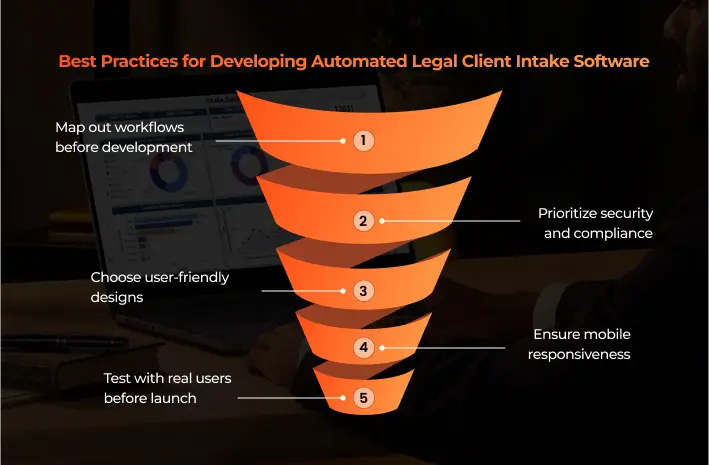
Challenges in Implementing Automation in Legal Client Intake Systems
1. Resistance to Change from Staff
The biggest resistance or challenge is your staff itself. Adopting legal client intake software can be particularly challenging when attorneys and staff are comfortable with traditional systems. To implement automation, proper change management is necessary to facilitate rapid adoption.
2. High Upfront Investment
The high initial cost of the legal intake system prevents smaller firms from adapting. The ideal situation is often to start with an intake form and e-signature, and then after a period, expand into predictive analytics and AI-driven qualification.
3. Integration with Legacy Systems
Sometimes, law firms use outdated systems for billing or case management. Therefore, it may be challenging to integrate old systems with new, modern intake platforms. However, working with Law Tech Software Development Companies with expertise in middleware, APIs, and data migration can lessen the risk of disruption and ensure a smoother transition.
4. Ensuring Compliance during Migration
Migration from legacy to modern digital platforms always raises compliance issues, mainly about data privacy. The systems should be designed to include encryption, consent management, and role-based access to ensure they adhere to all compliance requirements from day one.
Why Custom Legal Client Intake Automation Outperforms Off-the-Shelf Tools?
Off-the-shelf systems fail to cover the in depth features required by existing legal practices, resulting in low efficiency. For example, off-the-shelf tools may not have the most advanced conflict-checking, which requires industry-specific compliance or integration with proprietary CRMs.
Custom-built Legal Client Intake Automation presents:
- Structured workflows – demonstrating practice-specific needs (e.g., personal injury vs. corporate law).
- Extreme compliance integration – embedding firm-specific ethical rules and jurisdictional requirements.
- Growth – systems designed to develop alongside the firm’s client base and caseload.
- Distinct competitive edge – Making onboarding superior to competitors using generic tools.
The above points show why top legal firms collaborate with a Custom Software Development Company for long-term success.
Future Trends: The Evolution of Automation in Legal Software Development
1. AI-driven Predictive Intake Forms
In the future, no intake system will be simply information-recording. They will be anticipatory tools. By analyzing previous cases, predictive forms will be able to suggest questions and collect the information that is most required for specific practice areas. This will not only reduce the friction but will also make the data much more reliable.
2. Voice-based Intake Assistants
With the advent of highly conversational AI, clients may begin the intake process through voice interaction from smartphones or smart speakers. The hand-free operation is particularly significant to clients in a stressful situation, for example, those engaged in personal injury or family law cases. Voice-based assistants integrated by AI for Case Management can consolidate intake while keeping it in an empathic and client-friendly manner.
3. Blockchain-powered Secure Document Sharing
The most important factor in the legal practice is maintaining confidentiality. The use of blockchain technology in this arena is interesting because it provides a track-through method for document sharing during the course intake to be secure from tampering. By integrating blockchain into Client intake and CRM software for Legal Firms, companies can take care of the documents being presented as original, thus building the trust of the clients in data integrity.
4. Hyper-personalized Client Onboarding Experiences
Systems that are integrating both machine learning and behavioral analysis will be able to provide the next generation of onboarding with hyper-personal appeal. For instance, intake portals may automatically switch to a simpler language option if a client has a hard time reading a document or offer multi-lingual options in real-time. Firms working with AI Agents in Legal Industry may be able to provide the clients with exactly the experience they were looking for, hence they will be happy and come back again.

Why Choose A3Logics for Integrating Client Intake Automation with Case Management Systems?
Selecting the right partner for automation is as critical as the technology itself. A3Logics has established itself as a leader in Law Firm Software Development Services, combining deep expertise in the legal domain with advanced technology capabilities.
Key differentiators include:
- Custom-Built Solutions: A3Logics designs tailored systems, ensuring every aspect of attorney client intake software aligns with firm-specific workflows, compliance requirements, and growth objectives.
- AI-Powered Innovation: A3Logics integrates predictive analytics, NLP-powered chatbots, and machine learning models to deliver future-ready intake solutions.
- Compliance-First Approach: With expertise in U.S. regulatory frameworks like HIPAA, CCPA, and ABA ethical guidelines, A3Logics ensures compliance is embedded from day one.
- End-to-End Integration: A3Logics connects intake automation seamlessly with CRMs, billing, and case management systems, reducing silos and enabling holistic client lifecycle management.
- Proven Track Record: With 20+ years in technology consulting and numerous legal tech implementations across the U.S. and beyond, A3Logics delivers measurable ROI and long-term scalability.
Conclusion
The manual processes eat up the resources, make mistakes, and compromise the client’s satisfaction. On the other hand, the Legal Client Intake Software using automation is the one that offers real improvements in speed, accuracy, compliance, and profitability.
Every day you spend on outdated intake processes is a day of wasted resources. The future belongs to those who embrace automation now.
Partnering with a trusted partner like A3Logics, delivering world-class AI Development Services, means reclaiming productivity, delighting clients, and securing a future-proof advantage.
The legal industry is moving fast. This is your moment to lead, innovate, and capture the growing market.
Contact A3Logics today!