
As artificial intelligence progresses, there are two terms that arise repeatedly: computer vision and machine learning. These two emerging technologies are already transforming industries around the world. To take advantage of these new opportunities, organizations and technology leaders must understand the basics of computer vision vs machine learning and the importance of understanding their relationship for digital transformation.
Computer vision and machine learning are both very important core foundations of modern AI, but they serve very different functions. Computer vision is concerned with enabling computers to see and act in the same manner that humans do, interpret and act on visual information like images and videos, while machine learning provides systems with the algorithms and statistical models that enable a system to learn on data in every other format. Together, they create immense new opportunities; however, they are deeply different when it comes to optimizing for solution development, recruitment, and return-on-investment.
In this guide we will dig deeper into the nuances of machine learning vs computer vision, explaining how they work together, how they differ, and how the power of their integration is leading to the most exciting innovations taking place in AI. To harness their full capabilities, organizations are increasingly accessing Computer Vision Development Services from cross-industry subject-matter experts, and Machine Learning Development to accelerate the pace of adoption and impact.
What is Computer Vision and How Does it Work?
Computer vision is a field of science centered on teaching machines how to see by interpreting and understanding digital visual information. Applied with algorithms and computational models, computer vision systems can extract valuable information from images and videos, as well as video feeds in real-time. The basic tasks of computer vision are: classifying images (what is in the image?), detecting objects (where the objects are in the image), recognizing patterns, extracting features, and scene understanding.
Here’s What the Number Says:
- By 2030, the global computer vision market is expected to grow significantly from $17.84 billion in 2024 to $58.29 billion illustrating the rapid adoption of technology in common applications in a variety of industries.
- Computer vision systems are used for automated defect detection and quality testing by 80% of large manufacturing organizations.
- In 2024, the last facial recognition assessment had an accuracy exceeding 99.5 percent using known benchmark datasets.
- As of 2025, there are an estimated 1.3 billion surveillance cameras in the world using computer vision powered video analytics for security surveillance and monitoring.
- More than 75 percent of digital healthcare imaging solutions use computer vision algorithms for medical diagnostics, disease analytics, and anomaly detection.
- Computer vision-enabled autonomous vehicles traversed more than 20 billion test miles around the world to show that their route finding and perception can be utilized in a real-world scenario.
The principal methods of computer vision technology utilize advanced image processing, neural networks, and techniques such as convolutional neural networks (CNNs) and vision transformer models. The above techniques operate by breaking down images into pixel data, extracting relevant features, such as colors, edges, etc., and using a series of mathematical operations to produce increasingly layered interpretations. Presently, computer vision is able to recognize faces, count people in a crowd, interpret handwritten data, inspect manufacturing defects, and navigate self-driving vehicles.
Computer vision is valuable where quantities of visual data overwhelm human perception or cognition, removing raw images and providing actionable insights or automation.
Learn more about the core ideas in our blog Computer Vision Technology.
What is Machine Learning in Simple Terms?
Machine learning is a broad aspect of artificial intelligence. It is about giving computers the ability to learn and improve from experience (the data), rather than simply following programmed instructions. Machine learning generates a mathematical model using algorithms (decision trees, support vector machines, neural networks, etc.) to identify patterns in the data in order to generate predictions or make decisions.
Here’s what the number says:
- 91% of the leading organizations utilize machine learning (ML) as an ongoing investment, surprisingly embedding it as a core element of data-led organizations.
- Machine Learning models contribute to over 75% of all digital transactions in banking and e-commerce by enhancing security, personalization, or other purposes.
- Supervised learning, which represents 80% of applied Machine Learning, can yield as much as a 98% accuracy on tasks when high-quality labeled data is supplied.
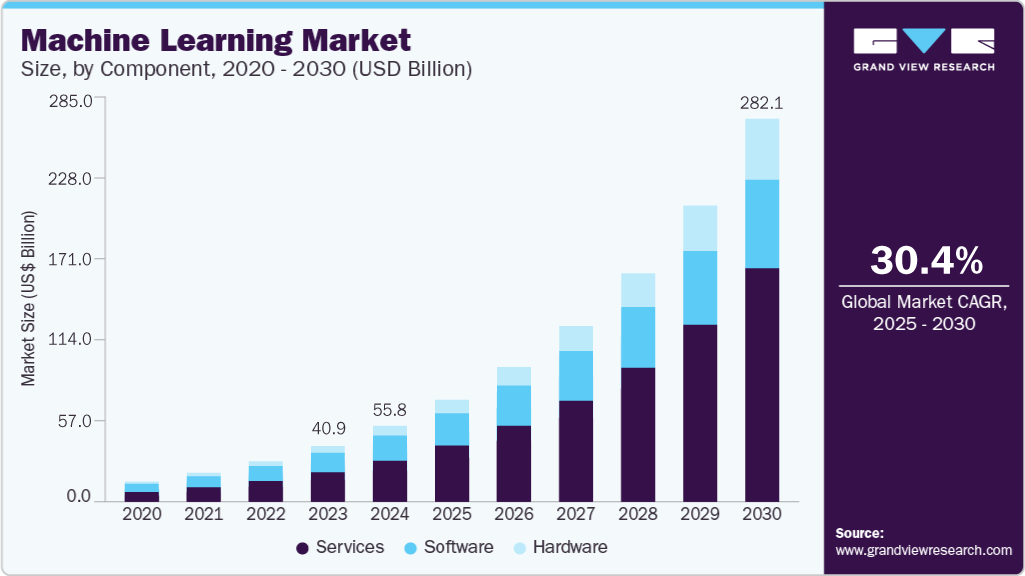
- According to recent research, the global machine learning development services market is growing at a CAGR of over 30% from 2024 to 2030 with verticals ranging from healthcare, opportunities in finance, and everything in between.
Machine learning uses supervised learning on labeled data, applies unsupervised learning to detect structure, and employs reinforcement learning through trial and error to maximize rewards.
Example applications are plentiful, from predicting discontinued customers (churning), to identifying spam emails, to forecasting markets, all of these were using large pools of data toward hidden answers.
Machine learning models adapt and refine over time as they process more data and respond to changing environments. They continuously learn patterns, improve accuracy, and enhance decision-making. As exposure grows, these models evolve further, delivering smarter outcomes for business, research, and other critical applications.
Computer Vision vs Machine Learning – Key Differences Explained
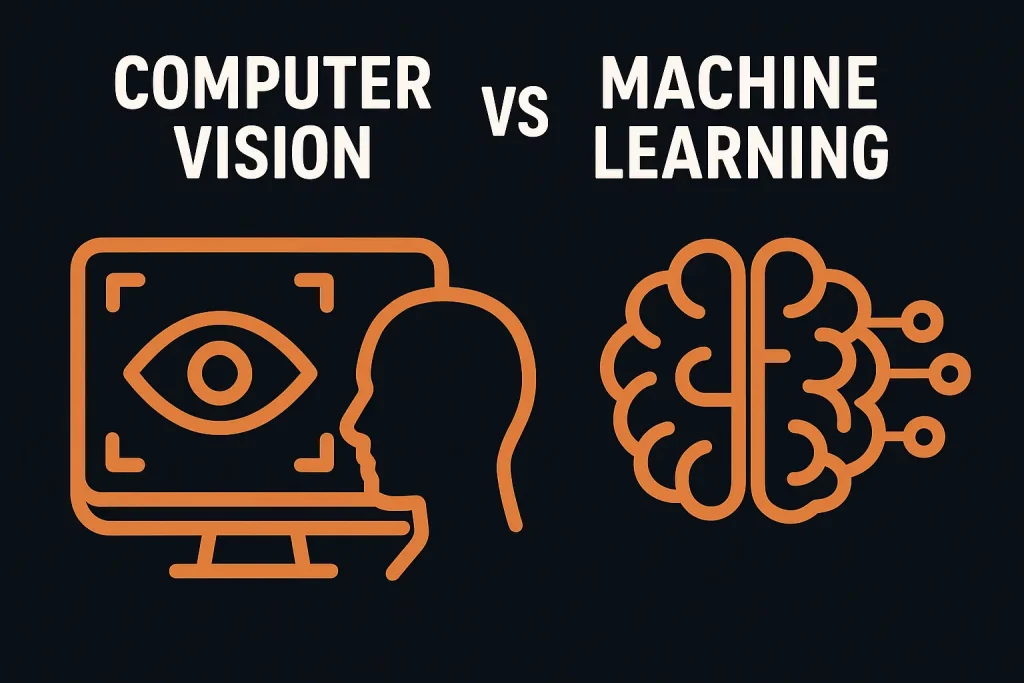
Although computer vision and machine learning are closely related, their basic scope and focus are different.
| Aspect | Computer Vision | Machine Learning |
| Definition | Interpreting/analyzing visual data | Systems that learn from data and improve |
| Core Tasks | Image classification, object detection, etc. | Prediction, classification, clustering, etc. |
| Data Handled | Visual (images, video) | Any type (text, numbers, audio, visuals, etc.) |
| Key Methods | Image processing, CNNs, ViTs | Regression, decision trees, neural networks |
| Applications | Medical imaging, autonomous vehicles, security | Fraud detection, NLP, predictive analytics |
| Relationship | Subfield of AI, often uses ML algorithms | Broad discipline in AI, powers computer vision |
| Goal | Understand/act on visual input | Learn from data for general decision-making |
| Limitations | Needs labeled images, high compute costs | Needs clean data, risk of bias, “black box” models |
In summary, Computer vision is about understanding visual inputs, and machine learning is about discovering patterns and learning from all types of data, sometimes including vision, but not limited to it. They have separate but complementary roles in a contemporary AI stack.
How Computer Vision Uses Machine Learning Models?
Today, computer vision systems rarely use rule-based logic exclusively; instead, they use machine learning models to discover patterns. For instance, an image recognition application employs supervised learning; it “trains” using a labeled dataset of images (e.g. cars, cats, trees), and learns to identify the features or combinations of features that indicate each category. For the most complex vision tasks, deep learning—the latest and most powerful model of neural networks—is typically used, achieving incredibly high accuracy for tasks such as facial recognition, autonomous navigation, and medical imaging.
Computer vision tasks use supervised learning to identify wildlife in camera traps, unsupervised learning to cluster types of defects in manufacturing, and reinforcement learning to teach robots to navigate dynamic environments. New and real-world problems will continue to present themselves, and vision models will become increasingly sophisticated as they are able to use advances made in the machine learning space in both accuracy and adaptability and scalability.
Top Real-World Applications of Computer Vision
1. Healthcare
In healthcare, computer vision enables radiology, enabling the identification of anomalies (e.g., tumors in scans), automating the analysis of pathology samples (e.g., cell counts), facilitating remote patient monitoring, and augmenting to robotic-assisted surgery to provide even more precise precision.
2. Security
In security, sophisticated security systems incorporating facial and object recognition can identify threats, monitor crowds, authenticate individuals at secure facilities and all these actions are performed through the analysis of video feeds in real time, automatically alerting security teams if anything out of the ordinary occurs.
3. Retail
In retail, computer vision drives self-checkout systems, measures movement patterns of shoppers for store floor optimization, monitors inventory through shelf cameras, and provides shoppers the ability to “grab-and-go” without going through traditional checkouts.
4. Agriculture
In agriculture, aerial drone imagery and field cameras harness computer vision to monitor crop health, recognize pests, assess yields, and inform precision spraying while also optimizing sustainability and productivity.
5. Automotive
In automotive, self-driving cars utilizing computer vision to detect lanes, recognize and adhere to traffic signs, avoid obstacles and navigate complex urban scenarios have made autonomous navigation a reality.
Learn more about this evolution in Trends in Computer Vision.
Everyday Examples of Machine Learning Applications
1. Banking
Machine Learning can be used to detect fraudulent transactions, inform credit scoring, and even predict the customer churn rate by learning from millions of previous financial data points.
2. E-commerce
Recommendation engines formulating a suggestion based on purchasing habits and preferences. Dynamic pricing tools provide real-time adjustments to offers and incentives.
3. Entertainment
Streaming services utilize Machine Learning algorithms to customize content feeds, auto-generate video captions, and improve content recommendations by the viewer’s preferences and usage analytics.
4. Customer Service
Chatbots and virtual assistance are often trained using Natural Language processing to answer typical questions, assist with typical problems, and identify unique problems and create a case ticket using the patterns of the action as compared to themes in past conversations.
5. Healthcare
Predictive analytics can highlight a potential hospital re-admission in software and suggest an early intervention on a patient. Operational analytics will help optimize staffing schedules (attributed with patient and operational data).
Benefits of Computer Vision in Today’s World
Computer vision offers various transformational benefits. With automated monitoring and facial recognition capabilities that enhance security, organizations can trust that risks will be detected faster and with less chance of human error. In health care, computer vision aids in rapid diagnosis by bringing attention to potential issues in data from medical imaging, resulting in fewer errors.
Visual inspection methods are used in factories and warehouses to help automate quality control assessments, while at the same time capturing a more accurate representation of the products bestowed to customers. Autonomous vehicles and drones are enhanced in terms of the socioeconomic impact by incorporating vision as part of a navigated design that aids in safe movement in complex spaces.
1. Enhanced Security Through Automated Monitoring
Computer vision embeds itself into real-time analysis of feeds from video or surveillance cameras. Many times, it appeared one was left with monitoring only through old visual systems, or one simply was not using enough staff to observe security cameras. With computer vision, one can apply advanced algorithms to identify unauthorized access, suspicious behavior or recognizable threats.
Also, with facial recognition or object detection capabilities together with automated alerts and responses, we can automate recommended practices that increase security and coverage compared to using a human to monitor. These systems allow for quicker identification of threats which increases safety in workplaces, public spaces, or critical infrastructure site.
2. Speeding Up and Improving Medical Diagnoses
By analyzing complex visual medical data, including X-rays, MRIs, or pathology slides, computer vision systems are able to automatically find anomalies or indicators that the human eye may miss and the diagnostic timelines can be shortened. Moreover, the increased information content improves diagnostic accuracy in tandem with reductions in human error allowing for earlier interventions and healthcare improved outcomes.
3. Automating and Improving Quality Control in Manufacturing
Factories and warehouses utilize computer vision tools on the assembly lines to visually inspect products for defects, improper assembly, or contaminants at superhuman speed and accuracy. Automated inspections reduce labor costs, eliminate variability due to human judgments, and maintain high-level production performance, all driving down waste and improving profit generation.
4. Improving Navigation for Autonomous Vehicles and Drones
Self-driving cars and drones or robotics utilize computer vision to identify lanes, roadside signs, obstacles, and environmental changes in real time. The ability to “see” opens new modes of mobility, improving safety and lessening accidents while also changing the efficiency of transportation, logistics, and field service deployments.
Advantages of Machine Learning in Problem-Solving
Machine learning is well-suited for processing large, high-dimensional datasets that may be too large to make sense to static algorithms, and needs to be processed in a flexible way so that it is still a response to new patterns in large complex datasets. In a business and science context these capabilities enhance forecasting, risk management, diagnostics, and decision making involving uncertainty.
Machine learning also allows deep personalization, enabling businesses to offer more effectively tailored digital services and products.Ability to analyze large quantities of data, enables a mode of prediction or probabilistic reasoning, and gives rise to highly flexible solutions means that once learned the engagement can just evolve.
1. Efficient Handling of Large-Scale Complex Data
Machine learning algorithms can analyze and draw insights from extremely large and complex data sets (sometimes multidimensional data sets) that are beyond what humans or rule-based systems can now handle or analyze. This allows for the rapid identification of patterns, trends, and anomalies across many fields, such as finance, healthcare, and marketing, allowing for quicker decision-making based on new or better information.
2. Continuous Adaptation Without Explicit Programming
Unlike traditional coding, machine learning systems not only improve their performance as they see more data, they also learn and refine their models and logic in ways that will allow them to better adapt to similar or very different future inputs (e.g., changes to user behavior or market dynamics). When using machine learning, especially if using deep learning, as long as your data inputs continue to be relevant, your solutions will become even more useful and valid as your inputs change and evolve over time.
3. Superior Decision-Making in Uncertainty
Machine learning is useful for tasks that require some level of prediction and deals with incomplete or noisy data. Situations where a systematic and statistical approach is necessary to address uncertainty will benefit from machine learning. It is valuable in areas like weather forecasting, fraud, and risk assessment when dealing with uncertainty, because traditional decision-making methods may not work due to complexity or uncertainty.
4. Deep Personalization of Products and Services
Most machine learning models learn user behavior and are able to provide highly tailored digital experiences based on a user’s preferences. Personalization of digital experiences leads to tailored product recommendations, targeted advertising, content-dedicated interfaces, etc. Personalization leads to increased engagement and satisfaction and helps earn brand loyalty, ultimately providing businesses a competitive edge in e-commerce, entertainment, education, and financial services.

Challenges and Limitations of Computer Vision Technology
Although computer vision holds a lot of potential, the technology has some limitations. Most models require substantial labeled datasets in order to train. Collecting and annotating large datasets is expensive and a time-consuming process. Computer vision systems can perform poorly and can create safety issues if they are supplied with images that are of poor quality or biased in some way.
There have also been ethical discussions about the growing use of facial recognition technologies and implications for employee privacy and surveillance, particularly in settings with sensitive applications. Furthermore, many aspects of vision require substantial compute power; in particular, real-time video and producing images with high enough resolution. High infrastructure costs can create barriers to entry for smaller startups or organizations.
1. Requirement for Large, Labeled Datasets
Computer vision models, particularly deep learning-based models – have substantial reliance on large amounts of labeled data. The amount of human and financial resources required to collect, clean, and label large datasets can be beyond many organizations. Per industry-specific applications (e.g., medical imaging and industrial inspection) there can be a requirement for experts to collect and label the data – this can increase time and cost further and limit the innovation potential of smaller organizations.
2. Sensitivity to Data Quality and Bias
Computer vision systems’ accuracy and reliability depend heavily on data quality and representativeness. Images can be low-resolution, noisy, or biased, which results in incorrect interpretations of scenes or failures in high-stakes situations. In safety-critical contexts (e.g., self-driving cars, healthcare diagnoses), these failures have the greatest consequences, eroding trust and causing potential harm.
3. Ethical and Privacy Concerns in Facial Recognition
Numerous advanced computer vision applications, such as facial recognition, raise significant ethical issues related to surveillance and privacy. The introduction of facial recognition systems in public spaces has raised concerns regarding consent, data ownership and governance, and the potential for abuse by governments and third parties (particularly around sensitive topics like law enforcement or political demonstrations).
4. High Computational and Infrastructure Requirements
Vision-based AI applications usually consist of processing lots of high-dimensional image or video data. This requires powerful computational hardware (e.g., GPUs), a lot of storage, and a solid network for instantaneous inference or high-resolution analysis which translates into costs that can demand costly infrastructure investments that take financing away from other, and potentially more productive, investments.
Challenges and Limitations of Machine Learning Systems
Machine learning models depend entirely on their training data. Biased, incomplete, or unrepresentative data can prompt models to make flawed, unjust, flawed, or discriminatory predictions. Experts often call many high-performing systems in deep learning “black boxes” because they remain opaque and difficult to explain.
Training and deploying machine learning systems demand expensive compute resources, while traditional software usually requires fewer resources and hours. Unlike traditional systems, machine learning often needs advanced hardware and longer processing times, which increases costs and limits accessibility for smaller organizations.
Most critically, models that are high-performing on one dataset may not generalize and may misbehave when applied to new or different datasets, and involve the potential for problems when applied in complex and real-world ecosystems.
1. Dependence on Clean, Representative Training Data
Machine learning systems are fundamentally influenced by the datasets they learn from through training. If datasets are biased, incomplete, or not representative of real conditions, the model’s predictions may be flawed, unfair, or discriminatory. Generally speaking, this problem is more problematic in sensitive applications and domains that rely on sensitive attributes such as examples in finance or recruiting.
2. Lack of Transparency
Many of the latest machine learning models, particularly deep neural networks, act as “black boxes,” providing almost no insight into how they derive their decisions. The primary challenge with the black box nature of many machine learning models is that it creates roadblocks to trust, creates challenges for debugging, and may preclude meeting compliance requirements if a level of transparency or auditability is required for the automated decisioning process.
3. High Computational Resource Needs
Training complex machine learning models (especially with very large datasets) takes enormous computational power (e.g., high-performance GPUs and distributed computing ability). Costs for cloud computing, electrical power, and continuous maintenance can add up quickly and be a significant amount of a project’s budget.
4. Generalization and Transferability Issues
Many models often overfit training data and respond poorly to new or changing datasets, creating real-world implementation challenges. This limitation complicates machine learning adoption, as unseen or drifted data may not match the original training conditions.
How Businesses Choose Between Computer Vision and Machine Learning?
When exploring computer vision and machine learning, businesses often try to categorize their challenge into either visual or data focused. If you mainly need to extract meaningful insights from images or videos, then computer vision (likely utilizing machine learning) is best for the job.
If you want to analyze trends, forecasts, natural language, or structured data predictions, machine learning models serve better. Moreover, many digital transformations today merge both fields; for example, retail chains use computer vision for in-store analytics and machine learning for customer segmentation or product recommendations.
If your company wants to leverage these technologies, it should seek advice from Computer Vision Development to ensure your efforts align with your business goals and success with adoption.

Why is A3Logics Your Ideal Partner for Computer Vision and Machine Learning Solutions?
A3Logics has extensive experience in the convergence of computer vision and machine learning. An AI Development Company, A3Logics employs recent findings, industry best practices, and custom-built technology to provide cohesive solutions for visual analysis, business automation, and predictive analytics.
A3Logics leverages convolutional neural networks, vision transformers, and domain-specific architectures through their Computer Vision Development to tackle visual inspection, validation, and real-time monitoring challenges. Their Machine Learning Development focuses on data wrangling, model design, deployment and model maintenance for our highest value business outcomes, building solutions that are scalable, explainable and impactful.
Whether you need a needs assessment, an architecture that enables real-time access to multi-dimensional data, implementation and deployment, or full integration and support for blended computer vision and machine learning systems, A3Logics’ technical capability, business sensibility, and ability to build AI responsibly and ethically is exemplary.
Final Thoughts
With computer vision and machine learning redefining the digital landscape with new means of automating perception, comprehension, and resulting action, it is essential to understand the major distinctions, scope, methods, use cases, and limitations, between machine learning vs computer vision for organizations to make informed strategic technology decisions, use the best technologies available, and unlock new value in an increasingly complex artificial intelligence ecosystem. Leveraging the best platforms, industry knowledge and experience, and a partner such as A3Logics can provide firms with the opportunity to get ahead of the automation, insights, and seeing competitive advantages.