
Business automation started from automating the frequently performed tasks on a regular basis, which required similar processes, but were time and labor-intensive. ERP and RPA were used to handle such tasks, now replaced by advanced automated systems. These followed a set of instructions for executing the basic tasks like typing, text entries, and mouse clicks.
Gradually, Artificial Intelligence and machine learning were integrated into this rule-based approach and transformed the entire era of business automation with AI. It was the beginning of a smarter and self-directed system, which could learn from its past interactions and enhance performance consistently. As per McKinsey research, corporates using AI are likely to add $4.4 trillion in their productivity growth.
The emergence of intelligent agents is the next climax in the story of business automation, which not only learns and grows but also interacts with the users in natural and conversational language. AI Agentic Workflows are supposed to achieve predefined goals without any human intervention, handle complex tasks automatically, and display reasoning ability by delivering the most relevant outputs.
Intelligent agents in AI can also answer the open-ended queries of users, on the basis of their past interactions and advanced analytics. They even reflect on their own results to make improvements and offer the best possible solution in a cost-effective and time-efficient manner.
The Rise of Agentic AI
The consistent upgradation of foundational AI models unveiled intelligent agents that no longer depend on manual prompt execution. At the same time, these advanced models have the capabilities to automate complex business operations, manage multi-step processes, and minimize human intervention.
In short, it includes AI agents and ML models that can copy the reasoning and contextual ability of humans and generate highly relevant results in real time. These agentic systems are designed to achieve specific goals, and all the included agents perform their assigned subtasks in a coordinated manner, which is called AI orchestration.
Agentic AI is boosting business automation and replacing the old AI models by simplifying complex tasks without human supervision. Traditional automation, such as RPA and ERP, was based on predefined rules and constraints, requiring user input. In contrast, AI agentic workflows run independently, showing adaptability and complete autonomy.
Unlike the legacy models, which were limited to only fed data, intelligent agents in AI learn from the environment and their past actions, imitating human behaviour. The reasoning capability of an agentic system adjusts its analytics dynamically according to the changing contexts and produces customized outputs for different users.
Emergence of LLMs (Large Language Models), multi-agent systems, and genAI (generative AI) are significantly contributing to uplifting business automation with AI. These technologies complement AI agentic workflows to function in the fluctuating digital landscape. For instance, Gen AI uses its patterns absorbed from past interactions to create content, and multiple agents take it even further by using generated content in providing an edge-to-edge solution to complex problems.
Demystifying Agentic Workflows
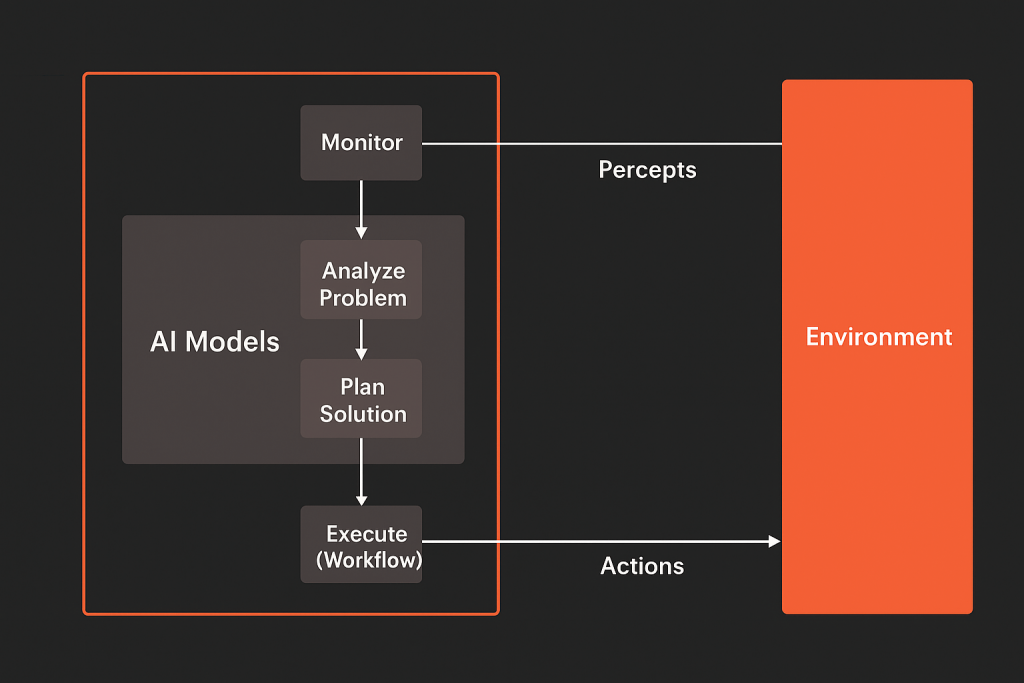
AI agentic workflows are basically digital systems that can function unassisted and adapt themselves to the changing environment and the needs of the user. The autonomous AI agents can solely plan their actions, coordinate with other agents or people, use multiple software and online tools required to complete the assigned task, and continuously learn from their experience to improve future performance.
AI workflow automation is applicable in various dimensions of a business as well as for individual use. These are specifically used for the multi-step processes and complex tasks that require condition-based reasoning and dynamic interactions. Supply chain management, software development, customer services, driving automation, and smart manufacturing are some of the most prominent agentic AI-driven areas.
Autonomous, goal-driven AI agents imitate human decision-making and thinking abilities to respond in a relatable manner. This intelligent system breaks the specific goals into small tasks, assigns them to different agents, utilizes multiple tools, evaluates the final results, and adapts as required. AI agentic workflows are self-guided without external supervision and take necessary actions to achieve their goals. For example, if you ask it about the best time of tracking, it will not only suggest the month and date, but also the perfect place according to your current location, and can even book tickets and hotels at your preferred choice.
Traditional automation followed static workflows, which lacked flexibility, reasoning capability, complex problem-solving, and complete autonomous decision-making. But with the rise of intelligent agents in AI, these shortcomings of static systems are washed out to a great extent. A clear leap in business automation with AI is visible after the introduction of auto-processing mechanisms requiring minimal to no human intervention. Dynamic workflows with agentic AI not only function independently but also improve themselves over time by constantly learning from their own performance, which is not viable in the case of static workflows.
Key Components Powering Agentic Workflows
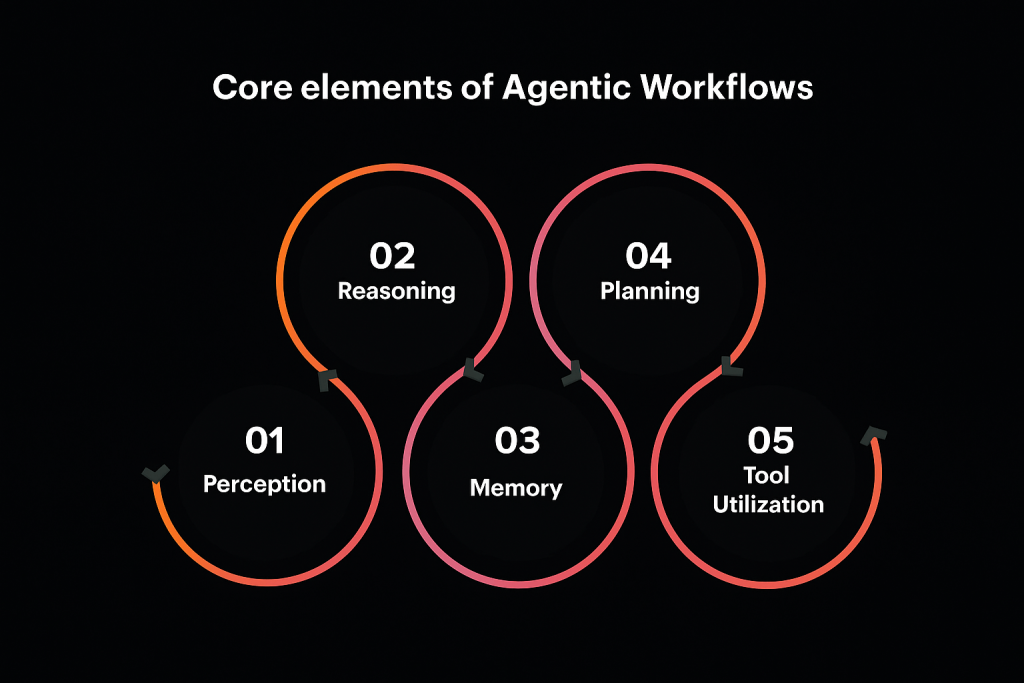
The following components are essential for AI agentic workflows to function automatically without human assistance:
1. Perception
This ability of agentic AI helps it to capture and understand data from the internal as well as external business environment. It collects inputs from diverse sources and in various forms, including text, signal, images, audio, or video files. Perception keeps agents aware of the context and required changes in output in order to ensure that the generated results are up to date and relevant.
2. Reasoning
After gathering all required data, intelligent agents in AI evaluate it thoroughly, identify patterns, and conclude results logically. Reasoning element helps in making sensible decisions based on input, which optimally aligns with the designated goals and can offer meaningful insights to the user. This ability not only helps in making informed decisions but also settles the course of action needed for achieving the goals.
3. Memory
The memory feature of autonomous AI agents helps in storing past interactions and experiences that assist them in improving their long-term performance. Just as our life experiences help us to do better in the future, retaining historical responses and contextual knowledge helps these digital agents to refine their logical processes and determine the best possible outputs over time.
4. Planning
Autonomous AI agents break down complex problems into small, actionable tasks, and planning helps them to design the process required to complete these tasks. It allows agentic AI to strategize a chain of steps toward a goal and prioritize actions on the basis of context.
5. Tool Utilization
Intelligent agents in AI approach multiple external tools, services, and software, such as APIs, to execute tasks smoothly. They interact with different systems to ensure that the inputs and outputs comply with the changing environments and decision-making complexities. Access to a variety of tools enables agentic AI to perform versatile functions and automate multistep processes.
Architecture & Frameworks Behind Agentic AI Workflows
System architecture and frameworks provide the foundation for building AI agentic workflows and implementing business automation. They coordinate all the components of agentic AI to perform complex tasks.
1. Modular Agent Architecture
Modular architecture includes layers and modules that perform different tasks for agents. Each layer executes a particular function of the agent, and all the important modules, such as observation, memory, planner, and executor, work together in order to maintain flexibility and scalability in the AI agentic workflows. Here is how the different layers work:
- First is the input layer, which gathers data in various formats, such as text, visuals, audio, and APIs, from multiple sources.
- The memory layer stores past interactions for future reference while understanding the context.
- Next comes planning to evaluate all the collected data and break difficult tasks into sub-steps in order to speed up the process.
- The action layer connects and interacts with different tools, systems, and users to execute the activity.
- The last layer is of learning, which makes sure to learn from every interaction and feedback, and bring improvements.
2. Popular Frameworks for Building Agentic Workflows
Frameworks are the standardised structures that assist developers in building and deploying intelligent agents without starting from scratch. They can focus on more crucial elements such as agents’ behaviour and reasoning capabilities, instead of wasting time on the basics.
There are a variety of frameworks that offer all the primary tools for carrying out AI agentic workflows. The most popular ones include LangChain, AutoGPT, and MetaGPT. These platforms empower the agents to not only answer the question but also perform specific tasks aligned to goals. For instance, AutoGPT enables agents to schedule meetings, assist with research, or begin basic campaigns.
3. Agent-Oriented Patterns
Developers figure out the patterns in agents’ behaviour, which help them to understand how later ones perceive any situations, reason it, interact with other systems or tools, and generate relevant output. Thus, these are called agent-oriented patterns, assisting in designing flexible and dynamic AI agentic workflows.
i. Task decomposition
Agents generally diversify their different sub-tasks between various tools or APIs.
ii. Multi-agent collaboration
While working on complex projects, multiple agents with specific capabilities work together in the direction of predefined goals.
iii. Feedback loops
Agents continually reflect on their own responses and consistently improve themselves by taking needed actions.
4. Deployment Considerations
For introducing intelligent agents in business, the autonomous, effective deployment of agentic AI is as important as building the model. The following are the key factors that influence performance and safety in AI workflow automation:
i. Infrastructure
Employ efficient tools and systems for autonomous AI agents, which can offer scalability and end-to-end support.
ii. Monitoring
Ensure transparency and real-time error correction in outputs by observing agent behaviour and responses.
iii. Versioning and updates
Implement changes safely with version control and effective management of updates to maintain continuity in existing workflows.
Real-World Use Cases Across Industries
Industries have witnessed the impact of AI agentic workflow on their productivity and efficiency worldwide. The following are the key sectors using intelligent agent networks in their regular operations:
1. Financial Services
Financial institutions deal with an immense amount of data on a daily basis, and services are offered in a fluctuating environment, including a high risk of fraud and uncertainties. Agentic AI serves various features for these businesses in terms of fraud detection, alerts on finding anomalies in transactions, and market evaluation for customized investment advice.
2. Software Development
AI agentic workflows assist software developers in development projects by automating the basic process, including code generation, debugging, and testing. Tech professionals use intelligent agents to seek improvement suggestions, manage project timelines, and speed up the development cycle, delivering software within the time frame.
3. Cybersecurity
Business automation with AI allows the managers to monitor the enterprise network and trace every hint of cyber threat before it harms the automation infrastructure. Intelligent agents can proactively detect online attacks in real time, respond instantly, and isolate systems to prevent them from digital damage. Thus, an AI agentic workflow frees up the technical teams from security concerns to focus on more complex issues.
Key Benefits of Agentic Workflows
AI agentic workflow is bringing new capabilities with the growing technologies in the automation era. Numerous industries are benefiting from the intelligent agents network in the following aspects:
1. Enhanced operational efficiency
Agentic AI handles regular repetitive tasks and automates routine processes, eliminating the need for human intervention. It also tracks business progress over time and initiates improvement in the areas that are lacking. Thus, autonomous AI agents save resources and time to a great extent, reduce manual workloads, and enhance organizational productivity.
2. Seamless scalability across processes
You need not reinstall or manually expand agentic workflows to cater to the growing needs of business. Instead, it can automatically adjust itself with systems across different teams and departments within or outside the organization. Agentic AI’s scalability saves the developers from redesigning the process and offers quality performance regardless of the changes in size or condition of business operations.
3. Greater adaptability to changing inputs
Agents learn from their past interactions and feedback over time and make improvements in their reasoning patterns. They can better understand the context of users and adjust their response accordingly. Autonomous systems adapt as per each input and generate relevant output even for the multistep complex problems, using their agent/tools network and scalability.
4. Superior decision-making capabilities
Intelligent agents thrive on their reasoning and memory capabilities and can mimic human thinking patterns without continuous oversight. They have access to an immense database and can interact with several external tools, which allows for quick query resolution. Thus, businesses can take informed decisions in real time, initiating faster execution as well.

Navigating Challenges in Agentic AI
Automation is the key benefit of intelligent agents, but it can also result in serious issues if not managed properly. It is crucial to navigate through the implementation challenges of AI agentic workflows in order to leverage its advantages for business profitability.
1. Accountability – Who’s responsible for AI decisions?
It is quite tricky to determine accountability in the autonomous workflow, as it involves minimal human inclusion and monitoring. Agents can’t be held responsible for the decisions, specifically over sensitive matters. Thus, robust control over the autonomous system is crucial, specifically in high-risk use cases.
2. Security – Safeguarding AI agents and workflows
Agents interact with external systems and tools on a daily basis, raising cyber threats as a serious concern. They need to be protected against breaches and misuse. AI workflow across a dynamic environment must be shielded by ensuring comprehensive security protocols and authorized access.
3. Ethical Concerns – Bias, transparency, fairness
Make sure that the agents behave just the way they should and are completely transparent. Agentic AI must adopt bias-free and fair evaluation methods to generate genuine results. But in reality, AI agents are built to achieve specific goals, and are highly inclined towards getting the job done even through data manipulation practices. Thus, it is challenging to design an autonomous system that is highly goal-oriented while maintaining ethical behaviour.
4. Integration – Compatibility with legacy systems
The existing system may not be compatible with integrating an AI agentic workflow, creating a technical hurdle for the developers. Legacy architectures of APIs and data pipelines often do not support the autonomous frameworks and demand full upgradation. The absence of a compatible legacy system increases the financial burdens that restrict the benefits of business automation with AI.
The Future is Now: Embracing AI Agentic Workflows
AI agentic workflows are the new face of advanced automation in modern industries. Digital agents are playing human-led roles with enhanced adaptability and accuracy.
1. Trends and predictions
Agentic AI is on the edge of a transformation era, inhibiting human capabilities with seamless automation. Artificial intelligence is no longer limited to instruction-based performance; instead, it is collaborating with people, understanding their needs and delivering expected outcomes. With more focus on ethical training and intent-based evaluation, AI agents are likely to continue to create tangible value for businesses.
Key trends in agentic workflows in 2025 include automated customer services, AI agent-driven supply chain, and enhanced multi-agent collaboration.
2. Organizational readiness
Companies seeking to adopt business automation with AI must invest in their talent acquisition programs in order to build a highly skilled professional team, which can nurture the evolving autonomy. Additionally, a robust cybersecurity infrastructure and governance frameworks are key aspects to evaluate an organization’s readiness for the AI workflow automation.
3. First steps to adoption
The first step to implement agentic AI is to conduct a thorough assessment of existing architecture and business goals, to identify the most value-generating areas. Then, a business must consider the important factors like budget, timeframe, and required resources. Partnering with the right AI agent development company is also a crucial step that provides end-to-end assistance throughout the project.
Conclusion
Agentic AI is the new update in the era of automation and digital operations. The new agentic AI solution offers the capabilities of a human with increased accuracy, speed, and cost-effectiveness. The adaptability and scalability of the systems bring long-term benefits with one-time deployment.
Increasing complexities of business functions and industrial evolution make it essential for organizations to early adopt AI agentic workflows to accommodate competitive advantages.
Why Choose A3Logics for AI Agent Development?
It is highly important to partner with the right AI development company to embrace the benefits of evolving technologies. A3Logics holds more than a decade of experience in providing the best AI agent development services that allow businesses to shape smart products according to their real-time requirements. Also, we help them understand the difference between AI agents vs Agentic AI to choose the right one for their operations.
Our proven frameworks and solutions for developing AI agentic workflows are customized according to your unique needs. No matter what the size of your business, a startup or large enterprise, we are committed to implementing a scalable and functional AI workflow automation.
At A3Logics, you will get a complete guide to building an AI Agent, end-to-end support for agentic workflow integration, enabling you to leverage its full potential.