Brief Overview and Importance
A wide range of programming languages is available to choose from, but Python vs Scala is a common comparison when it comes to data-intensive applications. These two are top choices in the corporate world due to their strong performance capabilities. Both languages serve different purposes based on project requirements and scope and are powerful in their respective areas of use. It is essential to first understand the key differences between Python vs Scala to select the most suitable one for your enterprise needs.
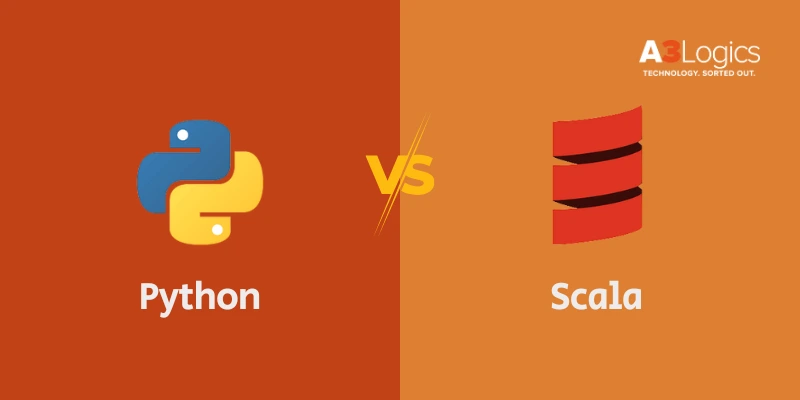
The right programming language is crucial in the present era of big data processing and analytics, for effective decision making and better management. The unique pros and cons of each platform make it a critical concern for data scientists and programmers to opt for the best coding framework that can work effectively with their objectives. It makes Python vs Scala a top topic of debate among developers and fresh learners.
In this article, we will explore Scala vs Python for data science, for a comprehensive comparison between these two languages to differentiate their major strengths and limitations, and guide tech leaders to choose the best option for them. The evaluation will focus on Python vs Scala syntax, Scalability, performance, real-world application, and business integration.
Overview of Python
Language Background and Strengths
Industries widely adopt Python because of its simplicity and ease of use. Guido Van Rossum created and released it in 1991 with a focus on code readability. Developers can write and execute code more easily since Python is dynamically typed and interpreted, eliminating the need for a compiler.
This framework of dialects contains clean syntax and a fast learning curve, proving it ideal for quick software development. Developers initially used Python for data analytics, website building, and task automation, but its growing versatility has expanded its applications across the machine learning landscape.
According to DeepLearning.AI, Python is used by 90% of the data science professionals for their work. At the same time, Python is ranked #1 as the most preferred programming language by professionals with different experience levels.
Its key strengths are:
- Python is backed by extensive libraries like NumPy, Pandas, TensorFlow, and Django. Its huge ecosystem supports a wide range of projects, including web development and data manipulation.
- The versatile uses of Python make it a suitable language for machine learning, game development, automation tasks, and scientific computing.
- It can run on all major platforms such as Linux, Windows, and macOS, due to its cross-compatibility.
- Most of the developers possess Python knowledge and a good command of it, providing community support with extensive learning resources.
Limitations
Despite the numerous positive points of Python, it still contains some sort of limitations listed below:
- It generally performs slower than other languages like Java or Scala due to their compiled feature, which is missing in Python.
- It lacks multifunctionality because of its GIL (Global Interpreter Lock) feature, creating a bottleneck in multithreaded programs.
- Developers can not detect errors while writing the code, as it types dynamically, and thus the mistakes can be traced only on execution, making debugging hard for large projects.
- It falls short in supporting mobile platforms as compared to other programming languages, limiting its real-world application.
Overview of Scala
Language Background and Strengths
Martin Odersky developed and launched Scala in 2004 as a modern, scalable language that runs on the Java Virtual Machine (JVM). Developers often consider it an upgraded version of Java due to its seamless interoperability, which allows direct referencing between Scala and Java code. Its major strong points are:
- It can smoothly work on existing Java code and can use its massive library ecosystem.
- Scala is the original language of Apache Spark, and thus offers local APIs for big data processing.
- It supports high concurrency and parallel processing, capable of performing multi-performance-based applications.
- Scala emphasizes functional programming and provides features like pattern matching, immutability, and higher-order functions.
Limitations
In addition to its strengths, Scala has the following downside as well:
- Scala is complex to understand for beginners, with its steep learning curve, and object and functional programming.
- It consumes a long compilation time, slowing the development process.
- Scala is a comparatively new programming language, and thus only a few have in-depth command over it. Its small user base results in limited community support and fewer learning resources.
- Verbose compiler errors make debugging difficult in Scala.
Python vs Scala Syntax Comparison
The following table provides a side-by-side Python and Scala comparison based on key usage criteria:
| Feature | Python | Scala |
| Readability and typing | Python mimics plain English with dynamic typing, making it highly readable. | Its expressive syntax and static typing provide a concise but complex reading. |
| Ease of coding | The minimalist approach in coding under Python is beginner-friendly. | For coding in the Scala language, developers must have advanced knowledge of programming concepts. |
| Learning Curve | It takes comparatively less time and effort to learn Python with a flat learning curve. | It has a steep learning curve and requires more work to learn. |
| Community Support | Python carries large libraries and a vast user base, offering active community support with extensive learning resources. | Scala‘s users are fewer in comparison, but are growing with time, making it a popular choice among large-scale enterprises for high-performance applications. |
| Best For | It is best suited for small to medium-sized projects, including machine learning, web development, and automation. | On the other side, Scala is best for large-scale projects with big data, requiring high performance and Scalability. |
| Language Paradigm | It focuses on object-oriented programming (OOP) with multiple programming paradigms. | Scala integrates OOP and functional programming, supports pattern matching, case classes, and higher-order functions. |
Python vs Scala Performance
Experts explain the difference between Python and Scala in terms of performance by comparing their speed, execution time, and real-world project applications.
1. Speed and Execution
Python uses dynamic typing closer to plain English and has an interpreted nature, making it comparatively slower. It provides limited support for parallel processing due to its GIL bottleneck and limited threading. However, it performs excellently in tasks like automation or lightweight scripts with a quick startup time and optimizes its performance via external libraries.
On the other hand, Scala offers 10 times faster performance in executing CPU-intensive and multi-threaded tasks. Its compilation with JVM bytecode supports excellent execution of simultaneous processing, but its static nature slows down the startup time. Scala contains built-in optimizations based on the JVM, providing concise and error-free or minimal error coding.
2. Use in Real-world Projects
Developers use Python for countless projects—such as machine learning, data science, data analysis, web and software development, data visualization, automation, and scripting—thanks to its vast resources and libraries.
In contrast, Scala is most suitable for big data processing, enterprise-level applications, and high-performance systems. It is a native language for Apache Spark, and JVM’s inclusion of functional programming properties in Scala makes it a great option for use in CPU-intensive applications.
Scala vs Python for Data Science and Big Data
Developers often debate Scala vs Python for data science, focusing on their library support and growing popularity.
1. Library and Ecosystem Support
Python has multiple libraries in the area of data science, along with a wide range of active users. You can get rich knowledge from Pandas, NumPy, Pytorch, TensorFlow, and Keras. It offers Python users strong community support and vast learning resources, proving Python as a versatile and powerful tool for various applications.
Scala, being a new and complex language, possesses a smaller ecosystem, but it is continuously growing due to its robust support for concurrent and distributed data sets. It is directly used in Apache Spark and is an improved version of Java with simpler syntax.
2. Language Popularity in Big Data
Python is popularly used for small to medium-sized projects that require fast prototyping and application deployment. The simple, flexible, and easy-to-use approach allows developers to work effectively and quickly on minor data for startups and small teams. However, Python does not support parallel processing and thus is not preferred for big data handling. Here, Scala for big data wins as it excels in data engineering and real-time streaming. It offers a high level of Scalability and concurrent programming, appropriate for data-intensive tasks.

Python vs Scala: Learning Curve and Community Support
A Python and Scala comparison on the basis of the time required to learn these languages and available resources is crucial to select the optimum one for new learners as well as application developers.
1. Ease of Learning
Python has a nearly flat learning curve, indicating that it takes less time to learn, and hence, developers with no prior programming experience can also become productive using this language. The ease and simplicity of Python for machine learning have made it the first preference for students and new professionals.
Whereas, on the part of Scala, it takes a longer time and requires deeper understanding, posing initial challenges for the learners. They need to grasp knowledge regarding immutable structures, type systems, and functional programming to get the full rewards of the language in the long run.
2. Developer Community
Since Python is backed by large libraries and a huge developer community, it provides numerous free resources, helping channels, and tutorials on several platforms. This key difference between Python and Scala, in association with developer support, impacts the language preference to a great extent.
Scala’s user circle is small but highly skilled and focused on distributed computing, big data, and JVM-based applications for enterprises. The several advantages of Scala for big data, including its ability to work in a multicore architecture environment, have gained popularity and are increasing the number of Scala users.
Python vs Scala: Scalability and Maintainability
Scalability and maintenance requisites are the most prominent deciding factors in choosing Python vs Scala syntax. Both languages hold Scalability, but to a different extent and with distinct maintainability.
1. Suitability for Growing Applications
Python vs Scala: Scalability can be one of the core selling points in programming languages, as it stands for expandable features. The name of Scala is a contraction of Scalable language and hence it provides easy, low-latency Scalability, which is a must-have condition for growing applications.
The ability to expand depends to some extent on the architecture of a language, and Scala contains more memory and JVM support. In contrast, Python offers serverless Scalability, but it is better suited for small-scale projects. However, Python can not extend on the level of Scala; still, it can scale in microservice architecture, using tools like Redis and Celery.
2. Long-term Maintenance Support
Maintenance support is a major key difference between Python and Scala, and the latter holds a strong position as it provides comparatively bug-free outputs. It checks for errors in the compilation process and offers better type safety, requiring fewer corrections, which is viable for large applications.
On the other hand, Python can type dynamically but involves hidden runtime errors, which can be detected only after the complete output generation, leading to rewriting of the entire code. Hence, despite initial complexities, Scala for big data is a better choice for long-term maintenance support.
Python vs Scala for Enterprise Development
Python and Scala comparison about enterprise development basically refers to the selection of the best language according to the size and complexity of a business firm.
1. Integration with Enterprise Systems
Scala offers seamless integration with various systems and tools, including Apache Spark, making it a popular choice for developing complex applications. Spark is written 80% in Scala, and thus the language is preferred to handle big data through Apache’s analytical engine. Here, Python vs Scala performance in terms of integration with large enterprises differs significantly.
Python, however, provides only microservices and primarily focuses on quick API development and data integration; still, it can be used for big data using PySpark. Still, the fact is that enterprises with large-scale systems requiring distributed computing and high performance favour Scala over Python for their rapid development.
2. Adoption in Corporate Tech Stacks
Python has a broader adoption evident through its listing on 2826 company stacks & 3632 developer stacks. Famous corporations like Uber Technologies, Spotify, and Netflix use Python as their coding language for backend services, machine learning, and automation. This language is most preferred due to its readability and simple syntax.
Companies like Twitter, LinkedIn, or Intel use Scala as their programming language for its concise syntax and Scalability. It grows with the enterprise’s system growth, and thus Scala is successful in grabbing 437 company stacks and 324 developer stacks, and continuously expanding its reach.
Use Cases: When to Use Python and When to Use Scala
Scala vs Python for data science use cases relies heavily on the enterprise priorities and scope of the system.
Python Best-fit Scenarios
- Python is the best fit for small to medium-sized projects requiring simple programming and an easy-to-use language. If your mission scope is limited and does not necessitate heavy performance or expandability, this is a suitable language for you.
- If you are a startup or new learner and want free resources from extensive libraries with community support, Python is your optimum option.
- It is preferred for machine learning, AI modeling, Web APIs, automation scripts, rapid prototyping, data science, and micro-level analytics. Its libraries, like NumPy, Pandas, Scrapy, Beautiful Soup, and TensorFlow, increase Python’s versatility to automate tasks, write scripts, and extract data from websites.
Scala Best-fit Scenarios
- Scala is the best option for projects requiring concurrency and large-scale web services with JVM support.
- Scala for big data with real-time error checking is used while developing critical applications.
- It offers a robust environment, suitable for web development with a play framework for high performance.
- For developing predictable and testable code, Scala is adopted due to its functional programming paradigms and features like pattern matching, immutability, and higher-order functions.
- While working on distributed systems and building data pipelines, this language is often used to perform ETL processes on large datasets.
Hence, Python vs Scala performance varies for different use scenarios and is selected on the basis of the best match with predefined requisites of the intended projects.
Which is Better? Python or Scala
Contextual suitability is the only parameter when answering the question of Python vs Scala- what to choose. However following are the major decision-making factors for selecting a better language option:
1. Development Team
Choose Python if your team of developers includes beginners or fresh data scientists. Whereas, with the group of JVM experts and deeply experienced staff, you can certainly go for Scala.
2. Speed and Deployment
If you want quick deployment of your project with fewer initial challenges, Python is a better choice, but if you are deploying data-intensive programs and require fast processing with concise and bug-free coding, Scala is no doubt the best option.
3. Performance and Scalability
When working with complex missions, where performance and Scalability are critical factors, Scala goes well. Tasks including intensive computations and big data processing fall under this category, making the mentioned language the winner in the Python and Scala comparison.
4. Project Size and Complexity
For building machine learning and AI models requiring rapid prototyping, Python is a better solution for its ease of use and huge ecosystem. But for complex projects with distributed systems and concurrent processes, Scala has more advantages.
Choosing the Right Programming Language for Your Project
Language that best aligns with business goals and program objectives tends to be the right option for your project. Thus, mere features can not be considered while selecting between Python vs Scala; instead, factors like team skill sets, data volumes, enterprise needs, future requirements, and deployment complexity are the major deciding variables.
Thus, it is imperative to deeply understand key differences between Python and Scala and choose what best fits with your project functions and objectives.
Why Choose A3Logics
At A3Logics, we cater to your overall programming language needs with our distinguished services and support clients’ application deployment journey from start to end. Our Python vs Scala software consulting services guide you to opt for the best IoT solution and accelerate your enterprise development goals.
1. Expert Consultation on Python and Scala Development
Our expert teams with over two decades of experience help you to decide which programming language is best suited to your analytical requirements and business goals. We serve our clients by using both Python for machine learning tasks and Scala for big data projects.
2. Custom Enterprise Development Solutions
A3Logics offers tailored software development services, ranging from AI applications and real-time systems to robust data pipelines. By leveraging Python and/or Scala based on the unique requirements of each enterprise, we ensure scalable, high-performance solutions that align with business goals.
3. End-to-end Support from Design to Deployment
We provide complete support throughout your project lifecycle with the best programming language, implemented among Python vs Scala or any other language if required.
Our team handles every step, starting from architecture design and development to final testing and release, providing full Scalability, maintenance services, and high performance in both languages.

Final Thoughts
After evaluating Python vs Scala syntax and performance, we find that both languages have their pros and cons, and neither stands out as the best choice for every project. However, several factors—such as Python vs Scala scalability, project complexity, data size, and concurrency needs—influence which language is more suitable.